
To uncover your house history, begin with the present parcel number and street address, then move backward through deeds, permits, historic maps, city directories, and photographs. Keep three timelines: who owned the land, who actually occupied the building, and what physical structure stood on it. These histories may overlap, but they are not the same. A tax assessment can predate the present house; a buyer may rent the building to others; and a reported year-built field in an assessor database may be an estimate. The goal is a sourced narrative with dated evidence and candid gaps.
Identify the property despite changing addresses
Find the current parcel or tax-map identifier through the appropriate local assessor or land records office. Note the legal description, lot and block where available, municipality and any subdivision name. The street address is a helpful modern locator but may have been renumbered; parcels can also be subdivided or combined. Record the parcel’s legal identifier separately from the mailing address so an old deed can be traced across a renamed street. Never assume an online real-estate listing describes every historical phase of the structure. For the fuller picture, see our guide “Historical Land Registry Records”.
Start a research folder with dated photographs of public-facing features and the source of each factual statement. If you are researching a property you do not own, stay with lawful public records and respect private property. A house’s visible style offers a range of possible dates, not a verified construction year. The Library of Congress house-history guide recommends multiple categories of documents precisely because architecture, location, ownership and inhabitants require different sorts of evidence. Our walkthrough on how to research old house records for construction and alteration dates sets out each step.
Build separate owner and occupant timelines
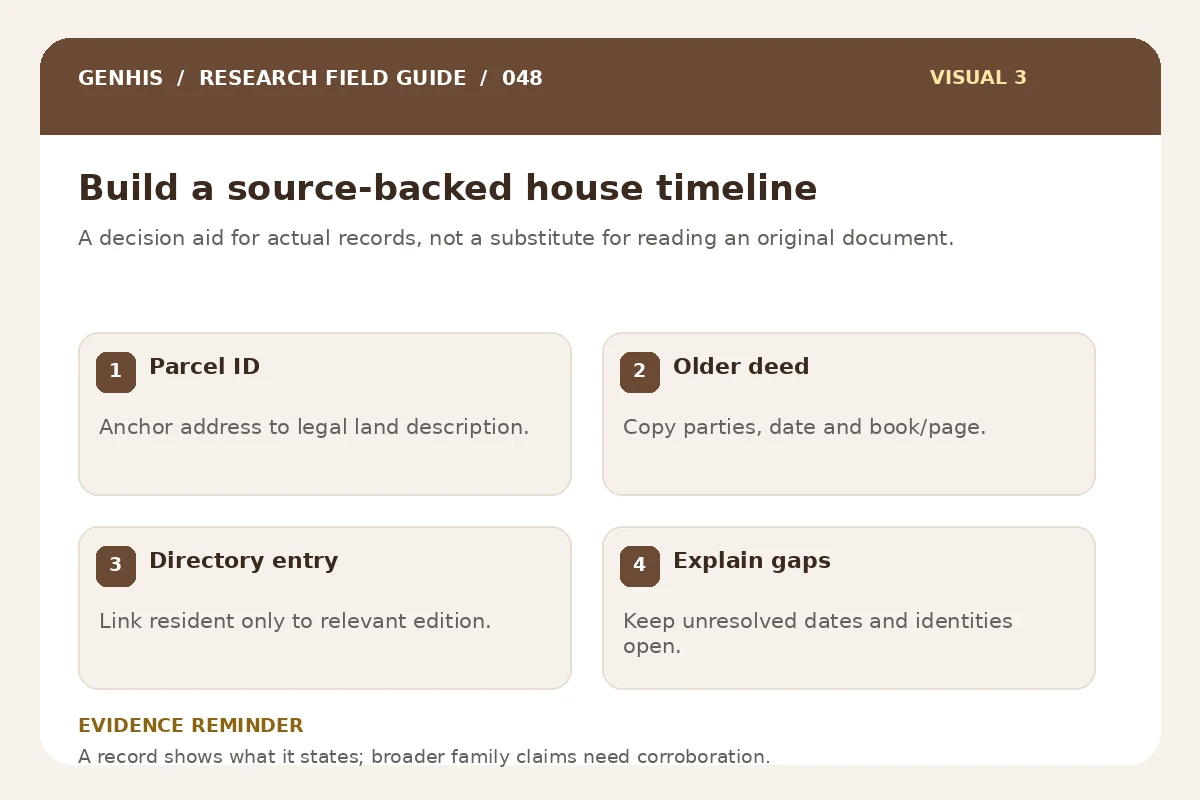
Follow recorded deeds backward, noting grantor, grantee, recording date, execution date, book and page or instrument number, and the land description. A recorded transfer documents a legal transaction, subject to the actual instrument; it does not mean the named party resided in the house. Record other kinds of interests, including estates and trusts, with their stated legal character. A deed may convey a parcel containing multiple buildings, or an empty lot, so ownership alone cannot determine when a particular structure existed.
Next inspect city directories and historical censuses for residents at the address. Directories can identify a householder or business but may lag, omit residents, or be compiled from incomplete information. Census records may describe a household at an enumeration address that later changed. Connect people to a precise year and source rather than assuming each person in a household owned the property. In the worksheet, label each person ‘recorded owner,’ ‘directory occupant,’ or ‘possible resident’ according to actual evidence. For the fuller picture, see our guide “Historical Property Search”.

Date buildings and additions using map editions
The Library of Congress Sanborn materials can show building footprints, construction categories, uses and street arrangements for covered towns. Compare two or more dated sheets for the same block: a structure appearing in a later edition but not an earlier one may suggest a construction interval, subject to coverage and map revision limitations. Check the sheet key and correction labels. A fire-insurance map was designed for underwriting, not to certify a legal completion date or prove the occupants’ names.
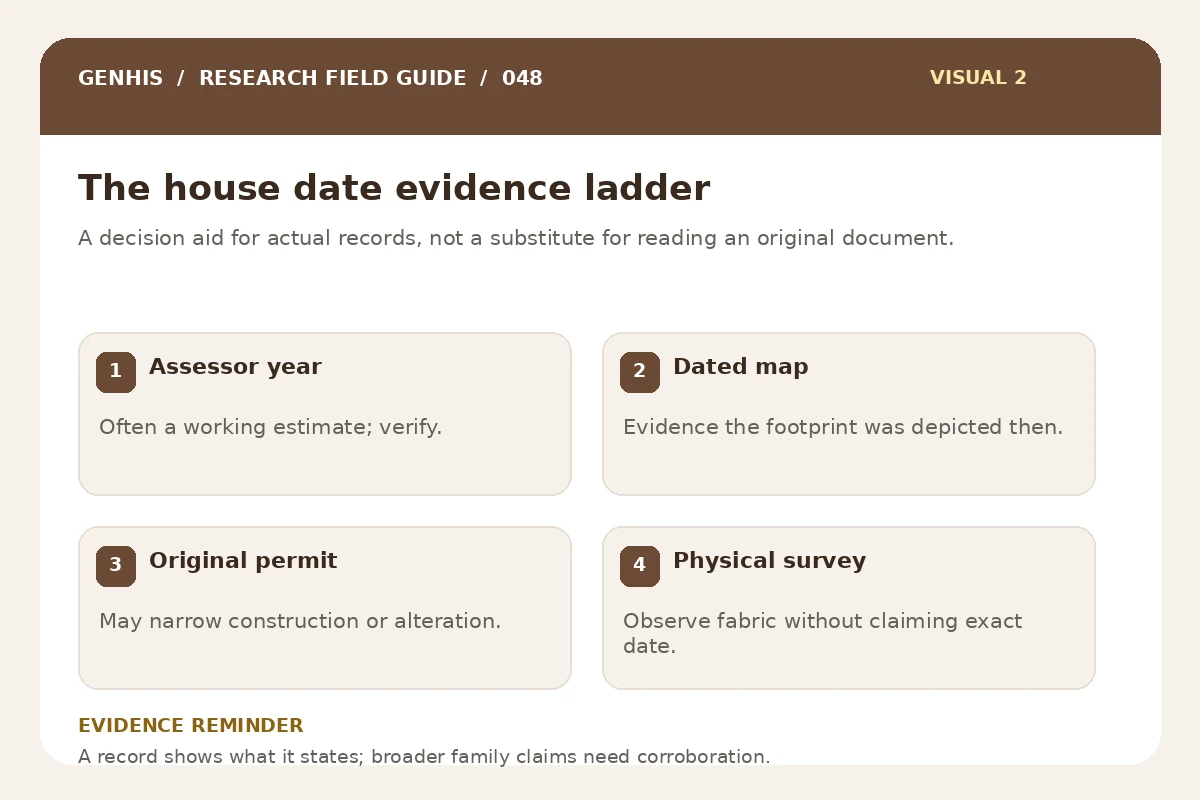
Building permits, inspection cards, architectural drawings and photographs may narrow construction or alteration dates. The responsible local planning, building or code office can tell you whether older files survive and which address or permit numbers to search. Beware a renovation date later entered as ‘year built’ by a database. Record a chronology such as: ‘Not depicted on the 1905 insurance sheet; depicted on the 1918 sheet; permit not located.’ It is honest to leave the construction window unresolved.
Reconstruct neighborhood stories without inventing inhabitants
Once the building and address are reasonably fixed, local newspaper archives, directories, photographs, neighborhood surveys and published histories add texture. Search the address under its historic street spelling and house number, then search verified residents’ names. Reports of fires, sales, expansions, store openings or community events can be useful leads. Distinguish an advertisement written by a seller from an independent account of a building’s earlier condition, and check the publication’s date and claims in other records. For the fuller picture, see our guide “QImagery Queensland”.
A hypothetical 1920 directory might list ‘A. Chen, carpenter’ at a street address now occupied by a different structure. That establishes at most a directory entry for that name and address at that edition’s time; it does not prove the carpenter designed or built the house. Compare the name with the deed timeline and census evidence, and leave both construction role and household relationship unknown until better sources are found. Fictional examples should never be copied into a live family profile.
| Decision point | Recommended research action |
|---|---|
| Land ownership | Follow recorded deed instruments. |
| People at address | Use dated directories and censuses. |
| Building footprint | Compare maps, permits and photos. |
| Keep distinct | Do not merge ownership and occupancy. |
Record disagreement instead of choosing a pretty story
Suppose a county property site gives an estimated 1910 construction year, an insurance map first shows the footprint in 1916, and a permit index lists an alteration in 1937. These facts are not automatically contradictory: the assessor may use an estimate, the map edition may lag the building, and a permit can describe later work. Enter each source’s exact statement and date. Do not average years or turn an index entry into an original permit document without viewing the underlying record.
Missing directories do not prove an empty house, and a name appearing in a later household does not fill every intermediate year. If two buildings share a number after street renumbering, go back to legal lot descriptions and the sheet layout. Identify what would disambiguate them: original plans, a corner-lot reference, an old telephone directory with cross streets, or a deed reciting an earlier plat. A sound house history can contain more questions than answers when records are thin. For the fuller picture, see our guide to Sands Sydney directory.
Publish a careful narrative with traceable sources
Organize the final account as a dated building timeline, owner list and separate known-occupant list, with citations attached to individual entries. Include a short neighborhood history only where a source supports it. Photo captions need dates and provenance; do not imply a period street image necessarily depicts your precise building. Create a bibliography listing offices, archival call numbers, directories, map edition sheets and the online access dates. Keep your original transcriptions distinct from edited narrative prose.
Before sharing the report, remove personal details about living residents, access codes, interior security layouts and material obtained from nonpublic records without permission. Explain that a historic listing, where one exists, is a cultural-resource designation and not proof of a supernatural story, famous occupant or structural condition. Finish with the strongest supported conclusion and a short list of unresolved questions for the next archive visit. Our guide “Historic Metsker Maps” shows how to find landowners in county atlases without overclaiming.
How We Research: map dates, documentary scope, and uncertain conclusions
We checked the Library of Congress house-history guide, its permit and directory sections, and the Library’s Sanborn search instructions. We also consulted the National Park Service guidance on documented historic properties. The fictional carpenter and the example assessor/map/permit dates are instructional hypotheticals. No address, resident or construction history is presented as independently established in this guide.
Authoritative sources and collection-specific limitations
guides.loc.gov — institutional source. Library of Congress outlines complementary sources for building and property history.
guides.loc.gov — institutional source. Library of Congress guide identifies permits, deeds and property taxes as key distinct source types.
guides.loc.gov — institutional source. Library of Congress describes city and telephone directories for place-based research.
guides.loc.gov — institutional source. Library of Congress explains how to find digitized and catalogue-only Sanborn fire maps.
www.nps.gov — institutional source. NPS provides documentation and database guidance for properties listed in the National Register.
More House and Local History Guides
Privacy, disclosure, and responsible interpretation
This article concerns historical public records only. Respect private property, avoid releasing information about current residents, and treat any construction or safety questions as matters for qualified local professionals. The historical-house reference institutions have not sponsored this guide or verified an individual property narrative. Read the GenHis affiliate disclosure for site policy.
Use dated city directories, historical censuses and other lawful public address records; verify names and changing numbering.
Not necessarily. A reported year built may be estimated or reflect later reconstruction.
No. Coverage differs by town, year, copyright status and digitization; rural houses may be absent.
No. A deed shows a transaction, while directories and censuses provide separate residence clues.
Track the legal parcel and compare historical maps, city directories and address-renumbering records.