
Historical UK company records can locate a business’s registered office, legal formation, directors and winding-up documents. But do not automatically identify its employees or prove who owned a family property. Search the Companies House register for a verified company name or number. For older firms dissolved in England and Wales, consult The National Archives’ company records guide, especially sampled dissolution files in BT 31. A significant 2026 policy detail matters: Companies House announced a pause in record destruction and transfers while reviewing the twenty-year retention period. Do not promise that every dissolved file has reached an archive.
Confirm the legal company name and registration number first
A family story may name a shop, a trading brand or a workshop, while government company files are arranged by a formally incorporated legal entity. Search Companies House using known names and date-range variations; copy the registered number and legal status for every plausible candidate. A firm may have changed names without becoming a different legal company, or the same name may have been used by unrelated businesses. Look for documented incorporation date, registered office and official notices, then record company number as the stable archive key where available. The registered office may be an accountant’s or solicitor’s address; it is not proof that a director lived there or an employee worked there. If no incorporation can be found, consider a partnership or sole trader whose records may survive locally rather than inventing a company number.
Decide whether the archive or Companies House holds the file
The National Archives guide describes BT 31 as a sample of files for companies registered from 1856 and dissolved after 1860. It is not an index of every business that ever operated in Britain. Companies House retains active companies’ filings and many dissolved-company records. The normal twenty-year policy was under formal review in 2026, with destruction and transfer temporarily paused, as explained in the May 2026 announcement. Search current official services and the archival catalogue before concluding a company file has been lost. For Scottish and Northern Irish company registrations, consult the National Records of Scotland and PRONI routes given in the UK archive guide rather than presuming BT 31 covers them.

Understand what BT 31 dissolution files actually contain
A surviving BT 31 file is primarily a government registration-and-dissolution dossier. It may contain a memorandum and articles of association, annual returns, registered office changes, shareholder lists or directors’ details, depending on the file and period. It is not ordinarily a staff ledger, employee payroll or family diary. Note the archival reference, corporate registered number, dissolution date and the particular pages that name the ancestor. The fact that a person signed a company document is evidence of that documented role at that time, not continuous employment or sole ownership. If a file contains a shareholder list, distinguish historical shareholding from management and from ownership of a building in which the company traded. Corporate entities and individual persons must be tracked as separate subjects in your notes.
Check new and older filings without assuming online images are free
Companies House guidance describes online filing histories and associated images, especially recent electronic submissions, but availability differs by date and document. Search the relevant firm’s filing history and use its guidance for older paper images or copies. The official guidance cites images generally free for electronically available filings from 2003 onward and a paid scanning route for earlier paper documents. But check current service terms before quoting a fee. If an archival BT 31 description appears without digitized pages, follow the National Archives’ access or ordering directions rather than fabricating a downloadable file. Keep a provenance chain: the name searched, company number, catalogue reference, individual filing date, and whether you saw an image or only a descriptive record. A catalogue hit is a finding aid, not direct proof of its contents.
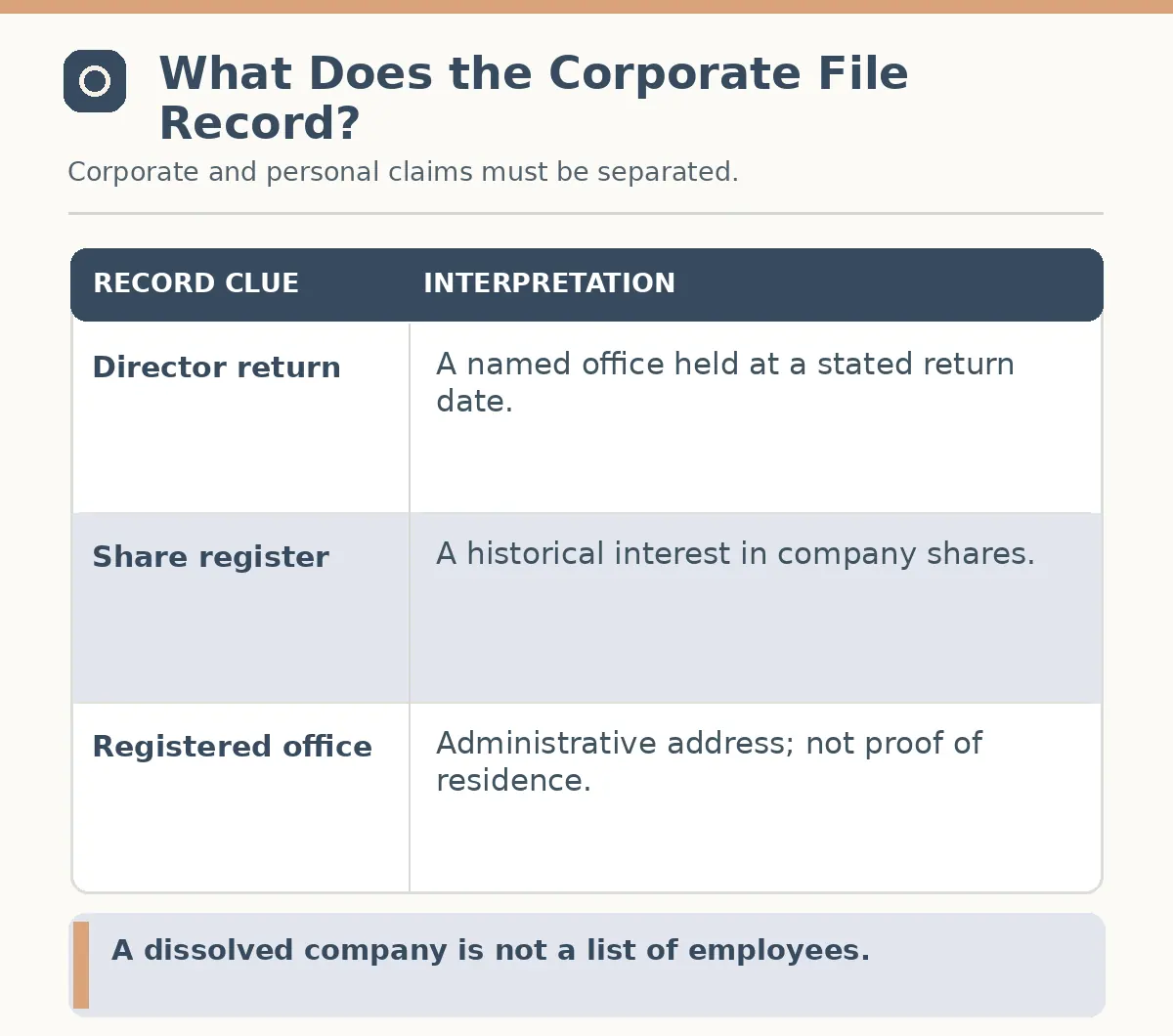
Separate directors, shareholders and workers in a family history
Corporate relationships are easy to overstate. A director named on an annual return is not necessarily a proprietor who owned every asset. A shareholder named in a snapshot need not have remained a shareholder throughout the company’s operation. A registered office is an administrative address, not evidence of a home. An employee may have worked for an unincorporated branch whose name never appears in the corporate papers. To test a claim about an ancestor, pair the dated corporate filing with independently preserved local directories, electoral rolls, census schedules, trade journals, business invoices, estate deeds or personal letters as appropriate. Record each source’s own claim type. If two men share an initial and surname, ask which separate dated document connects the candidate to the firm before assigning a directorship or shareholder status.
Use closure and company-name changes as search pivots
A business advertised in 1910 and absent by 1920 might have dissolved, merged, traded under another legal name or simply stopped advertising. Search company-name histories and notices, then check associated registered numbers where possible. Follow the National Archives’ wider company records guide to railway or canal company collections when the business was nationalized or passed into public control. The guide notes that such exceptions may preserve actual operational records rather than only registration papers. In a local business history, distinguish a firm’s dissolution date from the date a shop closed or a building changed hands. An archival sample might omit a company for selection reasons. So write ‘no file found in BT 31 using these terms’ instead of declaring that no company existed. Keep living persons’ personal information out of public genealogical summaries. For the same kind of choice in another place, see our guide “Queensland Company Registers, 1863–1959”.

More House and Local History Guides
How We Research Historical British Company Files
We use the National Archives company guide for BT 31 scope and the separate national repositories, and Companies House’s register instructions alongside the 2026 retention-policy update. The sample-versus-all-files limitation is integral to our diagrams. We discuss deceased historic subjects, avoiding personal details about living officers. Our affiliate disclosure explains editorial relationships; these recommendations concern public research gateways, not paid sponsors.
No. It is a sampled set of England-and-Wales dissolved-company files, not a complete national register.
Use a verified company number and incorporation dates, not the trading name alone.
No. Registered offices can be professional or administrative locations.
Not necessarily. Companies House announced a pause in transfers and destruction during a 2026 retention review.
Only when a specific filing documents the role; a company file is usually not a full employee roster.