
Search Queensland’s historical company registers, 1863–1959, by legal name and Northern, Central or Southern district. Registration establishes a company-level fact, not an ancestor’s shareholding or directorship without a separate named document.
Start with a registered company, not a family legend
Queensland State Archives holds historic registrations for companies between 1863 and 1959, with a searchable index of defunct companies. The archive describes records for Northern, Central and Southern Company Registry Districts. A family story that an ancestor “owned a company” is a starting hypothesis, not the meaning of a name found in the register. Begin with the historically used legal or trading name, the approximate town and the period of the alleged business activity. For the same kind of choice in another place, see our guide “Historic UK Company Records”.
Search full business names and sensible variants, including “Limited” and abbreviated company styles. A concern known locally by a storefront sign might have registered under a different formal name, while similarly named enterprises existed in different districts. Keep each candidate company in its own row until its date, district and business description match. The company registry is not a universal directory of all sole traders, shops or partnerships.
Use the three registry districts to prevent false matches
The Northern, Central and Southern registry districts are important archival locators. A Queensland place name should be matched to the administrative district relevant to the register, not automatically mapped onto a modern business address. If the family moved between towns, search each plausible district and compare the registration years. A company name repeated in different regions might refer to unrelated legal entities or to changes requiring a documented link.
The Queensland open-data resource lists locality, year, date, book, page, Queensland State Archives reference, series ID and item ID fields. Capture this whole set rather than keeping a surname-only result. The book and page can lead toward the original registration. A location recorded for the company is a business or registration clue; do not promote it to the home address of a particular shareholder without another source. Our guide “Brisbane Hospital Death Registers, 1899–1913” shows how to check the original entry.
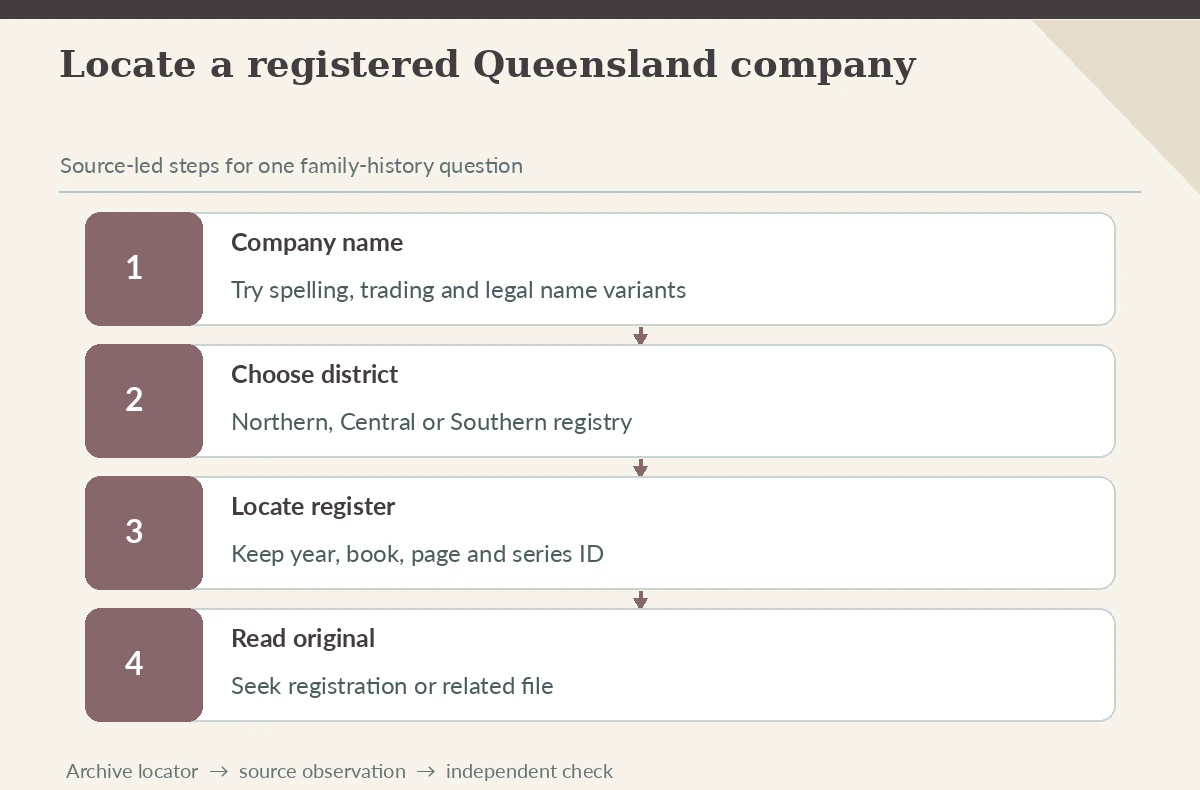
Trace a company index entry to its original register
The official company dataset is derived from Registers of Companies. A derived index may be sufficient to identify a relevant company but not to show exactly which natural persons signed its formation papers. Use its entry to request or view the appropriate original register or associated file. The QSA company-records guide identifies historic registration as the core archival function; exact item contents depend on the series, legislation and survival of associated papers.
When viewing an original page, record the legal company name, registration date, district, cited volume or page and each person named with their stated role. Do not label a signature “shareholder” or “director” unless the document supports that description. Memoranda, articles, registration references, changes or liquidation papers may serve different questions. If only an index is accessible, record that status and do not imply every underlying page has been reviewed.

Separate registration, people, address and liquidation events
A company’s existence, ownership, employment and dissolution are distinct kinds of claims. Queensland State Archives explains that historic company files can include company names, shareholders, registration dates and liquidation details; their exact contents are not uniform. To prove a family member’s role, find a contemporary document that explicitly names that person as a member, shareholder, officer or other participant. A surname inside the corporate title is not enough to establish who owned or controlled it.
Likewise, a registered office can be different from a trading site, branch or proprietor’s home. A liquidation record describes a legal or financial event at its own date, not necessarily the last day that the business operated from a storefront. For family-history purposes, create separate lines for registration, known members, address changes, commercial advertisements and any winding-up event. Attach a citation to each rather than making one index hit support all of them.
Verify that the named person is your ancestor
Suppose a fictional Clara Bennett appears in a newspaper advertisement for Bennett & Co. and a similarly named company is indexed in a Queensland register. The shared name suggests a search but is not a link. Find the original company entry, compare the legal identity and dates, and seek a directory listing, partnership document or newspaper notice that explicitly connects Clara to the same enterprise. An ancestor might have been a paid worker, a creditor or an agent without owning any shares. Our guide “Queensland Redeemed Land Orders, 1860–1906” goes into more detail.
Identity work is especially important when a family traded under a common surname. Build a table with company name, registration district, documented individual, role, dates, address and independent source. If a named person disappears from later documents, do not assume death or bankruptcy. A change could reflect a transfer of interest, a clerical difference or a new legal entity. Preserve the competing explanations until a source resolves them.
| Record checkpoint | Question to ask | Common false inference |
|---|---|---|
| Name | Match full person or corporate name | Do not assume a separate event or relationship |
| Time | Check the family member lived then | Do not assume a separate event or relationship |
| Role | Identify director, member, partner or employee | Do not assume a separate event or relationship |
| Proof | Use an independent local record if needed | Do not assume a separate event or relationship |
Know what Queensland State Archives does not hold
QSA explicitly cautions that it generally does not hold the operating business records of companies, apart from a few unusual cases involving liquidated firms. The index also concerns businesses no longer in existence, so an absent name is not evidence that a firm was never registered, or that a person never conducted business. Proprietorships and partnerships can require different records, and the archive’s business guide points readers to separate guides for firms.
Look beyond the company register according to the actual gap: newspapers for dated advertisements, electoral and address directories for an individual’s residence, court records for a commercial dispute, and local historical sources for a building. Each has its own coverage and evidentiary limits. Reconstructing a family business is most convincing when several independent dated records tell a consistent story rather than when a company index has been stretched into a biography.

Record the company’s paper trail and unresolved roles
A good company-registration citation provides Queensland State Archives as custodian, the creating register district, company name, precise series and item, book or page, registration date and image or microfilm reference if used. Distinguish a publicly searchable CSV entry from an inspected manuscript page. Name every person only to the extent the actual document does; do not insert a relationship or company role based on the modern researcher’s expectations. Our guide “Queensland Orphanage Admission Registers” adds more detail on this.
Your conclusion might establish that a particular legal company was registered in a certain district in a given year, while leaving a named relative’s interest unverified. The next action is then specific: search for shareholder or officer evidence, or a second source that links the person to the business. This claim-level approach creates a useful family-history article even when the original books do not contain a full set of business accounts.
How We Research This Queensland Company Registration
This guide was prepared from the Queensland Government and State Library archival descriptions linked below, checked October 22, 2026. We distinguish a name-index entry, the original record, and an inference about a person. Fictional names in worked examples are not transcriptions of any actual case. Historical records vary in surviving fields and availability; confirm the exact item and current access rules before requesting a copy. If a source has not been read in full, the article does not claim that it has.
More Records and Archives Guides
Primary Archive Indexes and Sources for Queensland Companies
Queensland State Archives business collection, three registry districts, evidence categories, and limitations (www.qld.gov.au).
Official Queensland State Archives Companies 1863–1959 dataset (www.data.qld.gov.au).
Company registry index dictionary: company name, registration date, book, page, locality and archive IDs (www.data.qld.gov.au).
QSA official company research guide describes 1863–1959 registrations for companies that no longer exist (www.publications.qld.gov.au).
Editorial disclosure: No paid recommendation or approved affiliate placement appears in this guide. See the GenHis affiliate disclosure. The records described are historical; protect information about living people, preserve the context of older administrative terms, and do not infer medical, legal or family facts that the original does not state.
No. Queensland State Archives says its collection concerns companies no longer in existence; coverage is not a comprehensive current business registry.
The archived company registers cover Northern, Central and Southern registry districts, so search all plausible locations.
No. You need a shareholder, director, partner or other named source, checked against independent identity details.
Usually not. Queensland State Archives warns that it rarely holds original operating business records, except some liquidated company material.
Use the company’s registered name, district, archival series and item, book or page, registration date and repository, identifying whether you read an index or original.