
Begin with the home and year, then search Queensland State Archives’ orphanage admission and discharge index. The dataset and its resource have different published date ranges; verify the specific original register before making a claim about a child or parent.
Start with the Queensland home, not a broad surname search
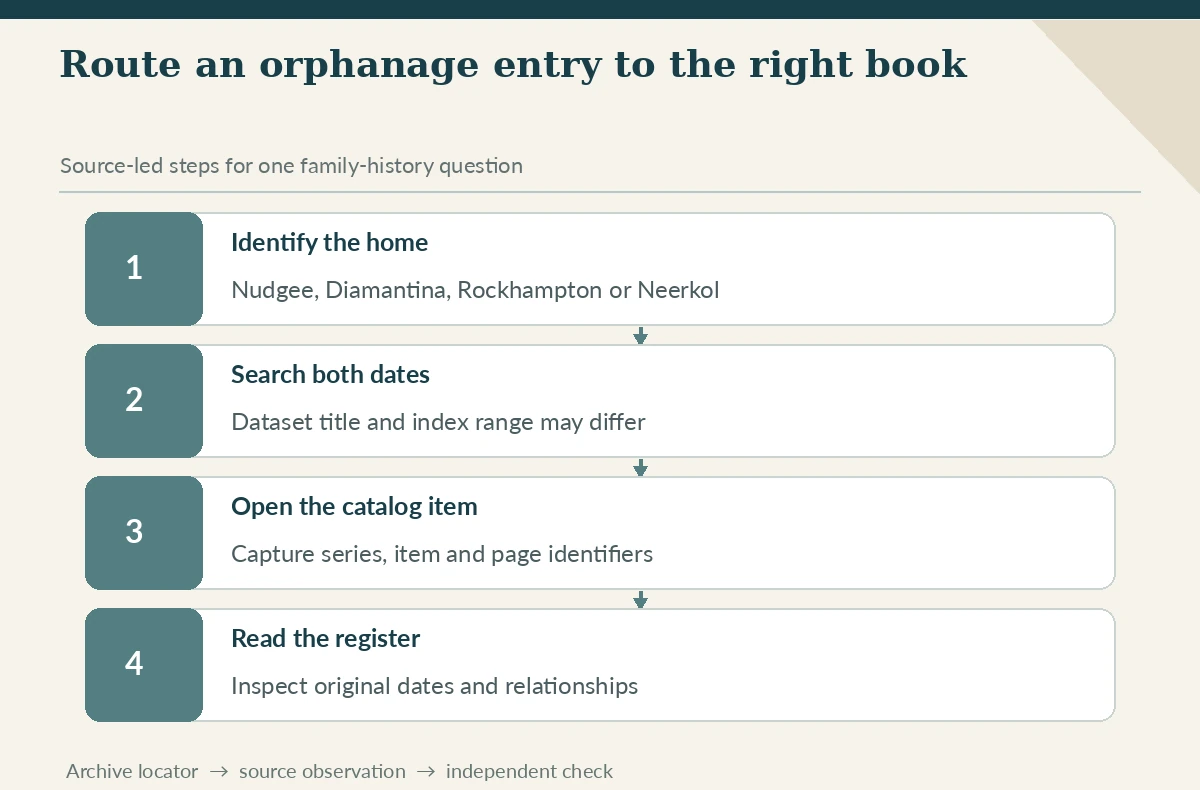
Queensland State Archives identifies a named group of child-care records in its orphanage admission index. A searchable result may be a useful lead, but its scope is specific: St Vincent’s Home at Nudgee, Diamantina Orphanage and receiving depot, Rockhampton Orphanage or receiving depot, and Meteor Park at Neerkol. The absence of a child elsewhere cannot be tested against this index. Begin with a documented town, family address or institution mentioned in a contemporary letter, notice or civil record. Our guide “Tasmania Queen’s Orphan School Records, 1828–1879” goes into more detail.
Write down the child’s exact name, likely age and time window before opening results. Search spelling variants one at a time and retain candidates whose institution and approximate dates fit. Treat a younger or older person with the same surname as a separate candidate until another record ties them together. An institution-level route makes this a narrower and more reproducible search than a website-wide query for an “orphan” surname.
Resolve the two published date ranges before drawing conclusions
The official open-data dataset is titled Orphanage Admissions 1865–1909. Its downloadable resource, however, is titled Orphanage Admission and Discharge Registers 1865–1919. This is a metadata distinction, not permission to assume every home’s registers survive without gaps for the entire longer span. Record the title and date of the source you consulted, then inspect the date range of the specific archive item that contains the entry.
For a child reportedly admitted in 1912, do not reject a candidate just because the dataset title ends in 1909. Equally, do not assert there must be a 1912 record because a CSV resource includes 1919 in its heading. Search the official index, follow the linked series and item in ArchivesSearch, and verify whether an original register covers the required institution and year. Note any unresolved gap explicitly.
Move from indexed name and age to the original register
Queensland’s open-data resource describes columns including a surname, given name, age, date, locality, notes, page, Queensland State Archives reference, item ID, digital image ID and series ID. These columns are finding aids, not a substitute for handwriting, column headings and the surrounding pages. Keep the item and page identifiers together. A surname match from an index with no image inspected should be marked “candidate: index only” in your research log. Our guide “Queensland Company Registers, 1863–1959” adds more detail on this.
When an image is available, inspect the entire relevant opening rather than only a cropped result. Note whether the date is admission, discharge, transfer or another event. Reproduce the spelling and labels as written, including abbreviations that remain uncertain. If there is no digitized page, use the Queensland State Archives catalogue entry to establish the item reference and check current reading-room or copy-request options. Do not describe a record as read when it has merely been located. Our guide “Brisbane Hospital Death Registers, 1899–1913” shows how to check the original entry.

Read parent, guardian and placement statements narrowly
Queensland’s collection guidance says admission and discharge records may contain details about children and parents or guardians, but the content varies. A person identified as guardian might be a parent, relative, legal custodian or another adult acting in that role. It is not safe to transform the word “guardian” into “father” or “mother.” Likewise, institutional placement alone does not prove a child was abandoned, orphaned or permanently separated from family. Our guide “Queensland School Admission Registers, 1878–2001” shows how to find pupil records.
Create a claim-by-claim table: the exact statement in the register, the date, the source and the independent evidence needed. A name in an adult-contact column might be checked against a birth registration, parish record, household record or later marriage document. Preserve a register’s historical terminology as attributed wording, without repeating potentially stigmatizing classifications as the researcher’s own description of the child.
Trace discharge and transfers without inventing a life story
A discharge notation may lead to a destination, a transfer to another institution, an apprenticeship or some other placement; not every entry contains such detail. First establish exactly what the surviving page says. A destination name is an administrative clue, not automatic proof of adoption, employment, residence or kinship. If the child appears in two institutions, make a timeline with both entries and distinguish events from retrospective annotations.
For example, consider a fictional Ada Mercer whose admission appears under one institution and whose later name occurs in a district school register. The matching age makes the school entry plausible, but it does not prove that the two entries concern the same Ada. A documented guardian, location or subsequent civil record would be a stronger bridge. If no bridge exists, preserve the alternative rather than merging the two people for convenience.
| Record checkpoint | Question to ask | Common false inference |
|---|---|---|
| Name and age | Compare a birth or baptism record | Do not assume a separate event or relationship |
| Named adult | Seek independent proof of the relationship | Do not assume a separate event or relationship |
| Institution | Check home and locality, not just surname | Do not assume a separate event or relationship |
| Outcome | Follow a documented transfer or discharge | Do not assume a separate event or relationship |
Apply privacy and contextual limits to sensitive child records
These were institutional records involving children and families often experiencing poverty or disruption. They can also reflect discriminatory administrative practices. Do not use them to make present-day allegations or publish intimate details about someone who might still be living. Queensland State Archives warns that records about children in homes may be access-restricted. A publicly searchable index does not guarantee that all related pages are available online or for unrestricted redistribution.
An inaccessible file should be described as restricted or not yet examined, not “missing.” Check the repository’s current access conditions for the exact item before trying to obtain a copy. In family-history writing, make the subject a person rather than a label imposed by an institution. Quote sensitive historical terms only when needed to explain the document, with clear attribution and source context.

Build an evidence note that another researcher can follow
For each promising record, save an evidence line with institution name, series, item ID, page or image, date, the exact name, the field that contains the claim and the access date. A clear conclusion may read: “A child of this name and reported age was admitted to this named home on the recorded date.” That is narrower, and better supported, than “this was the child of these two parents” unless the second relationship was independently checked.
After recording the citation, choose one unresolved question and pursue the source that can answer it. To verify a parent, seek a direct relationship statement in a civil or church record. To establish a later residence, seek a school, electoral or marriage record appropriate to the period. A documented absence from the indexed home is not evidence that a child was never in institutional care elsewhere.
How We Research This Queensland Institutional Record
This guide was prepared from the Queensland Government and State Library archival descriptions linked below, checked October 22, 2026. We distinguish a name-index entry, the original record, and an inference about a person. Fictional names in worked examples are not transcriptions of any actual case. Historical records vary in surviving fields and availability; confirm the exact item and current access rules before requesting a copy. If a source has not been read in full, the article does not claim that it has.
More Records and Archives Guides
Primary Archive Indexes and Sources for Child Admission Records
Queensland State Archives groups orphanage admission and discharge registers under schools, hospitals and orphanages, and cautions about restricted records (www.qld.gov.au).
Official dataset title 1865–1909; names Nudgee, Diamantina, Rockhampton and Meteor Park institutions (www.data.qld.gov.au).
Resource titled Orphanage Admission and Discharge Registers 1865–1919; defines fields and item identifiers (www.data.qld.gov.au).
Official name-index route with links to ArchivesSearch item descriptions (www.qld.gov.au).
Editorial disclosure: No paid recommendation or approved affiliate placement appears in this guide. See the GenHis affiliate disclosure. The records described are historical; protect information about living people, preserve the context of older administrative terms, and do not infer medical, legal or family facts that the original does not state.
No. Institutional admission does not by itself establish that either parent was dead. Read the register and check separate family records.
The government dataset page and its listed CSV resource have different date ranges. Verify the particular institution, series and item dates before relying on either as complete coverage.
The official dataset names St Vincent’s Home at Nudgee, Diamantina, Rockhampton and Meteor Park at Neerkol. It is not a complete index to every Queensland child-care institution.
A record may contain adult or guardian information, but fields vary. Check the original page and exact role label rather than inferring parentage from an index.
Cite Queensland State Archives, the institution and register series, item identifier, date, entry or page and any image locator actually consulted.