
Search the Queensland Treasury’s redeemed land orders index for 1860–1906, keeping immigrant and employer names distinct. A redeemed order can document an immigration incentive; it does not establish passenger arrival, legal land title or residence without further records.
Understand why a Treasury land order is not a land deed
Queensland State Archives indexes redeemed land orders from 1860 to 1906 among its immigration holdings. The official explanation distinguishes orders connected to an immigrant’s obligations from orders available to employers who engaged immigrants. A Treasury entry documents the reception or redemption of an order under a particular scheme; it does not in itself show that a specified person received legal title to a particular parcel. Begin by identifying what administrative action the source actually records.
If a family story says an ancestor “got land on arrival,” treat that as three testable questions: whether an immigration incentive was granted, whether an order was received or redeemed, and whether a separate land transaction occurred. These events could have different dates or parties. A redeemed land order may be an excellent bridge toward land research, but calling it a farm title bypasses the very step the researcher needs to verify.
Search both the immigrant and the employer names
The Queensland records can name an immigrant, an employer or a company. Search the ancestral surname but also employers or associates known from a shipping document, colonial directory or employment reference. The official index includes a field for last name or company name, plus given names and notes. Those field labels help explain why a candidate might appear under a business or sponsor rather than the passenger’s expected name.
Keep a two-person worksheet where the immigrant and possible employer occupy separate rows. An individual being named in a Treasury register is a documented participant in the land-order process, not necessarily the person who eventually selected, bought or occupied land. If a result lists only a company, seek the underlying record before assigning the entry to a named worker on the basis of proximity or family tradition.
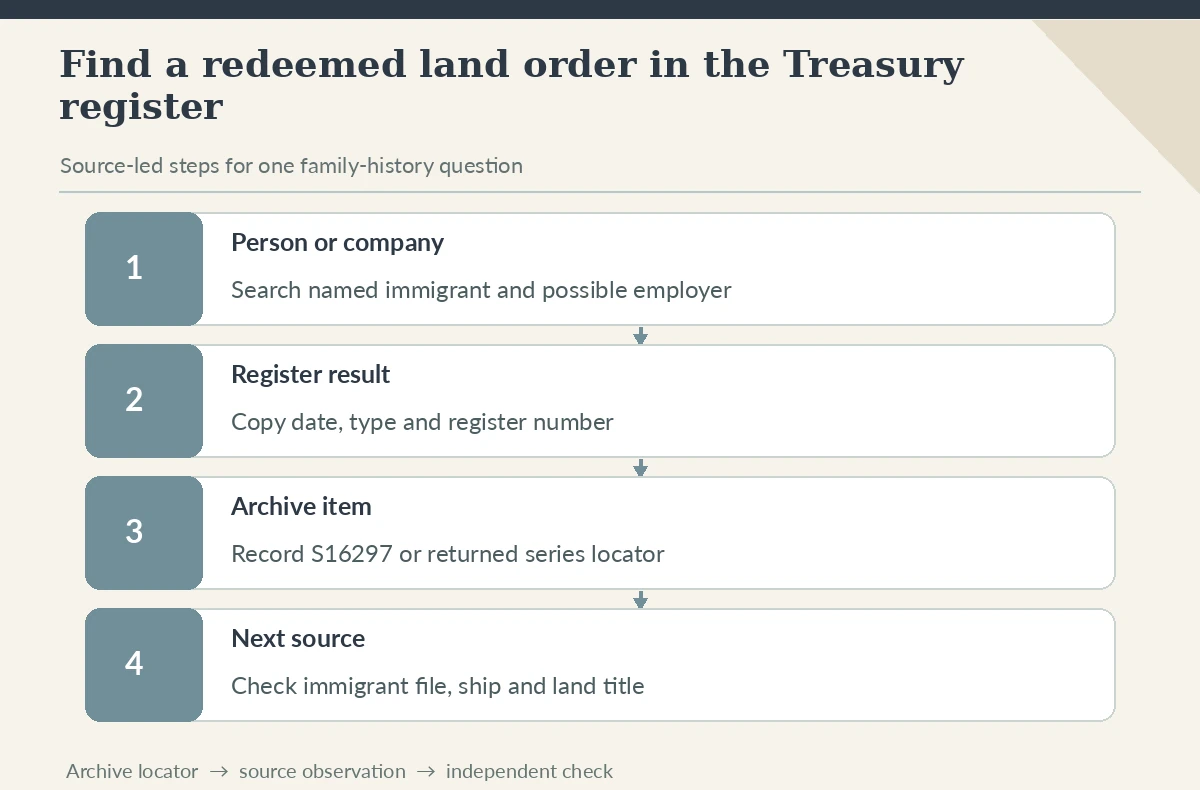
Use the index number, date and type to locate an original
The Queensland Government’s open-data dictionary for Redeemed Land Orders 1860–1906 includes date, year, order number, page, type, Queensland State Archives reference, item ID, series ID and image locator fields. Collect these before beginning a broader web search. One number may identify the register transaction, while a series or item ID is the route back to the archive. Do not confuse an index row number with the manuscript page or land lot number.
The resource points to Treasury registers including a Queensland State Archives series identified as S16297. Verify the exact series returned for the particular entry rather than assigning that reference to every order in the dataset. When the original page is accessible, transcribe its category and act or scheme description. If the manuscript is not viewable, label your finding as index-level evidence and use the item locator for a catalogue or reading-room inquiry. Our guide “Queensland Naturalisation Records, 1851–1908” shows how to find the original oath.

Separate the arrival, issue and redemption chronology
The date of a redeemed order is not necessarily the date of immigration. Assemble a chronology with columns for stated voyage or arrival, qualifying employment or obligation, order issue, Treasury reception or redemption and later land transaction. Insert only dates that a source actually supplies. This protects against two common errors: assigning a ship’s voyage based on a later financial date, and treating redemption as the first day of residence on a named property.
Suppose a fictional Eleanor Price appears in a Treasury index in 1874 and a candidate passenger list contains Eleanor Pryce in 1871. The chronology makes the possible match visible without declaring it proven. Compare the ages, any employer, locality and scheme reference; look for another passenger or Treasury candidate with the same name. A three-year gap may be consistent with an administrative process but cannot substitute for identity evidence.
Choose the next archive by the specific missing claim
For a voyage question, Queensland State Archives lists separate assisted immigration indexes that sometimes link to scanned registers of ships and passengers. The archive warns that survival and damage can affect early arrival lists, especially before the 1860s. For a property question, a land grant, certificate of title, transfer or selection file is the appropriate next record class. For an employer question, seek correspondence, directories, payroll or local advertisements where they survive. To go further, our guide “Brisbane Hospital Death Registers, 1899–1913” shows how to check the original entry.
These are distinct repositories and documentary functions. A person might qualify for an order without purchasing land directly, or an employer might receive an incentive while the immigrant later moved elsewhere. A negative title search for one district therefore does not nullify a well-cited Treasury transaction. Conversely, a land deed in the same surname cannot be linked to an order without an identity and property trail.
| Record checkpoint | Question to ask | Common false inference |
|---|---|---|
| Names | Immigrant and employer can differ | Do not assume a separate event or relationship |
| Dates | Separate arrival, issuance and redemption | Do not assume a separate event or relationship |
| Type or act | Do not combine different schemes | Do not assume a separate event or relationship |
| Parcel | Only a deed or title links specific land | Do not assume a separate event or relationship |
Avoid flattening different laws and categories into one scheme
The Treasury registers are organized under multiple categories and Acts. Preserve the index’s type and any legal reference before explaining why the order existed. A reader should not assume that every immigrant across four decades received the same benefit or completed the same obligations. If the exact conditions are necessary for the research question, locate the law or contemporary administrative instructions governing that order rather than paraphrasing the system from a modern one-line summary. For the fuller picture, see our guide “Queensland Company Registers, 1863–1959”.
Names may be abbreviated, indexed incorrectly or shared by unrelated people. Search variants and compare source descriptions across the same period. A blank field is a limitation of the surviving record or index, not evidence that a person had no employer or no property. These cautions are especially important when a family’s migration story has been simplified to “they were given land” without an identifiable original grant.

Cite the order and state what it establishes
A reproducible note names the Treasury register, Queensland State Archives, the actual series and item, the order number or type, date, page and digital-image locator if seen. A careful conclusion might say that a land order associated with a named person or employer was recorded as redeemed on a specific date. That conclusion is useful even if the immigrant’s ship or later residence remains unknown, because it specifies the administrative fact without pretending to prove a different event. Our guide “Queensland Orphanage Admission Registers” adds more detail on this.
From there, select one question: does a surviving passenger register corroborate travel, does an employment source identify the two named parties, or does a later land record attach an actual parcel to the family? Add each as a separate cited finding. If those links cannot be demonstrated, retain the unproved connections as hypotheses rather than turning a Treasury entry into a sweeping settlement narrative.
How We Research This Queensland Treasury Land Order
This guide was prepared from the Queensland Government and State Library archival descriptions linked below, checked October 22, 2026. We distinguish a name-index entry, the original record, and an inference about a person. Fictional names in worked examples are not transcriptions of any actual case. Historical records vary in surviving fields and availability; confirm the exact item and current access rules before requesting a copy. If a source has not been read in full, the article does not claim that it has.
More Records and Archives Guides
Primary Archive Indexes and Sources for Immigrant Land Orders
Queensland Treasury reception-of-redeemed-land-orders dataset, 1860–1906 (www.data.qld.gov.au).
Official field-level index: company or surname, given name, no., date, type, page and QSA series/item identifiers (www.data.qld.gov.au).
Queensland State Archives explanation of land orders issued to immigrants and employers, plus separate immigration lists (www.qld.gov.au).
Official search route and item identification in ArchivesSearch (www.qld.gov.au).
Editorial disclosure: No paid recommendation or approved affiliate placement appears in this guide. See the GenHis affiliate disclosure. The records described are historical; protect information about living people, preserve the context of older administrative terms, and do not infer medical, legal or family facts that the original does not state.
No. It records an administrative land-order transaction. Specific ownership must be checked against a land-title or transfer record.
Yes. Queensland State Archives says orders could be issued to immigrants or employers, so identify the named party’s role before interpreting the entry.
The official Treasury register index is labelled 1860–1906. Individual series and scheme-specific date ranges still need checking.
No. It may point to immigration, but a dated ship or passenger record is separate evidence of travel.
Record each date, order type, act and series separately; compare independent identity details before deciding whether they concern the same person.