
A person located on an 1860 census page may have two property amounts beside their name, but those figures answer different questions and are not recorded proof of ownership. Meanwhile an enslaver may appear on a separate schedule that does not name those subjected to enslavement. The most useful result of reading 1860 carefully is a dual-source evidence chart, not a confident family story pieced together from similar ages.
Separate 1860 free and enslaved schedules
The 1860 federal census is particularly useful for the distinction between real estate and personal estate. In Schedule 1, named free inhabitants appear with ages, birthplaces, occupations and two separate value columns. But the census also continued the separate Schedule 2 for people held in slavery, generally without naming them. Those are distinct record sets. A good search begins by identifying which schedule an online hit represents and whether the image preserves the original column labels, as explained in NARA’s 1860 census guide.
The reference date was June 1, 1860, rather than the later date an enumerator happened to knock on a door. Note the state and county as they existed then, the family and dwelling numbers, the exact written names, and the person-level answers. This census still lacked an explicit relationship-to-head question. A surname pattern, position in the row, or close age span can suggest an inquiry; none individually prove a parent-child or spousal relationship.
Interpret two different estate columns
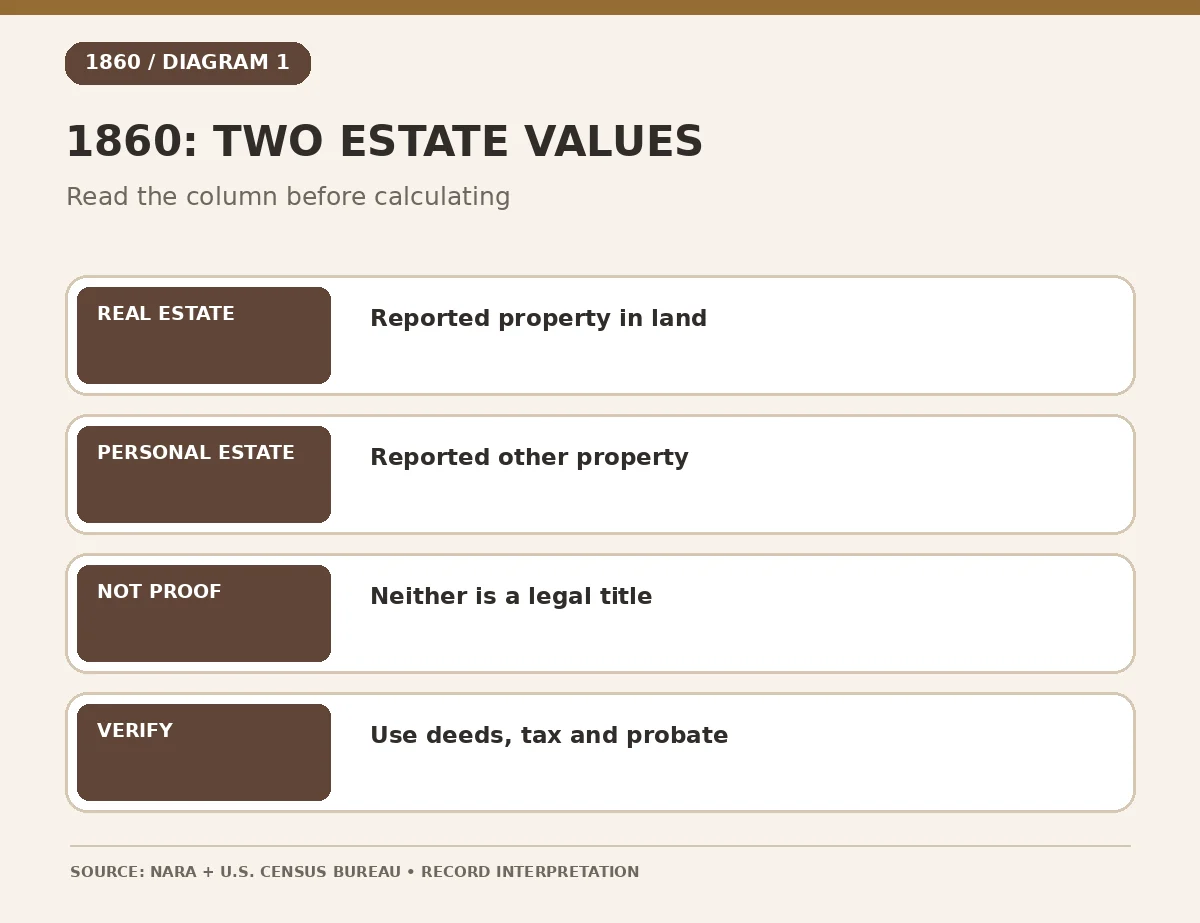
Real estate denotes the reported value of land or real property attributed to the enumerated person. Personal estate is a separate reported value for other property. The distinction does not automatically tell you whether the values were owned free of debt, how they were assessed, or whether they are comparable to modern wealth. The formal Census Bureau questionnaire confirms these two fields in Schedule 1. Transcribe them separately; never add them together without explaining why you are doing so.
A blank or zero-looking cell may mean no reported estate, an omitted answer, or handwriting that needs closer inspection. The form does not replace county property deeds, mortgage records, probate accounts, or tax assessments. For land questions, check the record office that served that locality in the relevant year. For family history, estate values are contextual hints that may help distinguish namesakes, not a genetic or social-status score.
Track mobility without assuming a family link
Use birthplace sequences to formulate a dated migration hypothesis. If someone born in one state in the 1840s appears in a household with younger people born elsewhere in the 1850s, their reported birthplaces may imply movement. Yet the census does not establish that each adult accompanied each child. Build a chronological table with the named person, reported birth year range, place, and independent evidence from marriage, tax, land, or church records. Our guide “1870 U.S. Census” adds more detail on this.
The enumerated occupation and estate values can help distinguish two same-name adults in neighboring counties. Test more than one field: approximate age, birthplace, district, household composition, and nearby associates. Use uncertainty labels where the image is unreadable. If the person seems absent, try name variants and image browsing rather than inventing a move that conveniently explains a missing index hit.

| Record feature | Direct statement | Not established |
|---|---|---|
| Schedule 1 | Named free inhabitants | No stated kinship |
| Real estate | Reported real-property value | Not title or current worth |
| Personal estate | Reported other-property value | Not same as land |
| Schedule 2 | Generally enslaver named | No direct person-by-person identity |
Use the original page to test identities
A search result generally presents a tidy name, but the original 1860 page contains neighboring households, family number breaks, handwritten markings and, sometimes, ambiguous zeros or dollar figures. Compare the record’s visual line with the index transcription; correct your own research log rather than assuming the platform has normalized the name accurately. Note the page number, enumeration district or locality, household position, and source host for retrieval later.
Read at least one surrounding page and review the enumerator’s style of digits if estate amounts are uncertain. It is easy to mistake a personal-estate amount for real estate when a cropped result omits headings. Prefer a full-page image. If you cannot access one through the chosen platform, use NARA’s digital census access directory to identify another index or image route; access conditions may differ by provider.
Build a careful 1860-to-1870 comparison
The 1860 slave schedule often identifies enslavers but omits the personal names of enslaved people while reporting ages and other categorized details. It is not a companion page that can be attached person-by-person to the free-inhabitant household simply because the names, location, or numbers seem close. The FamilySearch collection description explicitly warns that the named person is generally the enslaver. Interpret the form as evidence of a system and a geographic lead, not a shortcut to someone’s identity.
When researching an enslaved ancestor, anchor the inquiry in verified later records and look for person-specific emancipation-era and earlier legal sources where they survive. Wills, estate inventories, court cases, bills of sale, and Freedmen’s Bureau documents can be relevant but have separate coverage and ethical limits. Similar age and location are insufficient to identify the person, and records must not be used to infer an unnamed person’s surname automatically. Our guide “1880 U.S. Census” shows how to use relationships and parents’ birthplaces correctly.

Record both evidence and archival silence
Comparing 1860 with 1870 may illuminate residence and household changes across the Civil War and emancipation, but the records were made under profoundly different legal conditions. The 1870 schedule named formerly enslaved people among other inhabitants and canceled the slave schedule. Do not link a numbered entry from 1860 to a named person in 1870 solely on a county and approximate age. A defensible bridge requires independent names, association, or documents that make the link specific. Our guide “1850 U.S. Census” covers how to read named households and separate slave schedules.
For a free family whose 1860 location is secure, compare the 1870 state of birth, occupation and associates without assuming the head’s identity from a matching label. Record why the candidates agree, where they conflict and which independent document could resolve the mismatch. This is how you turn an attractive decade-to-decade narrative into a researchable argument instead of a story fitted after the fact.
More Records and Archives Guides
How We Research These Original Records
Before describing two kinds of wealth, we checked the 1860 enumerator questions for the real-estate and personal-estate columns. We separately examined the official slave-schedule fields to ensure the workflow never treats an enslaver’s name as the name of an enslaved person. Examples describe possible analysis only.
Sources and archive boundaries: The original federal questionnaire explains both property-value fields; NARA’s coverage guide describes the surviving schedules; and the separately indexed enslaved-person collection warns about the missing personal names. These sources do not identify a particular ancestor.
Disclosure and use limitations: Descriptions of enslaved people and estate values are presented as period record fields, not as a valuation or identification of any human being. This article has no paid 1860 lookup endorsement. The site’s affiliate disclosure explains broader relationships, and access conditions should be verified directly with the repository.
No. Relationships were not explicitly recorded in Schedule 1.
They are separate reported value fields; neither alone substitutes for a deed, tax, or probate record.
Generally they are not; the named person is usually the enslaver.
Not from age or proximity alone; seek person-specific documents that bridge the two periods.
Not automatically. Compare multiple fields and independent records, while noting the contradiction.