
The 1870 enumeration is a major documentary turning point for research into lives after emancipation, yet a person’s listed surname must never be treated as proof about who previously enslaved them. A sensible first task is to build a reliable named household anchor and then work backward using local documents created during Reconstruction. Follow this guide to separate a reported census fact from the later family connections you hope to establish.
Recognize what changed in the 1870 enumeration
The 1870 U.S. census was the first federal population enumeration after the Civil War and the abolition of slavery. It recorded named inhabitants rather than using a separate schedule for enslaved people. For many African American families, the 1870 household offers an essential starting point for a documented search backward through Reconstruction-era records. That does not mean it was the first census ever to name Black residents: earlier schedules named free Black individuals under the forms used at the time. The distinction matters when describing what an original record genuinely establishes. For a step-by-step method, see how to research African American genealogy across the 1870 divide.
The official census day was June 1, 1870. Read NARA’s year-specific 1870 guide before assuming today’s county names or digital database coverage apply. An index may display a standardized surname or racial category, but the source is the actual line on the surviving page. Begin with the resident’s recorded name, age, birthplace, occupation, dwelling/family number and any notes that can be read confidently.

Transcribe the actual person-level evidence
The schedule includes a birthplace (state, territory or country), real-estate and personal-estate values, and markers for whether a person’s father or mother was foreign-born. It also contains literacy, school attendance and, for relevant male citizens, political-status fields. Many of these categories reflect the social and legal attitudes of the census takers and period. Keep historical labels in a quoted transcription when needed but explain them neutrally rather than adopting the classifications as timeless descriptions of a person’s identity.
The 1870 enumeration did not directly ask everyone to state their relationship to the household head. A person on the next line with the same surname may be a family member, worker or another co-resident; the original entry alone cannot resolve that. A child’s reported birthplace and age can be useful in choosing where to search for an earlier marriage or community record, but they do not prove the identity of the child’s parents in that household. To go further, our guide “1880 U.S. Census” shows how to use relationships and parents’ birthplaces correctly.
Use a name-centered search with alternatives
Start a search with a confirmed surname and a generous range for age, not an exact birth year treated as fixed. Search the nearest known location, adjoining counties, alternate name forms and a distinctive household associate. View the full page, because a household may span a page break. Then search each adult separately: one person may be misspelled, recorded under another name, or living away from the rest of a family.
When matching two candidate households, compare age ranges, occupations, birthplaces, names of other residents and community associations. Keep the candidates as separate hypotheses until an independent record distinguishes them. The Census Bureau’s original questionnaire description shows the exact 1870 questions and confirms the separate slave schedule was canceled. The change in census design helps explain both the value and the limitation of cross-decade comparisons.
| Record feature | Direct statement | Not established |
|---|---|---|
| Population schedule | Named persons | Kinship not stated |
| Place of birth | State, territory or country | Not an exact birthplace |
| Parents foreign-born | Yes/no indicators | Neither parent named |
| Census vs Bureau | Different historical records | Link requires direct evidence |
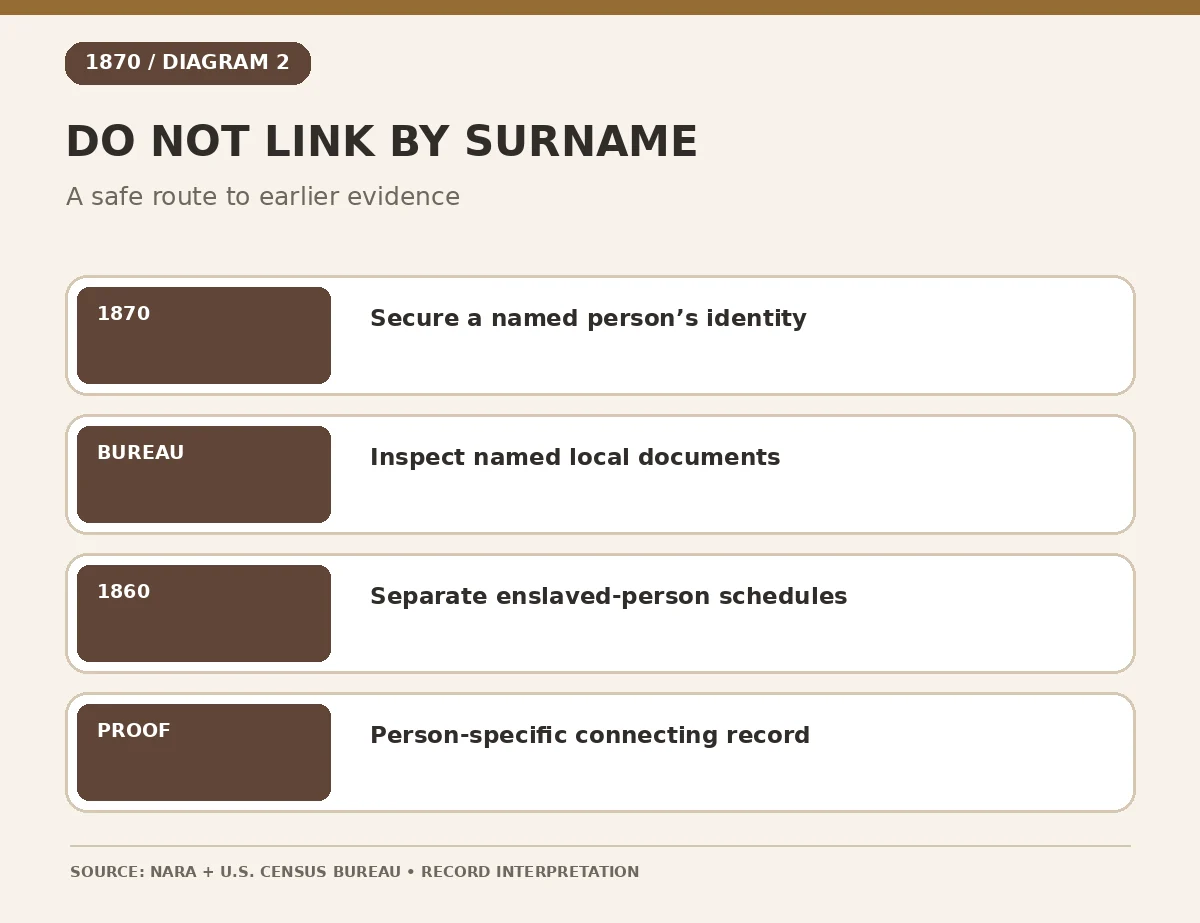
Avoid assuming a pre-emancipation surname or link
A frequently repeated shortcut is that a newly documented 1870 surname identifies the enslaver who held the family before emancipation. It does not. People selected, retained, changed, or were assigned surnames for varied reasons; a matching local white household or enslaver in 1860 is not person-level evidence of a historical relationship. A same-name presence in a slave schedule is especially insufficient because enslaved individuals were generally not named there.
Research backward by building a named 1870 family group first, including distinctive associates, probable migration paths and separate corroborating documents. Only then investigate specific antebellum estate and court records, and keep alternative identifications open. Treat stories, indexes, and automated hints as leads with confidence labels. No biological link, property relationship, or personal identity should be presented as certain solely because the proposed narrative fits the historical context. To go further, our guide “1850 U.S. Census” shows how to read named households and separate slave schedules.
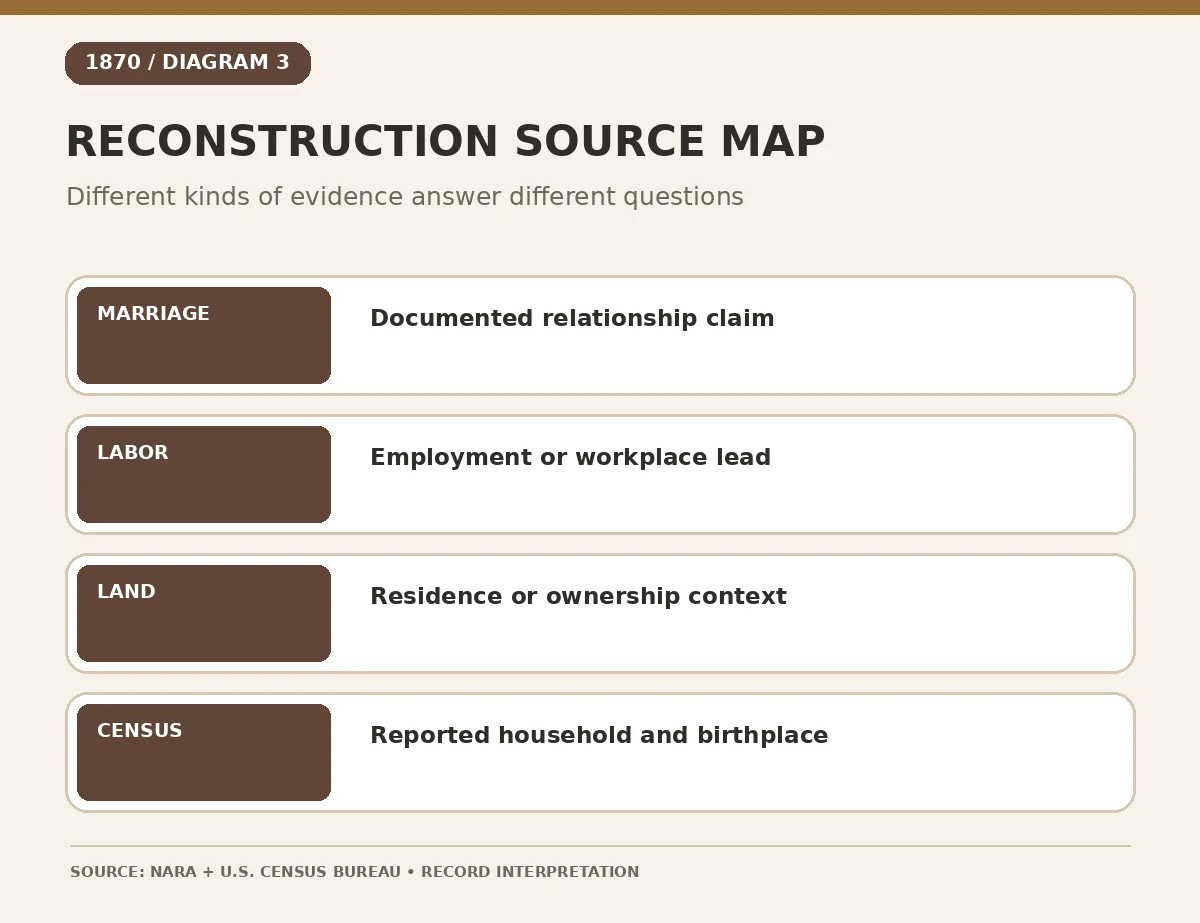
Consult Reconstruction-era corroborating records
The National Archives Freedmen’s Bureau resource describes records such as labor contracts, marriage documentation, correspondence, and complaints generated in particular locations and periods. These may identify named individuals or their associates, but the coverage is irregular and each series has its own provenance. Search by state and field office rather than assume a national list exists for every family. Reconstruct the local jurisdiction before selecting a record group.
Where you find a possible Bureau reference, record exactly who was named, the office, document type, date, and context. A labor contract can document that two people worked in the same arrangement; it does not by itself establish kinship. A marriage register or corroborated pension evidence may answer a different question. Keep these sources distinct from census statements and state plainly which proposed family relationship each additional document supports or leaves open. To go further, our guide to Freedmen’s Bureau marriage records shows how to find and interpret the evidence.
Handle gaps and contradictory 1870 returns
Some 1870 districts were re-enumerated, and surviving pages can show unusual numbering or variants. Search the original state, county, and locality instead of insisting on the present-day boundary. If a household is not located, check page neighbors, spelling differences, candidate households in adjacent places, and year-specific coverage guidance. A missing search hit is not proof that someone avoided the census or lived somewhere else. For the next step, our guide “1860 U.S. Census” explains how to check property columns and two separate schedules.
Where two records disagree about age, record both ages without overwriting the earlier entry; they may reflect mistakes, different informants, or different people. Map each candidate to an independent land, tax, school, church, court, or labor record where available. Do not treat an indexer’s modern racial grouping as a precise transcription of a historical enumerator’s categories; inspect the source image to understand its literal content.
More Records and Archives Guides
How We Research These Original Records
The first check was the original 1870 schedule, particularly its post-emancipation design and explicit inquiries. We then consulted federal archival guidance about local Freedmen’s Bureau collections to show which independent documents could connect a named person to an earlier place or family association. No example supplies a made-up ancestor.
Sources and archive boundaries: For the postwar shift, see the National Archives 1870 year guide and the original enumerator questionnaire. Possible contemporaneous evidence is documented separately in NARA’s Freedmen’s Bureau inventory. The collection’s existence does not mean an individual appears in it.
Disclosure and use limitations: Research across emancipation requires respectful language and independent person-specific evidence, not invented family ties. No service or archival partnership is represented by this guide. Readers can consult the GenHis commercial disclosure; availability of individual historical files remains a question for the relevant archival custodian.
It provides named post-emancipation household entries that can anchor a search for independent earlier evidence.
No. A matching surname or locality is not evidence of who enslaved a specific person.
No. It names residents but does not explicitly give relationships to the household head.
Consider available Freedmen’s Bureau series, marriage records, court documents, tax lists and other locality-specific sources.
Some places were re-enumerated; compare dates, page details and the entire context before selecting a return.