
A useful starting point for African American genealogy is a documented person in a known place, not an assumption about a surname or an enslaver. For many families whose ancestors were enslaved, the 1870 U.S. population census is a practical bridge: it often names household members after emancipation, while earlier slave schedules usually do not identify enslaved individuals by name. Free Black people also appear in earlier records, so 1870 is a research milestone rather than a universal beginning. The aim is to build a chain of independent evidence across that divide, documenting uncertainty rather than assigning ancestors to a plantation on resemblance alone.
Anchor a postwar household with independent records
Transcribe the entire 1870 census household, not just the target person. Capture ages, birthplaces, occupations, nearby households, county, township and page reference. Search the same area in 1880, relevant marriages, death certificates, land or tax files, churches and newspapers. Age estimates and surname spellings may differ from one record to another; those differences should be tracked rather than silently repaired. A single person named in a census is an entry point, not yet a complete identity across decades.
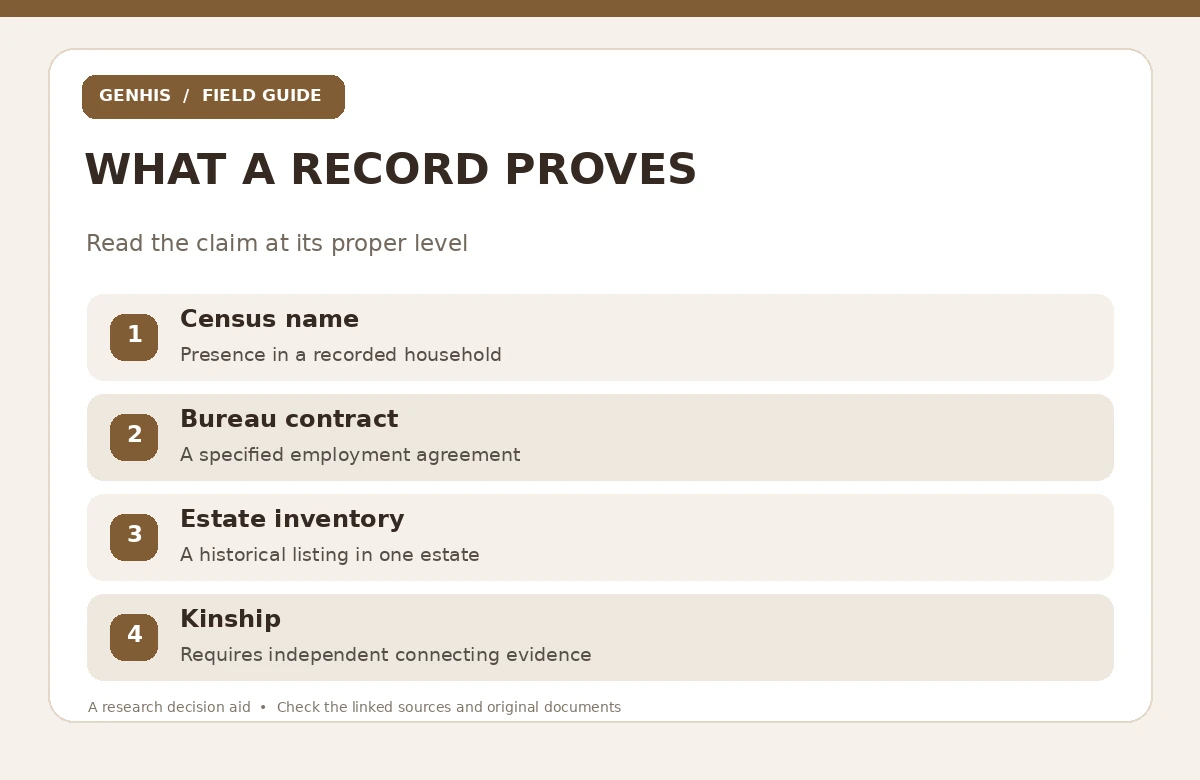
Reconstruct a local network through known children, spouses, neighbors and witnesses. Someone sharing a surname may be related, may have adopted a different surname after emancipation, or may have no kinship connection. Record what each document actually states about household membership: federal census entries in 1870 do not provide the later explicit relationship-to-head field. Compare postwar marriage and church evidence before assigning parent-child relationships based solely on household order. For a related choice, see our guide “1870 U.S. Census”.
Choose Reconstruction records by place and event
Once a household is anchored, search the records of the Bureau of Refugees, Freedmen, and Abandoned Lands for its state and nearby field offices. National Archives descriptions include marriage, labor, complaint, relief, school and correspondence series, but field office holdings differ. Start with the archive’s microfilm or digital collection description for the relevant county and office, then identify the appropriate series and coverage dates. Some families will appear repeatedly; others will not appear at all. For a related choice, see our guide to Freedmen’s bank records.
A labor contract can document an employment arrangement, while a complaint can preserve testimony about a dispute or mistreatment. Neither should be flattened into an uncomplicated family history. Record the office, date, parties, exact language, and who supplied the information. Not every name in a bureau document was an applicant or family member. If a named person seems connected to the 1870 household, ask what combination of age, residence, associate and event makes that link stronger than a matching name.

Use a record-to-claim bridge, not an enslaver guess
To reach earlier decades, look for a documented place and an event that connects the same person to prewar records. County deed books, probate estates, bills of sale, emancipation papers, church membership, military claims or court testimony may help. Historic documents sometimes describe people in dehumanizing language; quote only what is necessary to identify the source and distinguish that wording from your own descriptions. County jurisdiction and record survival must be verified independently for the event year. Our guide to Dawes rolls for genealogy covers a related question.
The 1850 and 1860 federal slave schedules generally recorded enslaved people by age and sex under enslavers’ names rather than listing them individually. Consequently, a female aged twenty in an 1860 slave schedule cannot be equated with a similarly aged Black woman in 1870 without other evidence. Build a side-by-side table of ages, locations, associates and documentary relationships, and leave the identification unresolved if several plausible people fit. Do not treat an enslaver’s surname as proof of ownership or kinship. Our guide “FAN Club Genealogy” covers a related question.
Look beyond plantations and federal schedules
Families who were free before the Civil War may appear by name in earlier federal population schedules, state enumerations, deeds, business records or religious registers. Research whether the jurisdiction used separate categories or restrictions, and avoid assuming that every Black resident was enslaved. Some free persons moved or changed legal status under different laws. A negative search of a single census cannot decide which history applies to an individual. Our walkthrough on how to research native American ancestry using tribal and federal records sets out each step.
Local archives, historically Black churches, mutual aid organizations, Black-owned newspapers, cemetery offices and family-held papers can preserve names and relationships absent from digitized national sites. Their collections may be uncatalogued or described under institutional names rather than surnames. Ask a repository about relevant series, date limits, image availability and use restrictions. For a fragile original or sensitive testimony, request a digital copy or guidance instead of attempting invasive handling.
| Record or source | Useful evidence | Critical limit |
|---|---|---|
| 1870 census | Names and locality after emancipation | Household order is not proof of kinship |
| Freedmen’s Bureau file | Named event or relationship when recorded | Survival varies by field office |
| 1860 slave schedule | Ages and sexes in enslaver household | Usually does not name enslaved people |
| County probate or deed | Transaction, estate or place context | May not identify a person uniquely |
Build an evidence matrix for competing identities
Use three confidence columns: documented fact, reasonable hypothesis and unknown. In the first, place only claims directly supported by cited documents, such as a named marriage in a dated county register. A possible connection between a postwar laborer and an earlier estate inventory belongs in the hypothesis column unless the record provides a reliable identifying bridge. The unknown column is not failure; it shows where archives, migration and incomplete records leave a gap.
When documents disagree about age, birthplace or parents, identify the informant and how close the information was to the event. A postwar pension affidavit may be detailed but recollected decades later; a contemporary contract may omit family members altogether. Resolve a conflict only after comparing the documents and their purposes. Preserve alternate surname spellings in a research log so future searches do not repeat the same assumptions.
Protect relatives and narrate difficult history responsibly
For family stories involving enslavement, coercion, violence or imposed classifications, use the person’s name and agency wherever the record permits. Identify exploitative systems honestly without inventing motives, relationships or experiences for a named individual. A historical register of an enslaver or property transaction is evidence about a legal regime, not confirmation that a particular present-day family has a specific relationship to the persons listed.
A working example can be entirely hypothetical: suppose an 1870 household appears near a known church and a similar name occurs in an 1867 bureau contract. You would test the location, age, spouse and employers against marriage or tax documents before linking them. Keep living relatives’ private information out of public pages, and obtain permission before publishing interviews or documents that reveal sensitive family details. The strongest result may be a sourced map of possibilities rather than a claimed lineage.

How We Research These Historical Records
We tested this workflow against NARA census and federal Reconstruction finding aids. The key historical control is the different naming practice in the 1870 population census versus the 1850 and 1860 enslaved-person schedules. We reviewed Bureau microfilm catalogs by field office, which vary widely in the surviving documents. Illustrative families are hypothetical; a plantation-to-person link has not been asserted from an age, location or surname alone. County inventories and permissions should be rechecked for the exact locality being investigated.
More Research Method Guides
Sources, Privacy and Editorial Disclosure
Checked repository material: The 1870 census as a postwar population enumeration and its research context.; Name coverage and limitations of pre-1870 slavery-era civil records.; Freedmen’s Bureau office and marriage microfilm series and location-specific record groups.; Naming practices for 1850 and 1860 slave schedules and the prewar free population.. The language of historical documents about enslavement sometimes treats human beings as property; this guide does not adopt that framing. We recommend recording contested claims without exposing living relatives or publishing testimony obtained in confidence. There are no affiliate endorsements in the steps above. Our general transparency notice is available through the GenHis affiliate disclosure.
No. The 1870 census is often a useful post-emancipation anchor, but free Black families can be named in earlier records, and family papers may reach much further back.
Most 1850 and 1860 slave-schedule entries do not name enslaved individuals. Age, sex and enslaver information may support context but cannot independently establish a person’s identity.
No. The bureau administered postwar relief and related activities; the separate Freedman’s Savings and Trust Company kept bank records, including some family-rich depositor registers.
No. Surnames could come from multiple sources, and a match alone is too weak to support that conclusion.
Document the last proved household, relevant local record groups, searches already attempted and competing hypotheses. An unresolved gap is more accurate than an invented ancestor.