
The Dawes Rolls are a specific historical enrollment resource, not a list of everyone with Native American ancestry. They emerged from the Dawes Commission’s work involving the Cherokee, Choctaw, Chickasaw, Muscogee (Creek) and Seminole Nations in Indian Territory. Records include approved and disapproved lists, enrollment cards and applications with testimony. The useful question is not merely whether a surname appears. It is whether a particular documented ancestor can be identified in the appropriate category, and what the surviving file actually says.
Establish the person and date before searching
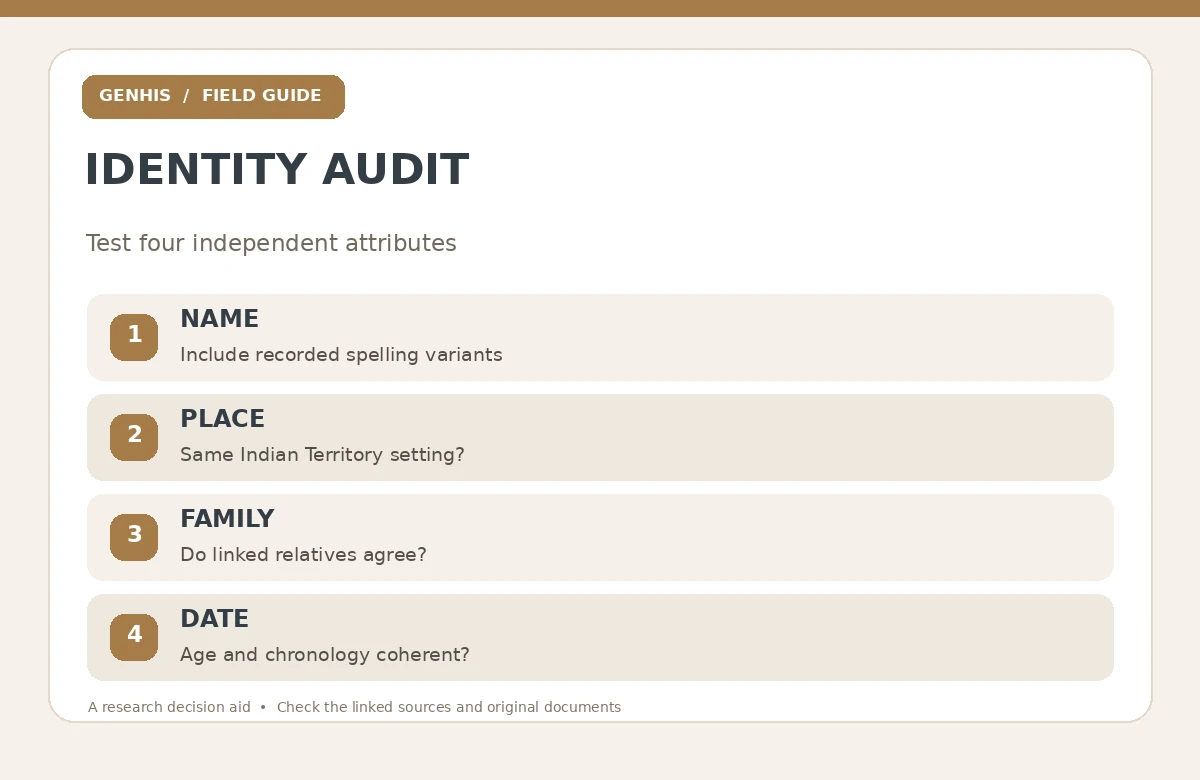
Write down the ancestor’s proven name, approximate birth, known relatives and residence during the relevant enrollment years. Make a simple timeline showing whether the person was in Indian Territory and which nation’s enrollment process could plausibly apply. NARA describes Dawes records through roughly the 1896–1914 period, while the commonly cited final approved roll series and supplements have more specific dates. Do not treat a title mentioning 1907 as the creation date of every underlying document.
Work through spelling variants only after checking the most reliable known identity. A common surname may occur in several categories and among both accepted and rejected applicants. Freedmen entries are part of the history of citizenship and enslavement involving the Five Nations, not an alternative spelling for the “by blood” category. The labels were categories in an administrative process; their meaning requires the relevant tribal and historical context.
Read the roll status rather than the name alone
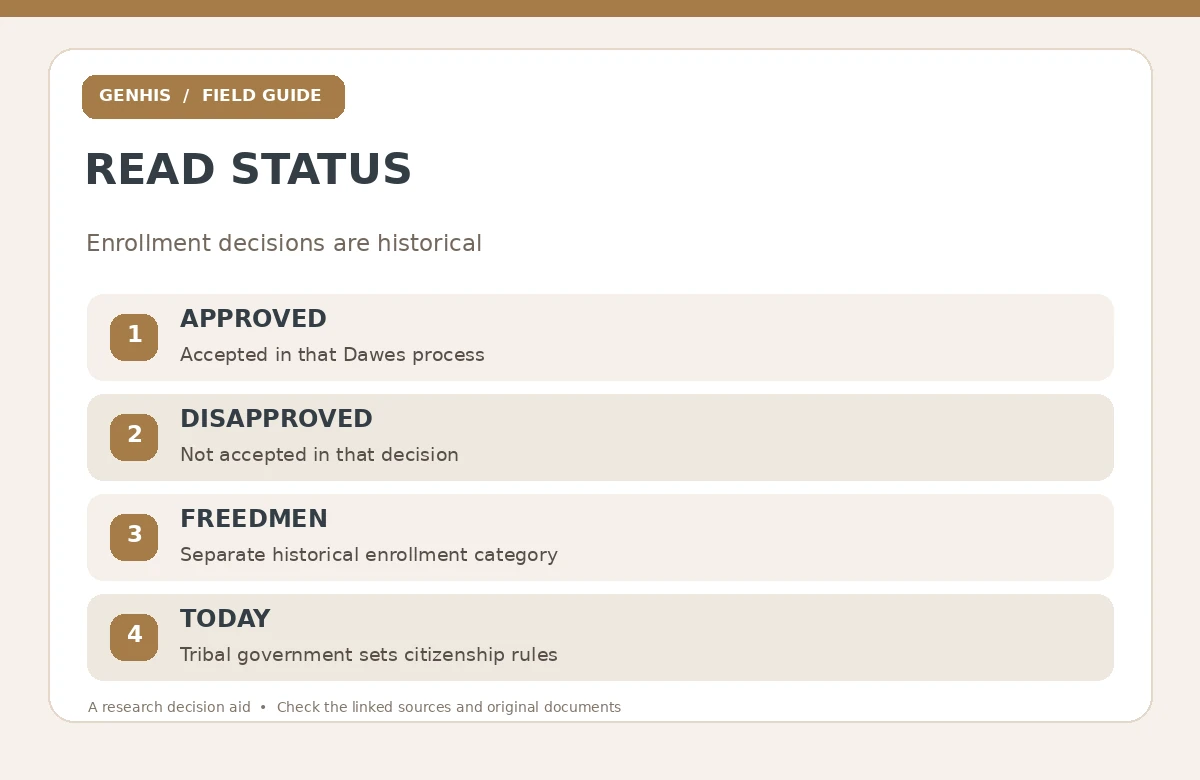
NARA’s Dawes guide distinguishes approved and disapproved rolls. An approved entry indicates the person was accepted as eligible under that historical process, while a disapproved or rejected entry documents a different outcome. Neither should be paraphrased as a universal verdict on Indigenous ancestry, identity or eligibility for a present-day nation’s citizenship. Record the tribe, enrollment category, roll number, name, age, sex and census card number exactly as visible.
Pay attention to marks, corrections and supplements. Transcriptions can omit marginal information that helps distinguish two similar people. Where an index references a census card, follow that pointer instead of relying on the surname result as final evidence. Save the archive identifier and the image information you actually consulted; the same name may be indexed in more than one derivative collection with different completeness.

Follow the census card to the application jacket
Dawes enrollment cards, sometimes called census cards, may identify family groups or associated individuals and often point toward an application number. They are not the same thing as federal decennial census pages. Use the card number to find associated application or enrollment-jacket materials. According to NARA, applications may include statements, testimony or other evidence assembled during the decision process. The precise contents differ from case to case.
When reading an application, annotate who made a statement, when it was made, the question the commission was deciding and whether testimony was contested. A reported parentage in an affidavit is a historical assertion by a witness; it should be weighed with independent civil, church, military or local records where available. Do not assume that every person named on a card is a proved biological parent or that an official’s classification fully represents the person’s identity.
Handle Freedmen and rejected cases with precision
The Dawes Commission materials include categories for Freedmen linked historically to the Five Nations as well as people listed as citizens by blood and other groups. Context is essential because categorical labels arise from laws and decisions that affected families differently. Do not collapse all categories into a single ethnicity score, and do not erase Freedmen’s history when explaining the roll. When interpreting a difficult case, use the exact nation, status and record citation. Our guide to Freedmen’s bank records adds more detail on this.
A rejected application is still an archival source and may contain substantial information about family members, places and earlier events. It is not proof that a family never belonged to a community. Conversely, an approved roll number is evidence within that historical administrative system, not an automatic modern tribal membership determination. If an index seems contradictory, consult the full jacket and decisions before presenting a result.
| Record or source | Useful evidence | Critical limit |
|---|---|---|
| Final roll entry | Nation, category, status, roll/card number | Do not infer membership today |
| Enrollment card | Associated people and case references | Group does not prove biological kinship |
| Application jacket | Witness statements and decision evidence | Statements may be disputed |
| Other family record | Identity, place and descent cross-check | Requires its own citation |
Build a reproducible four-stage citation
Keep four distinct stages in the research log: the search index; the final roll entry; the related census card; and the enrollment or testimony packet. At each stage record the repository, title of the series, nation, category, identifying number, page or image and archive URL. If a document is missing or restricted, mark it unavailable and do not describe its contents. This chain lets another researcher reproduce the result and spot transcription errors.
A hypothetical example illustrates the decision: your verified 1900 household includes a person whose name matches an approved Dawes entry. You next compare age, family members and residence with the associated census card. If the jacket points to a different parent or locality, the apparent match may be wrong. The workflow improves identification by using multiple record levels instead of importing the first index match into a family tree.
Know when Dawes is not the correct collection
Most Indigenous nations and communities do not fall within the Dawes enrollment process. Even within the Five Nations, not everyone who might have a family connection will appear as an approved enrollee. For another community or earlier period, consult the appropriate tribal records and other NARA series, such as specific agency censuses or other rolls. The same name appearing in two unrelated government series does not by itself establish a single identity.
If your question concerns today’s tribal citizenship rather than interpreting a historical file, go directly to the relevant tribal government’s official enrollment guidance. The Bureau of Indian Affairs says tribal citizenship rules are set by each tribe. Do not use a DNA ethnicity result as a substitute, request private identity paperwork in a public comment thread, or claim a legal outcome from a public genealogy article. For a step-by-step method, see how to research native American ancestry using tribal and federal records.
How We Research These Historical Records
The record chain in this article is based on the National Archives’ descriptions of final rolls, cards, enrollment jackets and associated map or allotment material. We checked the distinction between accepted and disapproved cases, and included Freedmen categories without equating them with biological ancestry. The person used in the hypothetical identity audit is not presented as a real historical claimant. Source status and case dates belong to an identified NARA document; a modern tribe’s membership decision is a wholly separate matter.
More Research Method Guides
Sources, Privacy and Editorial Disclosure
Checked repository material: NARA explanation of approved/disapproved rolls, enrollment cards, jackets and categories.; Dawes records relative to other different tribal-roll series and time frames.; Present-day citizenship set by sovereign tribal governments; archival and genealogical limits.. Roll labels must be quoted as historical bureaucracy, not accepted as universal statements of modern identity. Avoid publishing sensitive living-person applications and tribal enrollment correspondence. Our suggested workflow sends readers to archival material rather than sponsored services; see the affiliate disclosure page for the website’s general transparency policy.
The records address the Cherokee, Choctaw, Chickasaw, Muscogee (Creek) and Seminole Nations in Indian Territory, within the specific commission process.
No. It establishes a historical enrollment decision. The relevant tribal government decides current citizenship under its own rules.
Yes. A disapproved file may preserve testimony, relatives and places even though the original request was denied.
They refer to different levels of the Dawes record chain; use the census card number to find the related card and possible application materials.
Only if other documented evidence connects the person to that particular enrollment process; otherwise choose records appropriate to the specific community and jurisdiction.