
Historical Queensland electoral rolls can place a registered voter at a particular address and sometimes supply an occupation, but they do not list everybody living in that household. Start by deciding whether you need a Queensland state roll or a Commonwealth electoral roll, then locate the correct year, electorate and subdivision. Early voter eligibility depended on law, and the absence of a woman, young adult, First Nations person or other family member may reflect exclusion or non-enrollment rather than absence from the place. State Library of Queensland offers catalog and research guides for these resources. This guide turns electoral listings into a dated address timeline while explicitly marking what each roll cannot prove.
Decide which election and roll system applies
State and Commonwealth rolls were created for different elections under rules that evolved over time. A person may appear in one kind of roll without an obvious entry in another, especially when comparing earlier periods. Identify the election year and record title on the original page, not just the year in a commercial search result. Where the catalog says “Queensland electoral roll,” inspect whether the item belongs to a state district or a federal division. The institutional source and electorate boundaries are part of a usable citation. A single unsourced “voter in Brisbane” entry does not establish the precise neighborhood or the time span of residence. Our guide “Victoria Electoral and Voter Rolls” covers a related question.
Understand who could appear before interpreting an absence
State Library of Queensland explains that nineteenth-century voting rights could depend on sex, land and other qualifications, and that these qualifications changed. Federal and state rights did not change in lockstep. Historical restrictions excluded many people, notably Aboriginal and Torres Strait Islander communities, but a blanket claim that no First Nations person could enroll before 1967 is false; the National Archives explicitly cautions against it. If a family member is missing, first ask whether the person could lawfully enroll at that date and which roll was searched. A negative name result is not evidence that an absent person had moved or died.

Search by electorate, subdivision, name and address
Early rolls were commonly arranged by electorate and subdivision and then by surname; later formats may provide broader alphabetic arrangements. A street or house-number search is only useful if your chosen format and access tool support it. State Library Queensland describes onsite and microfiche holdings and Ancestry Library Edition routes with address-search possibilities for specific collections. Start with a documented district, record the publication year, then try variant surname spellings and the exact original address. Do not assume an online index has retained electoral district names or occupation fields correctly. Open the underlying roll page when access permits.
Use occupation and address as matching clues, not biography
Historical rolls can provide residential addresses and sometimes occupations; published format and time period control the available detail. A recurring occupation can help distinguish two James Browns in Brisbane, but occupation names are not unique identifiers and may change. A person recorded as “laborer” is not necessarily the relative whose marriage certificate also lists “laborer.” Combine address, occupation, spouse or other independent records and a consistent time window. The electoral address may reflect registration information before the election date; do not treat it as proof that someone slept in the home on a specific day. Record all fields verbatim before normalizing abbreviations. For the same kind of choice in another place, see our guide “New Zealand Historical Electoral Rolls”.
Avoid turning co-address voters into a household census
Two people with the same surname and street address may be related, sharing premises, or one may be a boarder. Conversely, children, disenfranchised adults, nonregistered residents and people who moved shortly before compilation may be missing. Electoral rolls are lists of electors, not family enumerations. Create a column for “same address observed,” separate from “relationship independently proved.” If a husband and wife appear in a later roll, their marriage still needs confirmation from civil or church records. Use rates and directories to check occupancy where possible, but neither substitutes automatically for a household-level census. Our guide “Australian Commonwealth Electoral Rolls from 1903” goes into more detail.
Make a multi-year address continuity ledger
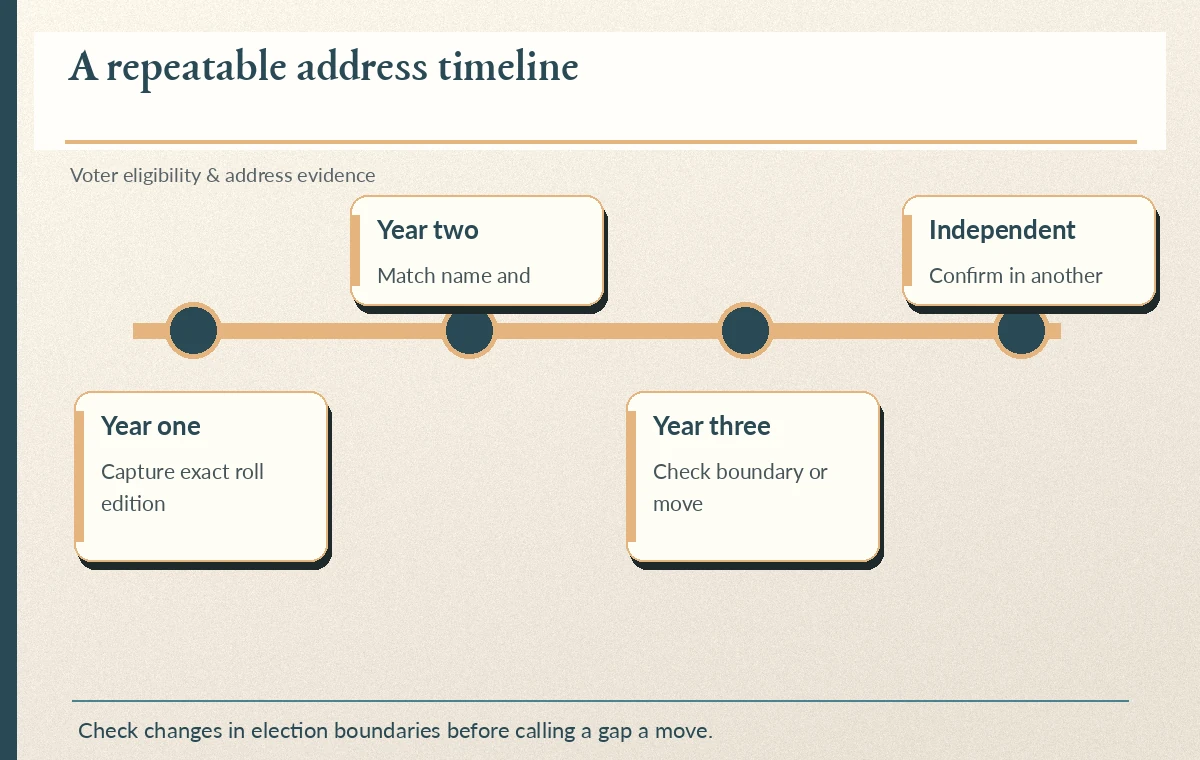
Take three or more roll editions around a possible move, rather than relying on one name hit. Record edition, date or issue, type of roll, division, subdivision, surname, given names, occupation, exact address, and source identifier. If a person disappears and reappears in another district, look for boundary changes as well as actual relocation. Compare the same person in city directories, vital events or property rates for an independent checkpoint. Keep two plausible candidates separate when names and occupations overlap. A time series shows a stronger geographic pattern than isolated results but still cannot establish every intervening month or every person at the address.
Worked example: the missing voter is not a missing resident
Suppose an illustrative Queensland family has adult parents and three young children at a suburban address in a 1930 directory. A matching roll lists only two adults. The children’s absence says nothing about whether they lived at home, because they were not eligible adult voters. Now suppose a 1910 state roll shows only one of two adults: the researcher must check that specific roll’s eligibility requirements and possible errors before inferring a departure. These are fictional names and events, not a real index example. The research question is who was registered to vote, not who existed or was alive in a particular household. For the same kind of choice in another place, see our guide “New Zealand Census Records”.

Know the practical limits of current access
State Library Queensland publishes research guides identifying its electoral roll resources and describes onsite tools such as microfiche and Ancestry Library Edition. It discusses selected Queensland computerized electoral roll material for 1903–1959, but that access note is not a universal statement of continuous coverage or remote free access. Check the actual library catalog and conditions for the year you need. If the source is viewable only onsite, retain the call number and request route. Never invent a free public full-image URL or assert that a commercial search preview supplies complete underlying record information.
| Observation | A cautious conclusion | Follow-up |
|---|---|---|
| Elector at an address | Registered in this roll edition | Check adjacent editions and directory |
| Same surname, same house | Possible association | Find independent kinship record |
| Name missing | Not found in the searched roll | Check law, boundaries and coverage |
| Occupation matches | Potential identity clue | Confirm with another dated document |
Cite the edition and preserve an ethical interpretation
A reproducible citation names the issuing election authority or library holding, roll type, year, electorate and subdivision, original page or image, and access date. When a later record supplies occupation, distinguish it from earlier editions that did not. Do not publicly post detailed addresses of living people simply because a historic database includes them. Discuss exclusions and changes in franchise with historical care, avoiding simplistic or disparaging explanations for who did not appear. Your conclusion should say that a named elector was registered at a stated address in a stated edition; family relationship and actual physical residence need additional evidence.
How We Research
We based the roll-search sequence on State Library of Queensland’s family-history guides, its explanation of electoral subdivisions, onsite resources and recorded occupations, and National Archives’ caution about historical First Nations voting. The method tests voter eligibility and the actual roll edition before treating a missing name as significant. Household relationships are deliberately kept outside what a voter listing itself supports. The fictional address example demonstrates why electoral registration and residence are not synonymous. Access methods, collection coverage and privacy requirements can change; check the institution’s current catalog before drawing conclusions from nonappearance.
More Records and Archives Guides
Primary sources and archive guides
State Library Queensland explains fields, electorate arrangements and franchise history (www.slq.qld.gov.au).
SLQ lists electoral rolls and their use as historical household-location evidence (www.slq.qld.gov.au).
SLQ explains address-based searches, Ancestry Library Edition and microfiche (www.slq.qld.gov.au).
SLQ describes historical Queensland electoral roll resources, including 1903–1959 searches (www.slq.qld.gov.au).
NAA cautions against claims that Aboriginal people could never enroll before the 1967 referendum (www.naa.gov.au).
This guide contains no affiliate links. Electoral archives reflect historical eligibility exclusions and omissions; a missing entry is not a judgment about a person. Do not publish current addresses of living people. See GenHis affiliate disclosure.
Depending on the year, it can place a registered voter in a district or at an address and sometimes identify an occupation.
No. They list eligible registered electors, not everyone in the dwelling.
Possible reasons include historical eligibility restrictions, non-enrollment, an indexing problem, a different division or a genuine move.
No. They were produced for different elections and may differ in date, arrangements and historic eligibility.
Start with State Library of Queensland’s family-history research guides and catalog, checking onsite or database access for the desired edition.