
Jewish genealogy becomes more productive when a name is tied to a particular town, date and family relationship. Historical Jewish communities existed across many regions, languages and political systems; there is no single universal archive. Civil registration, synagogue records, migration papers, burial evidence, community archives and Holocaust-era documents answer different questions. Start with a well-documented relative, establish the place as it was known at the time, and preserve alternate spellings. A surname, language or commercial DNA estimate by itself cannot prove religious identity or a specific lineage.
Identify the precise ancestral town and period
Find the most specific place named in a reliable record: an immigration manifest, marriage record, naturalization file, family letter or cemetery inscription. Distinguish an ancestral town from a port of embarkation and from a region written by a later informant. Draw a timeline of the locality’s names and political jurisdictions at the dates your relatives lived there. A modern country label can be misleading when borders moved and archives retained older administrative arrangements.
JewishGen’s Communities Database brings together historic community names, past jurisdictions and links to resources; its Gazetteer helps locate many settlements beyond communities with dedicated Jewish pages. Search spelling variants and neighboring localities, checking coordinates and context rather than choosing the first same-name town. A village might be described by a nearby market town or district, so preserve the original document wording alongside modern geographic identification.
Separate given names, surnames and transliteration
A person can appear with Hebrew, Yiddish, local-language or adopted given names, and spelling may change in Latin, Cyrillic or Hebrew scripts. Names in passenger lists or censuses might reflect a clerk’s hearing, transcription or the document’s administrative language. Record each variant with its own source, date and location. Avoid declaring that two names are equivalents in every family simply because a name dictionary lists a common association.
Create a comparison grid linking full names, parents, spouses, birth dates and places across records. Marital surnames, patronymics or religious names may offer leads, but the underlying conventions vary by period and location. Jewish identity should not be guessed from a surname that appears stereotypically Jewish. Check the relevant community records and an ancestor’s own documented life instead of treating language, name form or DNA percentages as a stand-in for family history.

Select civil, religious and community records
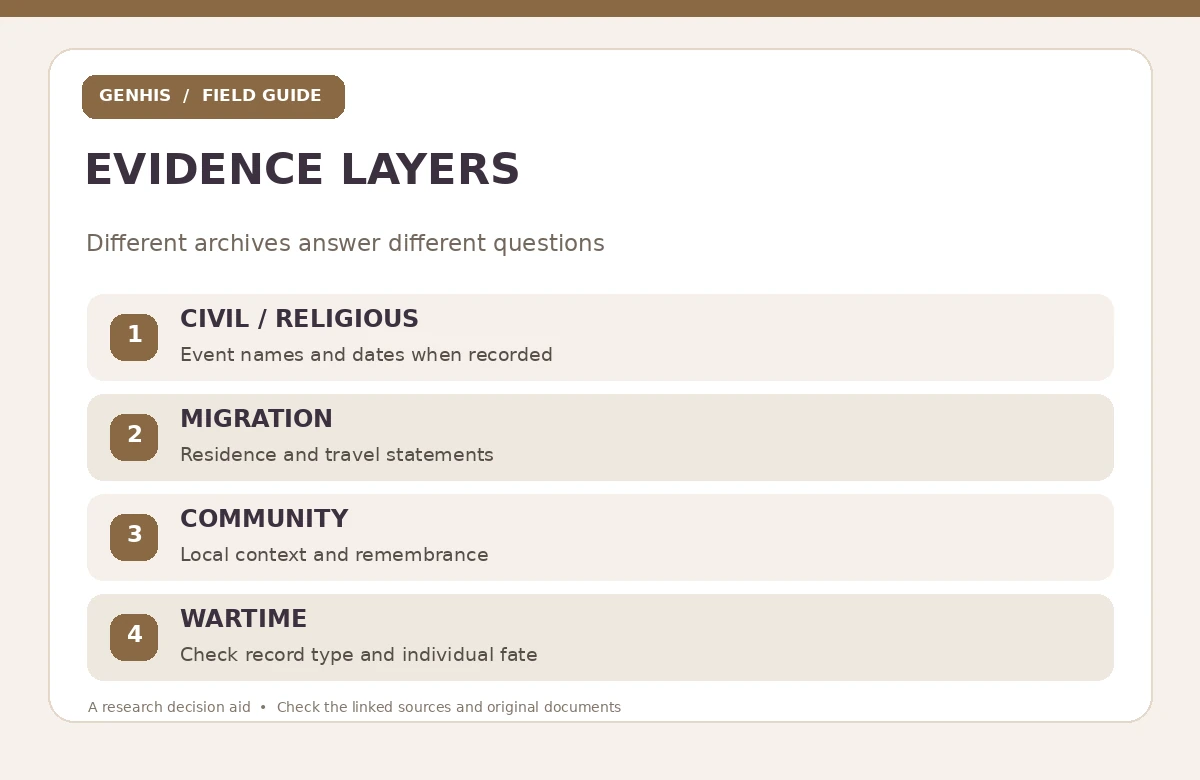
After establishing the period and jurisdiction, look for civil birth, marriage and death registers, synagogue or community registers, cemetery records, school collections and town directories. Laws governing Jewish registration differed by state and period, and not every register survived. Ask the custodian about the record group, which religious communities it covered and whether original images can be viewed. A modern catalog search that finds no digitized pages is not proof that the underlying archive has no holdings. For a related choice, see our guide “JRI-Poland Search”.
Community collections may include Yizkor books, landsmanshaft material, memorial lists or local-history accounts. Such sources can supply social context, variant town names and names to investigate, but their entries must be assessed individually. A memorial volume compiled long after an event may preserve crucial testimony while also containing errors or gaps. Cite page, editor, original language and translation when possible; distinguish community recollection from a contemporary event record.
Use migration documents as connecting evidence
Passenger arrival lists, naturalization petitions, city directories and later censuses may connect an overseas locality with a family settled elsewhere. Search a sequence rather than a single arrival year, and account for repeat migration or people traveling under varied spellings. Keep port, stated last residence, intended destination, named contact and documentary date separate in your notes. A passenger declaration of birthplace may be approximate and should be checked against another source.
If a migration file names a relative in the old country, investigate that person through local registers and community sources before merging the family trees. A similar town and surname are not enough where multiple branches use common names. Record which historical borders applied at the departure date, and verify the correct district for an archival request. This careful linkage is especially valuable when later records use only broad labels such as “Russia,” “Austria” or “Poland.” For a step-by-step method, see how to find the origin of a last name using historical records.

| Record or source | Useful evidence | Critical limit |
|---|---|---|
| Home-country civil records | Contemporary event or family details | Coverage differs by year and jurisdiction |
| JewishGen localities | Historic town names and community links | A locality entry is not an ancestor record |
| Migration documents | Connect old and new residence | Place may mean region or last residence |
| USHMM name database | Named mention in a specific wartime source | Not a universal list or automatic fate proof |
Approach Holocaust-era sources with care and context
The United States Holocaust Memorial Museum’s Survivors and Victims Names Database brings together name records from many distinct sources, including wartime, camp, displacement and postwar documentation. Its coverage is not a universal list of all people who experienced persecution; some records are not online. Search both names and source lists, and read the source description to understand what a specific entry documents. A name in a persecution-related collection cannot alone prove a death, survival history or a familial relationship.
Treat testimony and documents about mass violence, forced movement and family loss with accuracy and respect. Preserve uncertainty when dates or identities conflict, and avoid drawing sweeping conclusions about a person from a single list. The Arolsen Archives and USHMM provide distinct research services and access routes, some with eligibility or reading-room conditions. For living survivors and relatives, protect personal details and seek permission before publishing interviews, addresses or family correspondence.
Organize a multilingual, source-led research trail
For each document, save its original spelling, script, date, holding archive, identifier and a careful transcription. Store translations alongside originals and note ambiguous words instead of altering them to match a preferred family narrative. A town-name worksheet can list historical language forms, modern location, political authority at the event date and likely civil or Jewish community record keeper. This prevents searching archives in the wrong present-day country.
A useful hypothetical case is a U.S. marriage record that gives a broad former empire as birthplace, while a passenger list gives a smaller town. You would verify whether the town lay in that historical jurisdiction, identify its Jewish community records and seek a parent or spouse match. If no record directly connects them, leave the match tentative. Responsible Jewish genealogy respects diverse regional histories, religious practices and individual self-identification; it does not assign cultural narratives from a shared surname. For a related choice, see our guide “Ashkenazi Ancestry Research”.
How We Research These Historical Records
JewishGen’s live town tools establish the distinction between its identified community pages and broader place gazetteer. The U.S. Holocaust Memorial Museum describes its names database as a compilation of records with distinct source contexts, not a complete roll of all persecution victims. Our place-based examples describe a research method rather than actual persons. Historical spellings and jurisdiction labels must be confirmed for the relevant date. Living families’ stories and archives touching traumatic events deserve consent and privacy review.
More Research Method Guides
Sources, Privacy and Editorial Disclosure
Checked repository material: Jewish community names and political jurisdictions in different historical periods.; Gazetteer functionality for alternate localities and geographic cross-checking.; Named mentions, source context, coverage and access limits of USHMM records.; Arolsen/ITS archival access context and USHMM services.. Names in Holocaust-era documents require compassionate handling; never infer someone’s death or persecution history solely from a search hit. Consent is important when a record identifies a living relative, survivor, or interviewee. This page has no paid archive referrals. Read the publisher’s disclosure for the site’s standard relationship policy.
Work from a documented person to the most precise town or district in family and migration records, then establish its historical jurisdiction.
No. Surnames overlap across communities and are not a substitute for documented relatives, places and records.
The Communities Database emphasizes identified Jewish communities and linked resources; the Gazetteer helps locate a broader range of places.
Not necessarily. Read the individual source and its context; different lists document different wartime or postwar events.
Keep each original form and its citation, build a name-and-place comparison table, and do not merge people on plausible translation alone.