
A last name can suggest a language, an occupation, a location, or a naming convention. Finding the origin of *your family’s* surname is a different task from looking up a dictionary definition: it requires following a documented name through particular people, dates, and places. This guide shows how to move from a surname lookup to a defensible historical origin hypothesis. The example family below is fictional. No name meaning here is offered as proof of anyone’s ethnicity, nationality, ancestry, or biological parentage.
Separate the word's etymology from your family's history
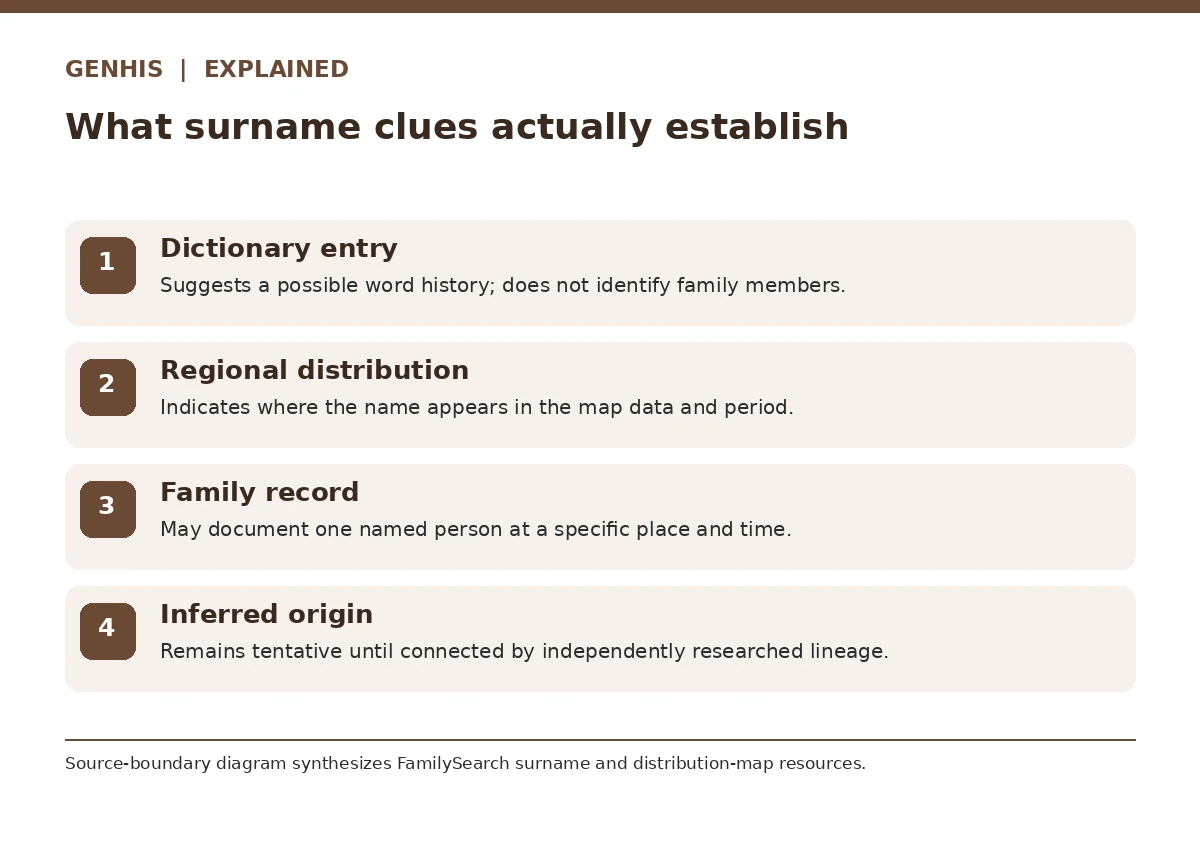
A surname dictionary may propose an occupational, geographical, descriptive, patronymic, matronymic, or other naming explanation. That is a statement about a form of a word in a relevant naming tradition, not a statement about every unrelated family now carrying it. A common spelling may have arisen more than once. Different languages can also produce similar sounds by unrelated routes. Your first task is therefore two-part: record a candidate linguistic explanation, then separately investigate where an identifiable ancestor actually used the name.
Write the initial question narrowly: “What is the earliest documentary spelling used by my documented line, and where was that spelling recorded?” Avoid “Where did all people named this come from?” unless you are conducting a much larger demographic study. FamilySearch’s surname guidance lists several naming categories and observes that standardized spelling is comparatively recent in many contexts. But local history, the relevant language, and the individual record still determine whether any category is useful for a particular person. A surname’s apparent English meaning, for instance, is not automatically the meaning of a similar-looking name recorded in another language.
Build the first verified spelling sequence
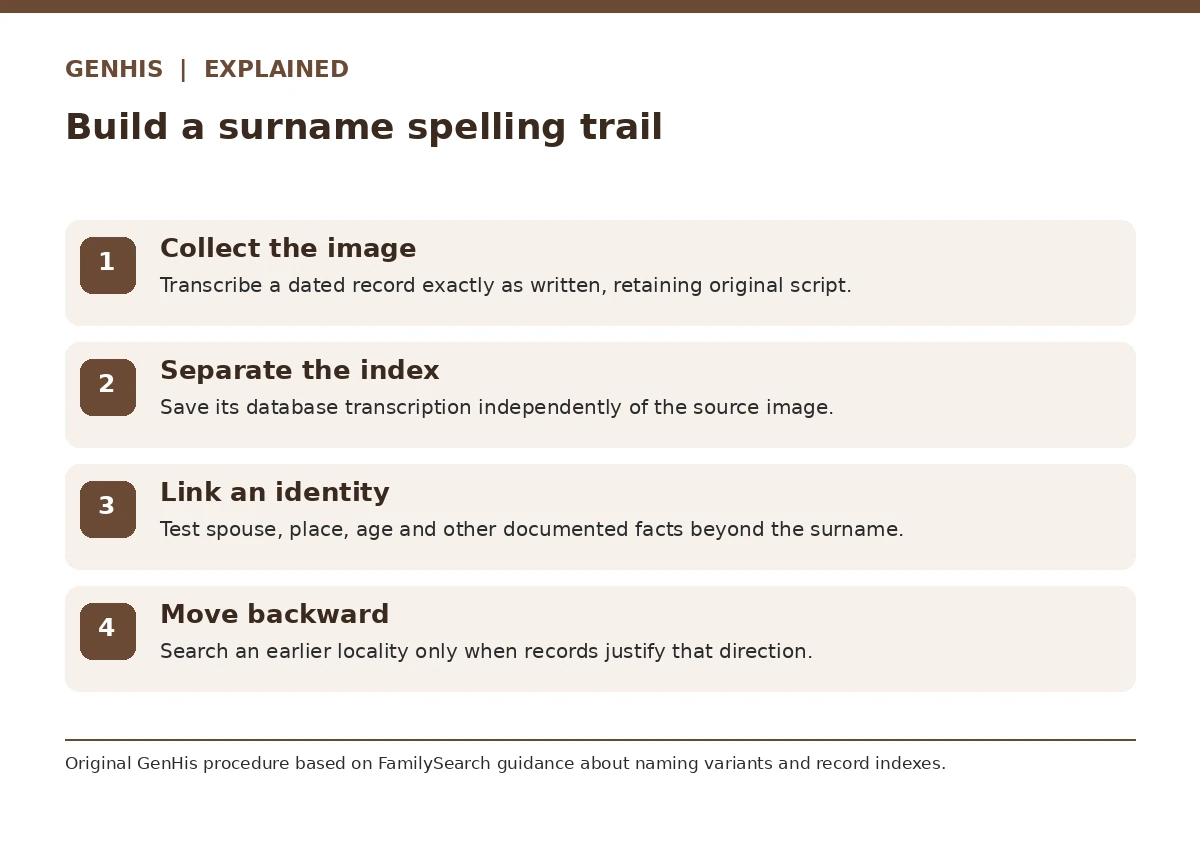
Begin with a deceased or otherwise appropriately documented ancestor whose identity is established through more than a name match. Make a compact table with document date, recorded full name, original script, locality at the time, type of record, and a precise source reference. Add an “index says” column only if it differs from the image. A baptism entry, marriage record, household list, or signed transaction may each record the same person differently. Transcribe the word before silently normalizing its spelling. Note whether it was written by the named person, an official, or a later indexer; those contexts are not equivalent.
For a hypothetical example, imagine a family using the written forms “Marlen,” “Marlenn,” and “Marlin” in successive records. Those invented forms demonstrate how to make a variant list, not a genuine derivation between languages. Record the three spellings, the documents that actually show them, and which other identifiers connect the entries. An exact match in age, spouse, household, location, or occupation may strengthen identification, but each match needs independent scrutiny. If you cannot yet connect the people confidently, keep separate entries rather than collapsing them into a single family line.
Locate the earliest supported place and historical language context
Once the spellings are documented, work backward from the most recent reliable residence to earlier records. Note that a place name may have changed, that administrative boundaries may have shifted, and that the language of a record can differ from the language a family spoke. Use the location and date on the document, not the modern flag on a web map, to decide where to look next. A reported birthplace in a later record may be useful as a clue but should not automatically override a contemporaneous entry.
Locate a credible surname reference for the *specific spelling and region*, then record its entry, publication details, and limitations. If a dictionary proposes multiple alternatives, preserve all plausible interpretations until the family record sequence gives reason to prefer one. A surname distribution map, when it has stated data coverage and a relevant historical period, can suggest where searches might be productive. It cannot identify your ancestral village on its own. A modern concentration may reflect population changes after the period you are studying, and distribution data can omit name bearers entirely.
Test variants rather than assuming an immigration name change
People may be recorded under translated given names, abbreviations, alternate scripts, phonetic renderings, double surnames, or clerical spellings. Test variants derived from *your documents*: one spelling from a marriage entry, a second from a census, an original-script form if available. Avoid speculative transformations with no connection to the place or language. FamilySearch describes original-record errors and separate index errors; a search result therefore cannot always be treated as a faithful transcription of the document.
An unfamiliar spelling beside a passenger entry does not by itself demonstrate that a surname was changed at a particular port or by a particular official. Ask which document first displays the new form and who recorded it. Compare pre-arrival, arrival, and post-arrival documents if such records exist for this individual and jurisdiction. When two documents disagree, spell out whether the discrepancy might be a recording difference, a genuinely adopted name, a different person, or an unresolved uncertainty. Never turn a family legend about a renamed ancestor into a certified historical event without evidence.
Record a defensible surname-origin finding
Prepare a one-page origin note with six labeled fields: earliest verified person, first documented spelling, first supported locality, candidate word meaning with dictionary citation, conflicting spellings, and an evidence-limited conclusion. A usable conclusion might read: “The spelling recorded for the documented family was X by year Y in locality Z; a linguistic reference associates this form with category C, but the family’s adoption of the name before that date is unknown.” The placeholders are instructions for a real researcher to complete, not invented archival findings.
An answer can remain provisional even if the dictionary entry is excellent. If independent branches use the same name, investigate them individually. If a source is indexed but the page cannot be viewed, mark the reading as secondary until a suitable image or authoritative transcription is available. Also, if a name was adopted through marriage, fosterage, enslavement, migration, administrative assignment, or another complex circumstance, a single inherited-father-line model can be actively misleading. Keep the human history distinct from the surface form of the name.

More Research Method Guides
How We Research: check dates, sources and claims
This method combines FamilySearch’s explanations of surname categories with its guidance on searching spelling variants and inspecting images rather than trusting search indexes. We did not search an individual family’s records and do not claim an exhaustive distribution map or an authenticated etymology for any sample spelling. Record availability varies by jurisdiction, religion, era, and institution; check each collection’s actual scope before drawing conclusions from a missing entry. Use the independent source links below to audit the general methods. Read our affiliate disclosure. No paid ancestry service or affiliate relationship is recommended in this guide.
FamilySearch: What's in a Surname? — FamilySearch describes surname-type categories, variation in spelling and differing traditions of name transmission.
Also, FamilySearch surname distribution maps — FamilySearch describes surname-distribution maps as research leads, not identified birthplaces for specific ancestors.
FamilySearch indexing errors — FamilySearch distinguishes errors in the image of a record from errors in its searchable index.
FamilySearch historical name variations — FamilySearch documents historical naming variation in church and other records, and cautions about establishing identity.
Frequently Asked Questions
It may propose linguistic associations, but a documented ancestral place requires records linking identified people to that location.
Treat the map as a lead and verify its dates, geographic scope and sampling before linking its patterns to a family.
Record each image spelling and reference with its date, then test identity using additional contextual details.
No. A change must be demonstrated by comparing actual prearrival and later records, not presumed from a different spelling.
No. Name forms alone cannot establish ancestry, ethnicity, biological descent or family identity.