
A family tree organizes relationships; a family tree timeline tests whether the events attached to those relationships can reasonably belong to the same people. By placing each sourced event in chronological order, you can spot implausible sequences, conflicting residences and record gaps that a pedigree chart conceals. This guide builds a working timeline with date precision, locality, source references and explicit uncertainty, rather than an attractive but unsupported biography. The demonstration below uses fictional individuals and invented example dates, not historical archival discoveries.
Choose one person and a question before collecting events
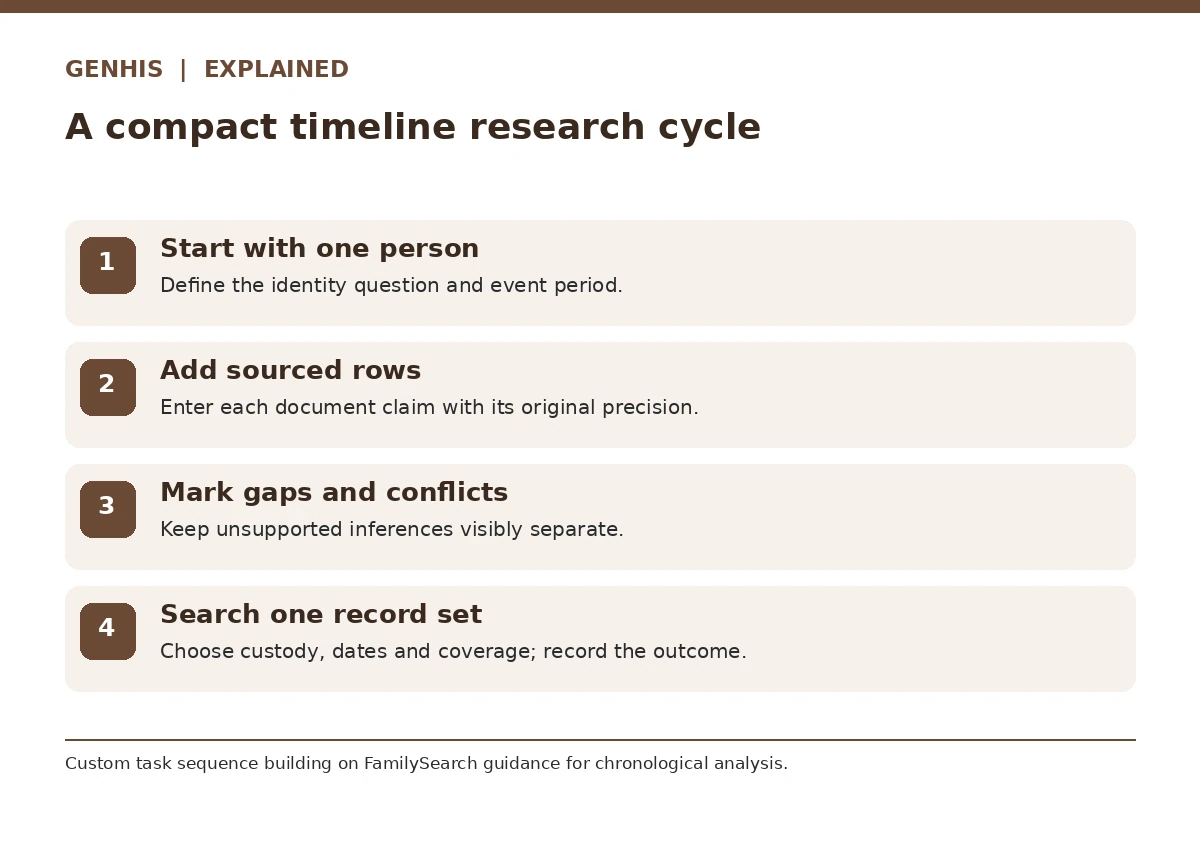
Begin with a single, researchable question: “Are these two household records about the same deceased person?” or “Where did the family live between two documented events?” A timeline that mixes every descendant, contemporary history and unsourced anecdotes may be visually impressive but impossible to audit. Choose the period you can investigate and a distinct subject identifier in your research notes. If two people share the same name, maintain separate candidate timelines until evidence connects them. Do not merge them merely because a web tree contains a matching spouse.
Add a row for each record-supported event rather than one vague sentence per decade. Essential columns are date as written, standardized sortable date, event, location as recorded, current place identification if verified, person or household, exact source citation, information type, and confidence or dispute note. A spreadsheet works; so does paper or a document. Recording the words of the source matters because a census age, for example, may yield only an approximate birth year rather than an exact birthday. Keep the approximation visible even after sorting the rows.
Sort dates without hiding uncertainty
A year-only event should remain year-only; do not convert “about 1880” into “January 1, 1880” just because software insists on a machine-readable field. Preserve “before,” “after,” “between,” and qualified ranges in a display column. Use a separate hidden or clearly labeled sort key if necessary, and never present the sort key as a claimed historical date. Likewise, distinguish the date a document was created from the date of the event it describes. A delayed certificate may have two relevant dates, and both can be useful in a source-aware timeline.
For illustration, suppose a fictional family appears in an imagined 1892 residence record in Town A, a 1897 marriage record in Town B, and a 1905 household record back in Town A. The entries establish what those hypothetical documents say, not continuous residence throughout the gaps. You must not invent a 1900 move to explain the sequence. A geographic difference creates a question: are these the same people, does the record use a historical locality name, or has an indexed place been read incorrectly? Record these alternatives instead of choosing a dramatic migration story.

Capture source quality beside the event, not afterward
Assign every event a retrievable source pointer: repository or website, collection, creator when known, item or page, image number if applicable, and access information. If a fact is only from an unsourced online tree, identify it as a research lead rather than a proved timeline event. When a source provides conflicting details, keep both entries and explain their source contexts. A direct record of a marriage and a late family recollection of the marriage year can disagree without either being deliberately misleading.
Be cautious when judging informant knowledge: an official document can contain information reported by someone who did not witness the event. A historical index is a finding aid, not necessarily the same thing as the original record. Mark missing images explicitly. A well-built timeline can show that a familiar record is derivative of another record, reducing accidental double counting. Label the source’s coverage limits before concluding that the absence of an entry proves a person had left an area.
Use the timeline to find the next answerable question
Highlight contradictions or unsupported jumps only after you have entered the available evidence. If the same proposed person seems to appear in two incompatible places or with conflicting relatives, investigate identity before adding a travel explanation. If a woman’s recorded surname changes, search for a relevant marriage or legal or customary naming context rather than assuming a particular cause. Also, if birth years differ across records, list the dates with their informant details and decide which document types could distinguish two candidates.

FamilySearch has described timelines as a research tool for re-evaluating facts, identifying additional sources and discovering connections; its current help also explains the timeline and optional map on a person page. You can build an independent spreadsheet even if a tree platform offers an automatic timeline. An automatic display inherits the underlying tree’s errors. A source audit provides the additional value: readers can tell which entries are documented and which are inferred. The result is a research instrument, not merely a family-history illustration. Our guide “Genealogical Proof Standard Checklist to Audit One Family Claim” adds more detail on this.
Turn an event gap into a targeted record search
Choose one gap in the sequence, then name the record type and jurisdiction most likely to test it. A missing interval between two residences could suggest checking relevant tax, land, directory, voting, parish, or other local series where such records exist; availability is not universal. Check the record creator, earliest surviving volume, access restrictions and archival custody before reporting that a search came up empty. Define what a positive result would actually establish, such as residence on a specific date rather than an unbroken decade of residence.
Update the timeline after every search, including negative results only when you know what collection and years were searched. Record the search date, database or archive, query or call number, and coverage limitations in a separate research log. The timeline records events and their evidence; the research log records your attempts to find them. These two outputs complement each other but should not be mixed into a confusing table. This distinction prevents a generic “searched archives” note from masquerading as a sourced life event.
Publish a readable chronology without overstating facts
For a shareable version, show five or six important sourced events in order, use an approximate-date symbol when appropriate, and provide citations beside each entry. Add a separate section for disputed events and unresolved identity questions. If you include historical contextual events, explain why they might affect the family’s records and avoid claiming a person personally experienced an event without evidence. Where local borders and place names changed, label time-specific jurisdictions rather than silently applying today’s map. For the fuller picture, see our guide “Genealogy Place Names”.
A working timeline is never the final verdict. Newly found records may split a supposed person’s history into two people or connect two partial sequences. Keep prior versions and explain revisions. Protect living relatives by limiting public personal information and using consent where appropriate. A responsible chronology leaves a reader able to reconstruct what the records say, what you have inferred from them and what no source yet establishes.
More Research Method Guides
How We Research: timeline technique and constraints
The method was checked against FamilySearch’s dedicated discussion of research timelines and its timeline/map help documentation. Our evidence columns, gap-analysis questions and fictional Town A/Town B example are original editorial teaching tools, not platform features or real archival data. Always confirm actual collection coverage for the relevant place and era. The reference links follow, together with our affiliate disclosure; no affiliate product is recommended.
FamilySearch on genealogical timelines — FamilySearch discusses chronological tables as a method for identifying conflicting evidence, gaps and research leads.
FamilySearch timeline and map help — FamilySearch explains the person timeline as a dated display of life events and source hints with optional mapping.
Also, FamilySearch historical record search tips — FamilySearch recommends spelling variants and inspection of original record images when available.
Include exact date wording, sortable date if needed, event, historical place, source pointer, evidence assessment and unresolved questions.
No. Preserve the original approximation and distinguish any administrative sorting date from a historical claim.
Keep both with citations, compare informant knowledge and identity details, and document what is still disputed.
Some platforms can display one, but the result depends on the quality of the events and sources already attached.
Not necessarily. Check which records were created, survive and are accessible before drawing a conclusion.