
“Cousin once removed” means that two cousins sit one generation apart in their paths back to a shared ancestor. It does not mean a distant cousin, someone removed from a family, an adopted relative, or a person who lives far away. The word “once” counts generations; the first, second, or third before “cousin” describes how far back their shared ancestral relationship begins. This guide starts with the everyday first-cousin example so you can decode the term without memorizing a large chart. If you need a broader relationship grid, use the separate cousin-chart guide; the focus here is the phrase “once removed.”
Start with two first cousins of the same generation
Imagine siblings Clara and Owen, the children of one fictional grandparent couple. Clara’s child Maya and Owen’s child Theo are first cousins: each is a grandchild of the same ancestral couple. That is two parent-child links from each cousin to the shared grandparents. The count describes relationships through the pedigree, not the ages of Maya and Theo. First cousins may be far apart in age if their parents had children at different times; no “removed” label is needed merely because of an age difference.
Now imagine Maya has a child, Eli. Theo and Eli share that ancestral grandparent couple, but Theo is two generations below the couple and Eli is three. Theo is Eli’s first cousin once removed. The same relationship works in the other direction: Eli is Theo’s first cousin once removed. Saying someone is “once removed” is symmetric; it does not indicate which person is older. FamilySearch’s cousin guidance explicitly explains that the removal count is the generational difference between the two branches.
Count from the same shared ancestor on both branches
Write the verified common ancestor or ancestral couple at the top of a blank page. Trace one parent-child link at a time to Cousin A, and then a separate series to Cousin B. Count each path independently, including adopted or step links only if your intended label explicitly accounts for those family relationships; do not silently treat a social or legal link as biological proof. For the basic conventional bloodline chart, two steps versus three steps yields first cousins once removed. Three versus four yields second cousins once removed, which requires a different explanation and different common ancestors.
The smaller of two *qualifying cousin* distances sets the cousin number, and their absolute difference sets removals: for distances 2 and 3, the calculation is first cousin, once removed. This shortcut applies when each descendant lies at least two generations below the common ancestor. A distance of one corresponds to a child of the ancestor, so an aunt, uncle, niece, nephew, sibling or direct-line description may be more appropriate instead of using cousin arithmetic. A pedigree may have several shared ancestors; evaluate the relevant path rather than forcing one label to cover every connection.

Recognize four familiar once-removed situations
Your parent’s first cousin is your first cousin once removed because your parent and their cousin share grandparents, while you are an additional generation below those ancestors. The child of your first cousin is likewise your first cousin once removed. If your parent has a second cousin, that person is generally your second cousin once removed. The child of your second cousin has the same relationship to you, through the corresponding established branch. These examples assume the usual pedigree structure and a valid shared ancestor on both lines.
The rule works in both directions. If a family member says “that’s your mom’s cousin,” ask which cousin degree the two adults have before labeling your own relationship. “Mom’s cousin” by itself does not distinguish a first cousin from a second or third cousin. Nor does “one generation removed” mean a person is literally your cousin’s parent; the relationship can be reached from either side of the two branches. What matters is tracing both people to the same common ancestors.
See how once removed differs from twice removed
One removal is a difference of one parent-child generation; two removals is a difference of two. Take first cousins: distances 2 and 3 from shared grandparents yield first cousins once removed, while distances 2 and 4 give first cousins twice removed. If you discover that your supposed shared ancestor is actually one generation farther back on both sides, your cousin *degree* may change without changing the *removed* count. That is why labeling from age or from the number of “greats” on only one branch is unreliable.
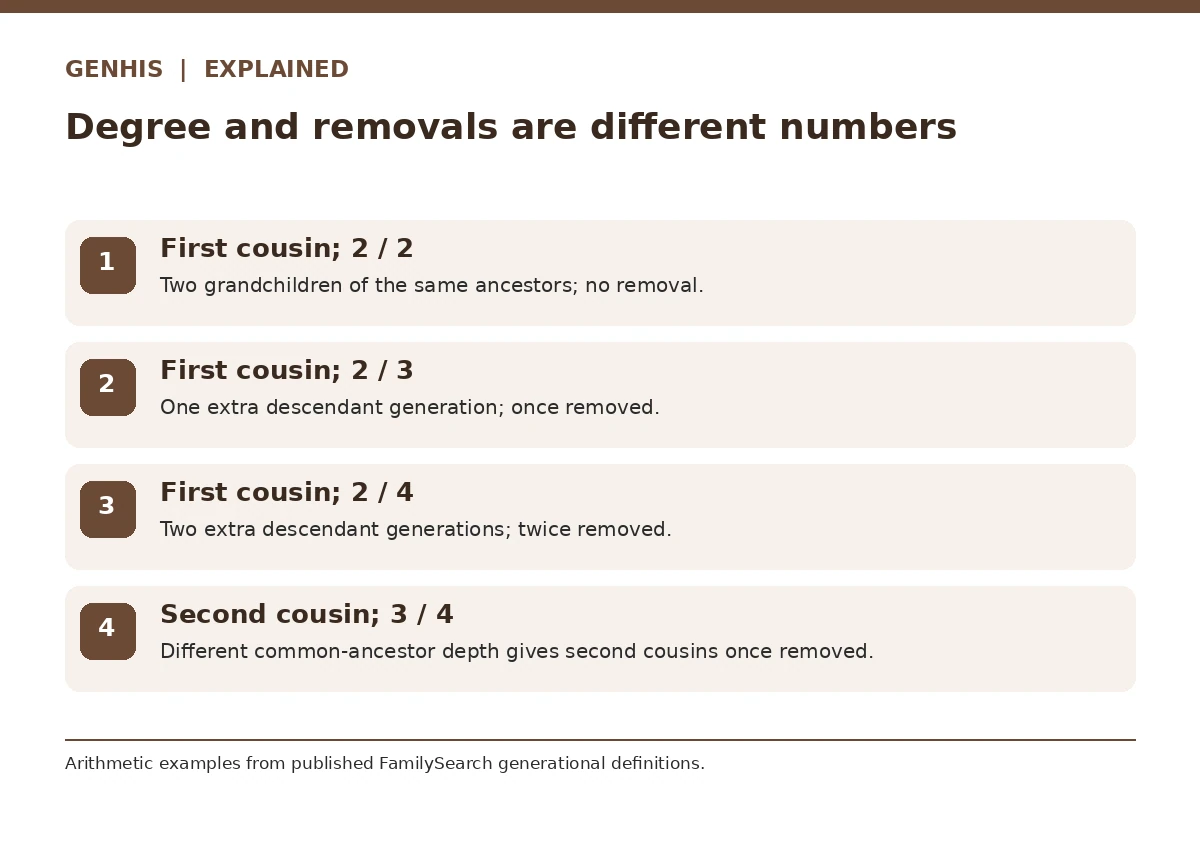
Try a small exercise without names. Person A and Person B connect to the same ancestor by distances 3 and 4. The smaller qualifying distance is three; subtract one to get second cousin. The difference is one; add once removed. Repeat with 4 and 5: third cousins once removed. For 3 and 5: second cousins twice removed. These are exercises in relationship terminology, not demonstrations of historical parentage. To apply them to actual people, establish every generational link with relevant documents first. Our guide “Cousin Relationship Chart” goes into more detail.
Avoid three common relationship-label errors
First, do not calculate removals from age gaps. Two siblings born many years apart may have children whose ages overlap with their aunts and uncles; the kinship term remains about lineage positions. Second, do not turn “first cousin once removed” into “second cousin.” Second cousins are the same generation below great-grandparents on each branch, whereas first cousins once removed have unequal generational distances below grandparents. Third, do not label an online match solely from a proposed tree path that contains unverified parents; display it as an unconfirmed potential relationship if the records are incomplete. Our guide “Second Cousin Once Removed Explained With a 3-vs-4 Family Tree” adds more detail on this.
Keep one small worksheet: shared ancestor, first person’s generational distance, second person’s distance, resulting cousin label, and a citation for each link. For a living person, do not disclose names or inferred parentage without consent. DNA match estimates can point to several possible pedigree connections and do not automatically prove the precise “removed” relationship displayed by a platform. This article teaches conventional chart vocabulary and does not interpret any person’s genetic health or ancestry percentage.

More Research Method Guides
How We Research: definitions, examples and limits
The explanations were checked against FamilySearch’s published cousin chart and its account of first cousins once removed. Our fictional cousins, counts and worksheets are teaching examples rather than archival findings. Relationship words may be used differently in some languages or family traditions. The mathematical shortcut assumes a known shared ancestor and the conventional cousin-generations framework. See the source links below and our affiliate disclosure; this guide has no affiliate product endorsement.
FamilySearch cousin chart and method — FamilySearch supplies conventional English cousin-degree and removal generation calculations.
FamilySearch second cousin explanation — FamilySearch explains how first and second cousins share ancestors and how removed labels show generation differences.
Yes, under the usual shared-grandparent lineage, because your branch is one generation deeper.
No. That person is your first cousin once removed through the documented shared-grandparent line.
No. It means one fewer or additional parent-child step to the same ancestor.
Yes. An age gap is irrelevant; their generation positions in the pedigree determine the label.
When the two paths differ by two generations rather than one, provided both fit cousin chart conventions.