
A genealogy brick wall is a specific unanswered question, not proof that an ancestor left no records. The most productive first move is to state exactly what is missing: an identity, a parental relationship, a residence between two dated appearances, or the origin of a person with a common name. Then audit the evidence you already have and test a new record type or locality. This guide provides a diagnostic worksheet that turns a frustrating repeated search into a limited, falsifiable next step. All sample people and records below are fictional teaching examples, not discoveries about a historical family.
Name the question instead of the obstacle
“Find everything about the Harris family” is too broad to resolve. A workable question is: “Is the L. Harris recorded in the 1880 township enumeration the same person as the L. Harris identified in the 1892 county tax list?” That question suggests specific comparisons: approximate age, household members, occupation, land neighbors, and intermediate records. It also admits a meaningful answer such as “not yet established.” Write the current hypothesis separately from the facts. An indexed name is a search result, not an established identity.
Create a one-page problem statement with four fields: known facts supported by citations, uncertain assertions, a target relationship or event, and the smallest record that could change your conclusion. A place name without its date is incomplete: boundaries and jurisdictions may have changed. A family story may suggest a route to test but should not dictate the answer. If your only evidence is a copied online tree, the first problem is source verification, not the next generation.
Diagnose which kind of wall you face
Different obstacles demand different responses. A person may be present under a spelling variant, absent from an incomplete collection, confused with a namesake, or recorded under a jurisdiction that no longer has the same boundaries. A relationship can remain unproven even when individual life events are well documented. Distinguish “no matching result in this search box” from “a particular surviving, relevant record set was examined without the expected entry.” The second statement is more informative, but still requires a reason to expect the entry.

Before searching again, note exactly which website, collection, date coverage, geographic scope, spelling filters, and image access you used. Search interfaces often emphasize indexed content and may not reveal all browse-only or unindexed material. If you know the record-creating authority, investigate whether records could have been created, where they were preserved, and where a modern catalogue says they are held. Do not assume a courthouse fire, missing census, or catalog gap without a documented source for that specific place and time. Our walkthrough on how to find an ancestor in records without mistaking a namesake sets out each step.
Rebuild a timeline with source-by-source gaps
Line up each independently documented appearance in chronological order. A useful table has columns for date, place as written, record type, exact statement, informant, citation, and confidence. Place an explicit question mark in gaps rather than interpolating moves or births. Two records five years apart do not by themselves establish that every intervening event occurred in the same county. Note when a document was created later than the event it describes; a delayed account may contain valuable clues but also secondhand details.
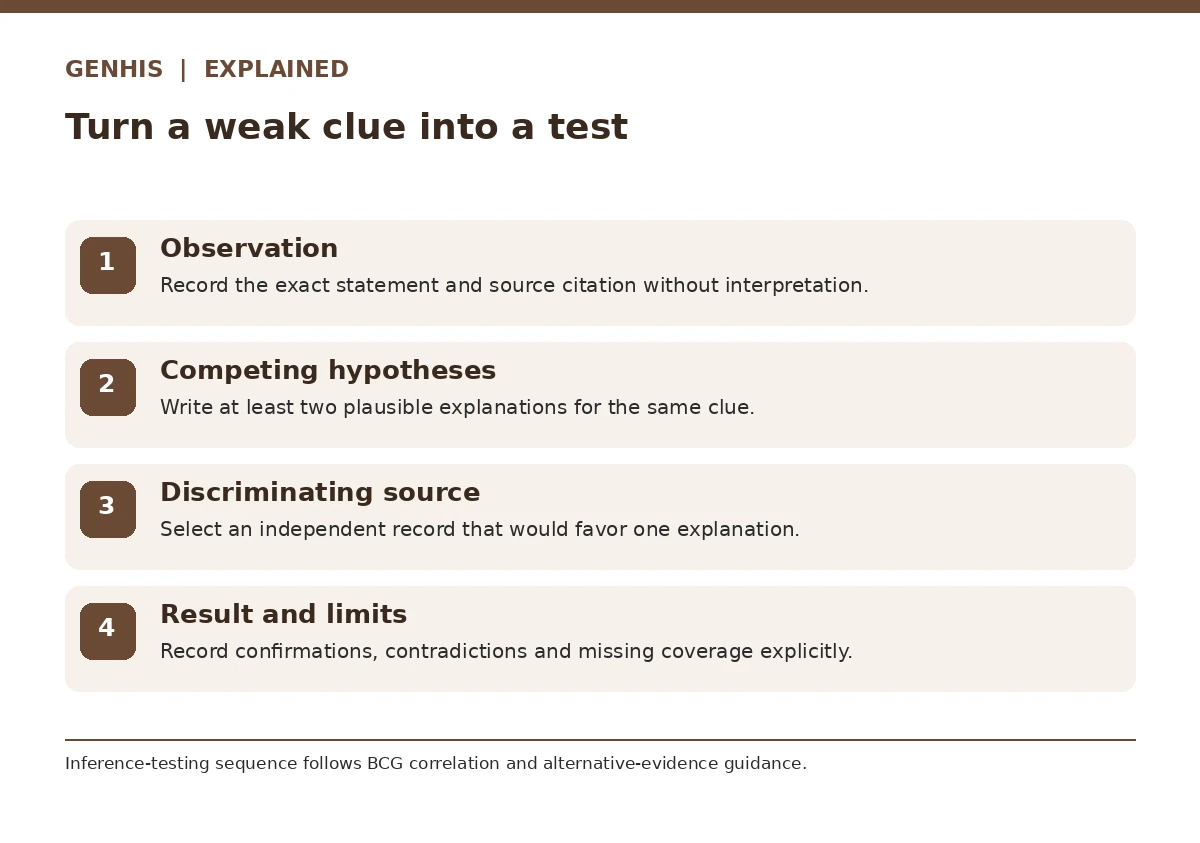
For a fictional L. Harris, imagine an 1880 index describing a farm household and an 1892 tax entry with only an initial. A surname match is weak. A matching land parcel description, linked associate, or consistent household may supply a stronger test. Conversely, a contradictory residence or a separate same-name household can support a competing hypothesis. Put both explanations into the timeline rather than hiding the less convenient one. BCG’s standards emphasize correlating evidence and resolving contradictions before presenting a firm conclusion.
Expand sideways without asserting kinship
When the direct line stalls, examine documented siblings, spouses, witnesses, neighbors, employers, and people repeatedly appearing with the subject. A neighboring household in a census is not automatically a relative, and an estate witness is not automatically a child. These people provide independent routes into other records: land transfers, tax lists, probate files, congregational registers, and local directories. Keep relationship labels neutral until the primary documents specify them or multiple independent clues justify a hypothesis.
For every associated person, record the exact link and its evidence: “next household in this enumeration,” “witness named in this deed,” or “listed as surety on this dated document.” Then investigate whether that associate can be traced through the same migration window. An associate’s clear location might reveal a search jurisdiction for your target, but it does not prove they traveled together. The separate FAN guide treats this network method in depth; here it is one branch of a broader brick-wall diagnostic. If that is your next decision, our guide “FAN Club Genealogy” explains how to build a sourced network of historical associates.
Search a new jurisdiction or record class deliberately
Start with the record creator and time period, not an assumed present-day website. Civil birth, marriage, and death registration began at different dates in different jurisdictions; church, court, land, military, immigration, and tax records have their own rules and survival histories. Maps in the National Archives can help identify historic localities and boundaries for U.S. cases, but the mere existence of a map collection does not establish coverage for your person. A catalogue entry may describe material held onsite, elsewhere, or under access restrictions.
Choose one test likely to discriminate between two hypotheses. For instance: if L. Harris moved, a particular land transaction might show the exact location; if two contemporaries shared a name, a sequence of tax lists might separate their parcels. Write an expected finding and an alternative finding before opening the images. This guards against treating every newly found surname as confirmation. Record searches that return no result, together with the limits of the collection, so future work does not repeat the same path.
Decide when a search result is enough
A breakthrough may be small: proving that two namesakes were different people is useful even without identifying either person’s parents. The outcome should be a documented change in the evidence, not merely an expanded tree. Label your status as supported, plausible, contradicted, or unknown, and attach the sources needed to reproduce it. For a significant identification or kinship claim, assess research breadth, citation completeness, correlation, conflict resolution, and the written reasoning before declaring the matter settled. For a step-by-step method, see how to Start genealogy research.
A responsible stopping rule is “I have tested the likely sources for this specific place and period, logged their coverage and results, and identified the next evidence gap.” That is not an assertion that all records have been searched. If available evidence cannot distinguish candidates, leave the relationship open. Namesake mistakes propagate quickly when an attractive guess becomes a parent-child link in a public tree.

A forty-minute rescue session you can repeat
Spend ten minutes rewriting the research question and identifying the strongest two existing citations. Spend ten more checking the geographic and chronological coverage of a collection you previously treated as comprehensive. Use the third ten minutes to compare one independent record class or associated individual. Finish by writing a dated log entry with what you learned, what remains unknown, and one next test. This time-box is a workflow aid, not a guarantee that a family mystery will resolve in one sitting. Our walkthrough on how to build a family tree timeline that reveals research gaps sets out each step.
If collaboration might help, share only the historical question, already-public record citations, jurisdictions, and precisely what has been tried. Avoid sharing living people’s personal data, private family communications, or unverified allegations. Community suggestions can generate hypotheses, but other researchers’ copied trees are not new independent evidence. The best ending to a difficult session is a cleaner question and a reproducible source trail. For the fuller picture, see our guide “Genealogy Research Plan Template for Testing One Family History Question”.
More Research Method Guides
How We Research and disclose limitations
This practical workflow synthesizes the Board for Certification of Genealogists’ research and evidence standards, FamilySearch’s brick-wall strategies, and the National Archives’ explanation of maps relevant to historic boundaries. The fictional Harris example illustrates decisions without representing an actual case or fabricated archive results. Record creation, custody, digitization, availability, and access differ by jurisdiction; check the relevant custodian before ordering or relying on a supposed absence. We have not verified any family’s ancestry through this article. See the site’s affiliate disclosure; no paid referral or affiliate relationship is claimed in these examples.
BCG Ethics and Standards — The BCG states the five elements of the Genealogical Proof Standard, including conflict resolution and reasoned written conclusions.
FamilySearch Brick-Wall Guidance — FamilySearch describes extending research to family and other records when familiar direct-line searches stall.
FamilySearch Relationship Verification — FamilySearch cautions about same-name confusion, contradictions and connecting proposed relatives through source evidence.
NARA Genealogy Maps — The National Archives describes maps that can document historical locality names, changing jurisdictions and selected named residents.
It is an unanswered family-history question where familiar searches have stopped producing useful, verifiable evidence; it is not proof that all records are missing.
Only when new collections have relevant coverage. First check the current sources, search limits, spelling variants and what specific evidence could resolve the question.
No. The record may be unindexed, incomplete, differently spelled, absent or held elsewhere. Evaluate record creation and coverage before reasoning from absence.
A documented neighbor provides a lead, not proof. Trace both people with independently sourced records and consider same-name alternatives.
Pause when likely surviving sources have been documented and the next discriminating test is identified; leave uncertain links explicitly unresolved.