
To find an ancestor in historical records, first define the identity you are trying to establish. A search hit with a matching name is a candidate, not a confirmed family member. Compare at least the relevant event date, location, household or relationships, and other identifying clues. If two people remain possible, hold both hypotheses open and search for a document that could distinguish them. This guide focuses on the decision that occurs after a name search: is this actually the right person?
The National Archives and FamilySearch both emphasize names, dates, places, and relationships as identifying clues. Their advice does not create a universal scoring formula, because records differ in how accurately they captured information. The practical scorecard below is a transparent thinking tool: it helps you state why you accepted or rejected a match. It does not assign mathematical certainty or replace reading the original source.
Define the Target Before Opening Search Results
Write a target profile from already supported information, not from the search results you hope will be correct. Include every documented name form, an estimated time window, last known locality, and relatives independently associated with the person. For each entry record which source supplied it and whether that source directly establishes the detail. A birth year from family memory may be useful, but it should not automatically outweigh a dated register; conversely, official-looking documents can also reflect misunderstandings or delayed reporting.
Choose one identity question: for example, “Is the person listed in this census the same person as the deceased relative named in a family-held marriage certificate?” That wording makes the match testable. It also prevents an easy mistake: using information copied from an online candidate profile to “confirm” the very same candidate. Independent clues must come from sources whose provenance you understand, and a copied description is not an additional piece of evidence.
Run a Search Wide Enough to Find Alternatives
Begin with a surname or justified variant, approximate date, and a place that makes sense for the person’s life. FamilySearch recommends not overconstraining a first search; too many guessed fields can hide useful candidates. If there are hundreds of hits, add a distinguishing relative, event, or locality. If there are none, remove a speculative constraint, try another spelling, or search a different collection. Keep track of each alteration so the lack of a result is not mistaken for a comprehensive negative search.
Check whether the website searched a full record image, an indexed transcript, or a compiled family tree. A searchable index may not contain every surviving item in a collection. Some records can be browsed but not found through a general name search. The absence of a result is therefore evidence about the search you conducted, not necessarily about an event or a person’s existence. Record coverage, locality boundaries, languages, and accessibility all affect the strategy.
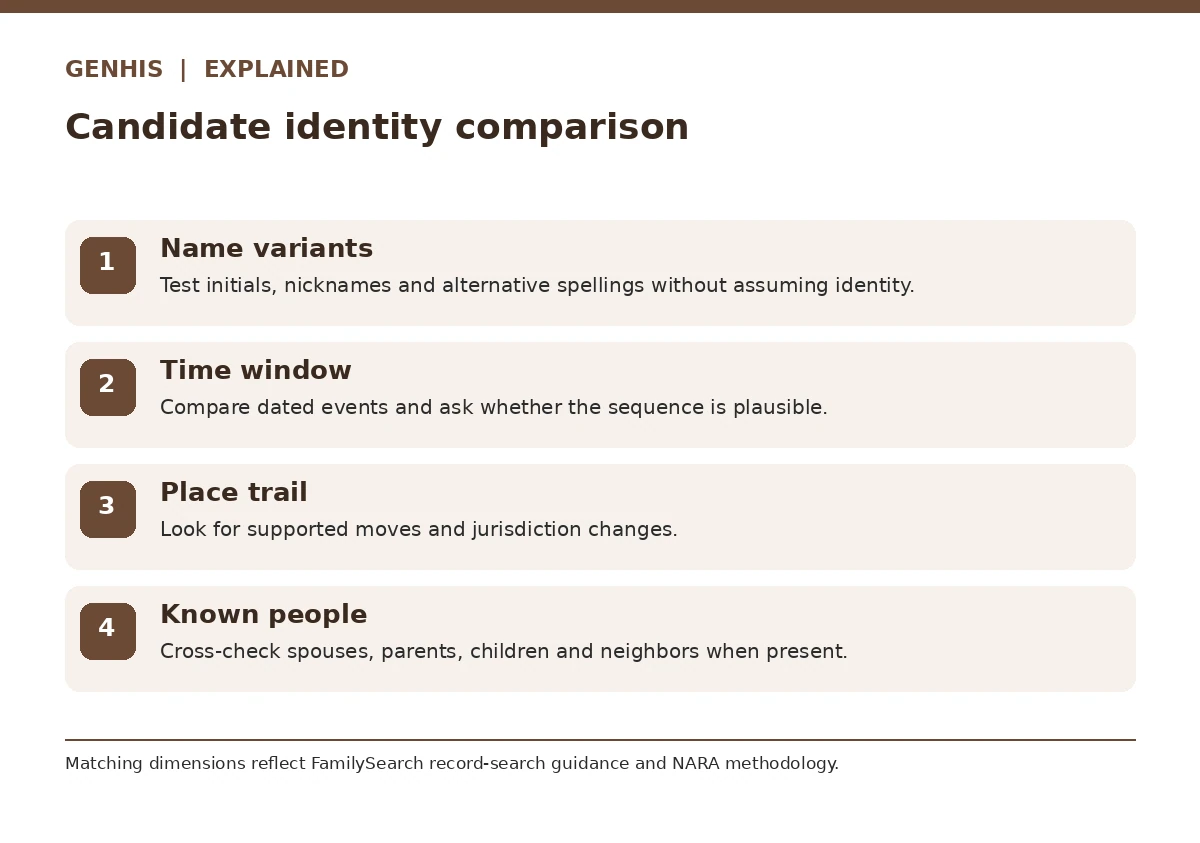
Compare Candidates Across Independent Details
Make a separate row for each possible individual. Check whether the person’s observed age fits the event window, whether documented place changes are plausible, and whether named relatives are consistent with known evidence. Look for relationships stated within the record, not assumed from the order of names. One candidate may share the full name yet live in a different household; another may use an abbreviated name but appear beside a supported spouse. A perfect spelling match should not outweigh strong contradictory context.
Evaluate conflicts instead of averaging them away. Ages may be estimates, names may be altered in transcription, and a record’s informant might not have known every fact. Ask who created the record, when, for what purpose, and whether the relevant field reflects first-hand knowledge. If a contradiction concerns a core relationship rather than a minor spelling difference, do not attach the record until an independent source addresses it. The correct conclusion may simply be that identity remains unresolved.
Follow a Worked Namesake Example Without Making a Claim
Imagine two fictional candidates named “Anna Hale,” both appearing in search results for a hypothetical locality. Candidate A has an approximate birth period consistent with the known relative, but the household contains no independently known associates. Candidate B has a less precise recorded age yet names a spouse consistent with a separate, properly documented marriage record. Neither is automatically proven. The next step is to inspect the original records and determine how those relationships were recorded.
A useful comparison note reads: “Candidate B is presently stronger because two independent details fit, but the spouse match has not been checked in the underlying image; Candidate A remains unexcluded.” This example uses no real person, alleged relationship, census entry, or invented archive holding. Its purpose is to show how to write a defensible hypothesis and select a further test. Find a record that supplies a new distinguishing clue rather than repeatedly rechecking the same secondary tree.
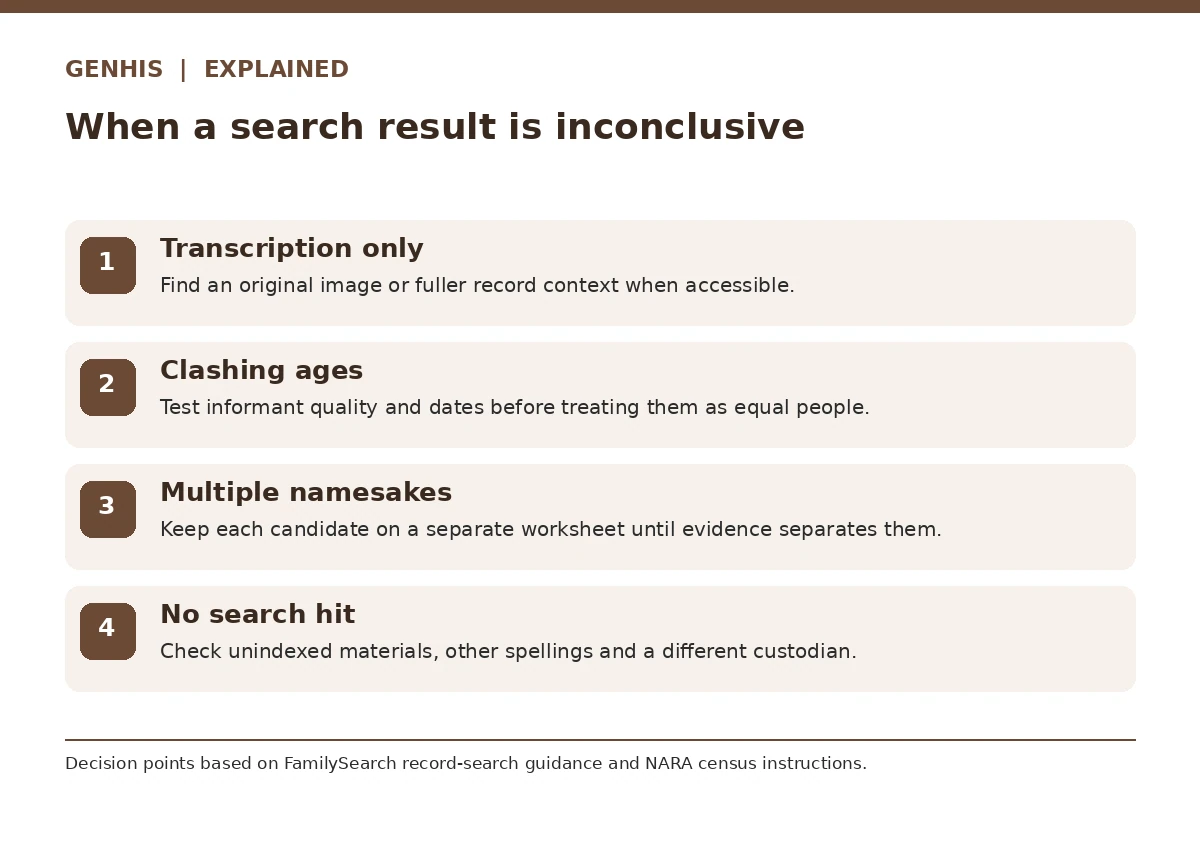
Read the Record, Not Just the Matching Result
Whenever possible, inspect the document image, associated pages, headings, annotations, and collection description. A transcription may omit context, misread handwriting, or standardize a place. A neighboring household, a certificate’s witnesses, or a note on the reverse may matter—but do not claim such fields are present unless you actually see them in that record. Capture the image reference and the source citation, then quote only the information you used for your conclusion.
For U.S. federal census research, the National Archives describes beginning with the most recent publicly available census and working backward. That is a useful direction of travel, not proof that every person will appear in every decade or that all census questions remained constant. If the target was in another country, identify the relevant national or local census or substitute. Jurisdiction-specific research matters more than treating a generic “census search” button as complete coverage.
When Records Disagree, Build a Resolution Plan
List every conflict in plain words: different birthplaces, incompatible dates, two spouses, or a place that would require an unexplained move. Rank the sources based on when the data was recorded, who could know it, whether the item is original or derivative, and whether it independently addresses the question. Seek a different record type created for a different purpose when possible. A second website displaying the same transcribed item is not an independent confirmation.
For a missing result, log exactly what was searched: collection title, period, location, spelling variants, filters, date, and whether only indexed names were searched. Next inspect catalog coverage or browse images if offered. A local archive, civil registrar, library, or religious repository may hold the relevant material outside the federal system. Do not infer that a missing online entry means the original was destroyed or that a person changed their identity.
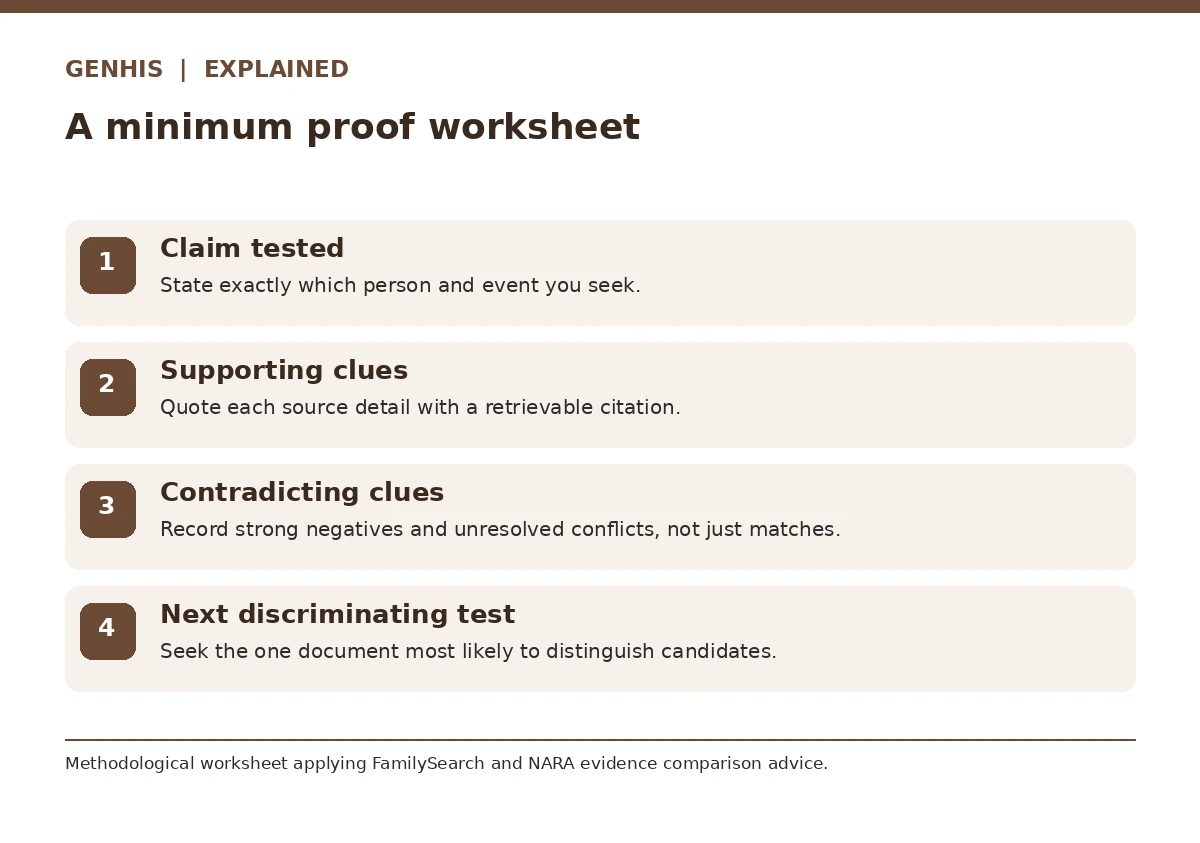
Write a Conclusion Other Researchers Can Audit
Use three explicitly separated lines: “The source states…,” “I infer… because…,” and “Still unknown….” Attach a full enough citation to locate each supporting document. If the conclusion is provisional, say what alternative candidate remains plausible. Keep private living-person details out of shared notes unless permission and appropriate controls exist. This is particularly important when a search unexpectedly points toward modern relatives rather than the deceased ancestor you set out to identify.
Finding an ancestor is not a race to add another generation. The meaningful result is a justified identification that can survive another person’s questions. If you cannot distinguish the remaining candidates, preserve them both on separate worksheets and stop short of a parent-child claim. The next useful action is the discriminating record identified in your log, not one more unsourced tree suggestion.
How We Research and What These Sources Establish
Our examples are deliberately fictional teaching cases, not identified historical people. We distinguish what a source reports from a reasonable hypothesis and what is unknown. This guide is informational, not a determination of family identity. Links below lead to the custodians or authors of the methods described; source availability and site interfaces can change. No paid partner relationship is asserted. See the affiliate disclosure policy (verified on GenHis on October 19, 2026).
Familysearch.Org: Fs Records — FamilySearch gives targeted indexed-record search guidance and cautions that some online material is not indexed.
Archives.Gov: Nara Census — NARA explains available federal decennial census schedules and searching backward from the most recent available census.
Archives.Gov: Nara Begin — NARA explains starting from known relatives and looking for names, dates, places, relationships and multiple local repositories.
Ask.Loc.Gov: Loc Start — Library of Congress advises beginning with known family, interviewing relatives, gathering family papers, and independently checking published trees.
No. Compare time, place, household, relationships, and alternative candidates, and inspect the record image where available.
Keep both reported years with citations and ask who supplied the information, when it was recorded, and what other details agree.
Names can vary in spelling, translation, transcription, and everyday usage. Try justified variants without automatically merging people.
Only within the specific collection, date span, search method, and indexing limitations you actually examined.
Once the evidence supports a defensible identity match and you can explain how the source relates to the person, including unresolved conflicts.