
Genealogy research begins with a small, answerable question, not a search for every person who shares your surname. Write down one known relative, the place and period where a particular event probably occurred, and what you want to establish. Gather documents already in the family, ask for permission to consult them, and record where each statement came from. The first successful session should end with a cited finding or a documented unresolved question—not an impressive-looking but unsupported tree.
This guide is a beginner’s first-session workflow. If your main problem is distinguishing two people with the same name, use an identity-comparison method instead. If you have discovered a large online pedigree, investigate the evidence behind that tree separately. The U.S. examples here illustrate a transferable method; archives, record access, and legal jurisdictions differ by country, region, and historical period.
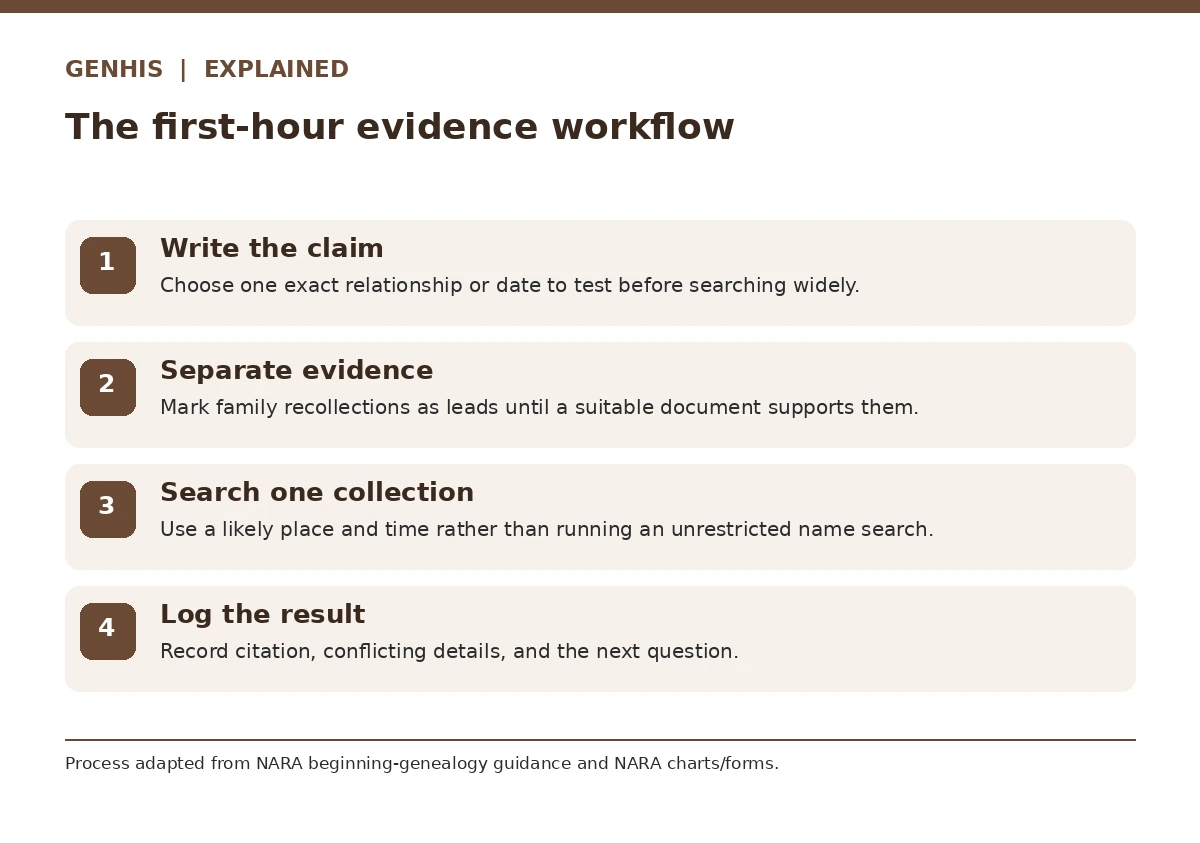
Choose One Question You Can Actually Test
An expansive question such as “Where did my family come from?” has no clear finish line. A more useful version is “Which record identifies the parents of my deceased great-grandmother?” Another option is “Which town was my grandfather living in when he married?” Note the name as currently known, approximate event period, any plausible location, and which details are uncertain. A research question identifies what information would change your conclusion and gives you a way to decide whether to stop or search somewhere else.
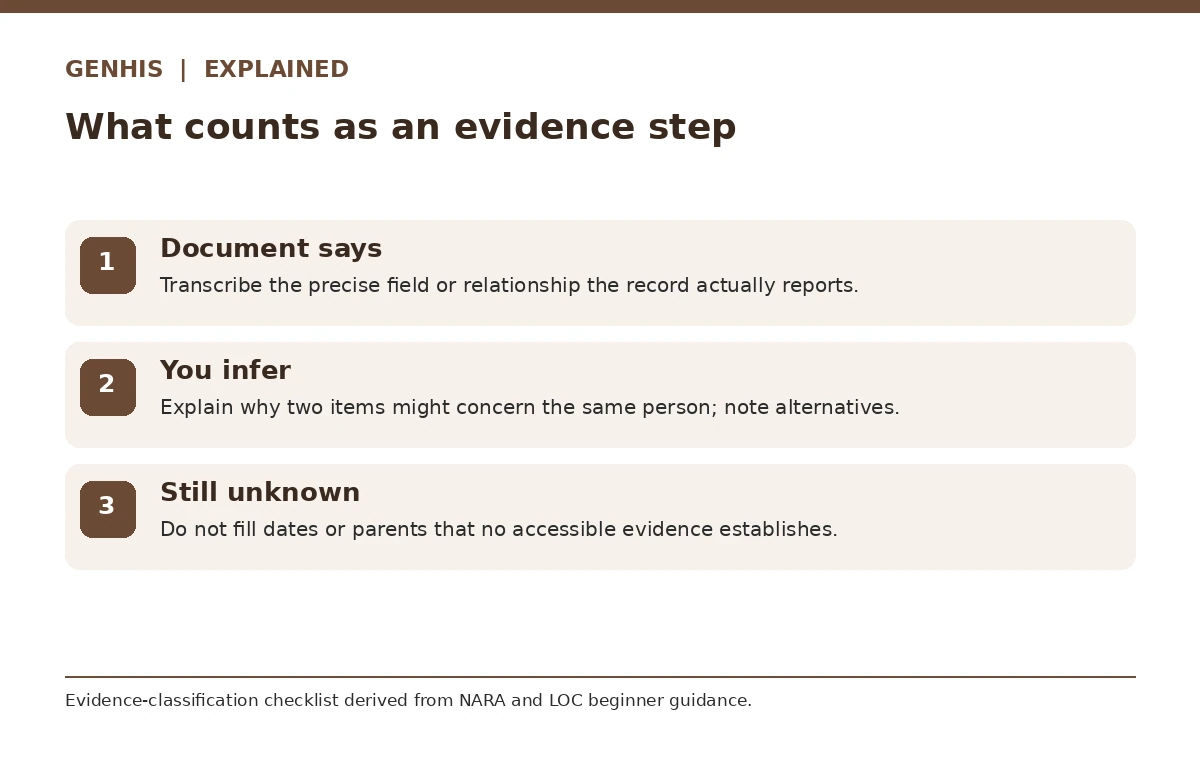
Create three columns headed Known from a document, Recalled or inferred, and Not known. A certificate naming a parent may directly state a relationship; a cousin’s recollection is a clue attributable to a speaker; and a missing birthplace remains unknown. Even documents can contain errors or report secondhand information, so “documented” does not mean “infallible.” Keep the date, creator, provenance, and exact wording of each item whenever you can. This discipline prevents early guesses from silently turning into facts later.
Gather Family Papers Without Losing Their Context
Look first for items with specific provenance: certificates, letters with envelopes, dated photographs, funeral programs, diaries, family registers, and papers kept together by a known person. Ask relatives who has already assembled a family history, but do not assume a compiled document is always correct. Take a clear photo or scan only with permission. Keep a note of who owns the original and whether the item was supplied directly or through someone else. Do not clean, tape, rebind, or otherwise repair fragile historical materials yourself.
Write the original wording before creating a standardized version in your notes. A place printed with a historical spelling or a surname containing an accent may be important for locating another record. Note missing pages or uncertain dates without filling them in. For living relatives, keep private contact details out of publicly shared trees and respect any preference not to be interviewed or identified. The goal at this stage is a dependable collection of leads, not a public family directory.
Follow the Person Backward One Generation at a Time
Start with the closest generation that has a reasonably clear paper trail. Establish a child’s identity, then seek a record that can independently support a parental relationship, and only then research the next generation. This is the backward-from-known method described by the National Archives and Library of Congress. A published pedigree may provide a candidate name, but it does not replace evidence for each connection. Treat several plausible people with the same name as separate candidates while you investigate.
Record names, dates, places, and relationships as four different evidence categories. A census household may help locate people together, but relationships, ages, and spellings must be interpreted according to the particular census and the person who supplied information. Civil registration may be held by a local or state custodian rather than a national archive. For a non-U.S. ancestor, identify the relevant country and period before assuming a U.S. record type or repository will help.
Work a Small Example Without Inventing an Ancestor
Consider this entirely fictional teaching case: a family note says that “M. Rivera married in Oakford around the 1930s.” This is a starting hypothesis, not evidence that a historical M. Rivera existed in that place. First determine who wrote the note and when. Next ask whether Oakford is a precise locality and what jurisdiction issued marriages during the relevant years. Search that custodian’s catalog for available registers or indexes. If two plausible names appear, do not choose the first; compare dates, spouses, and other independently known details.
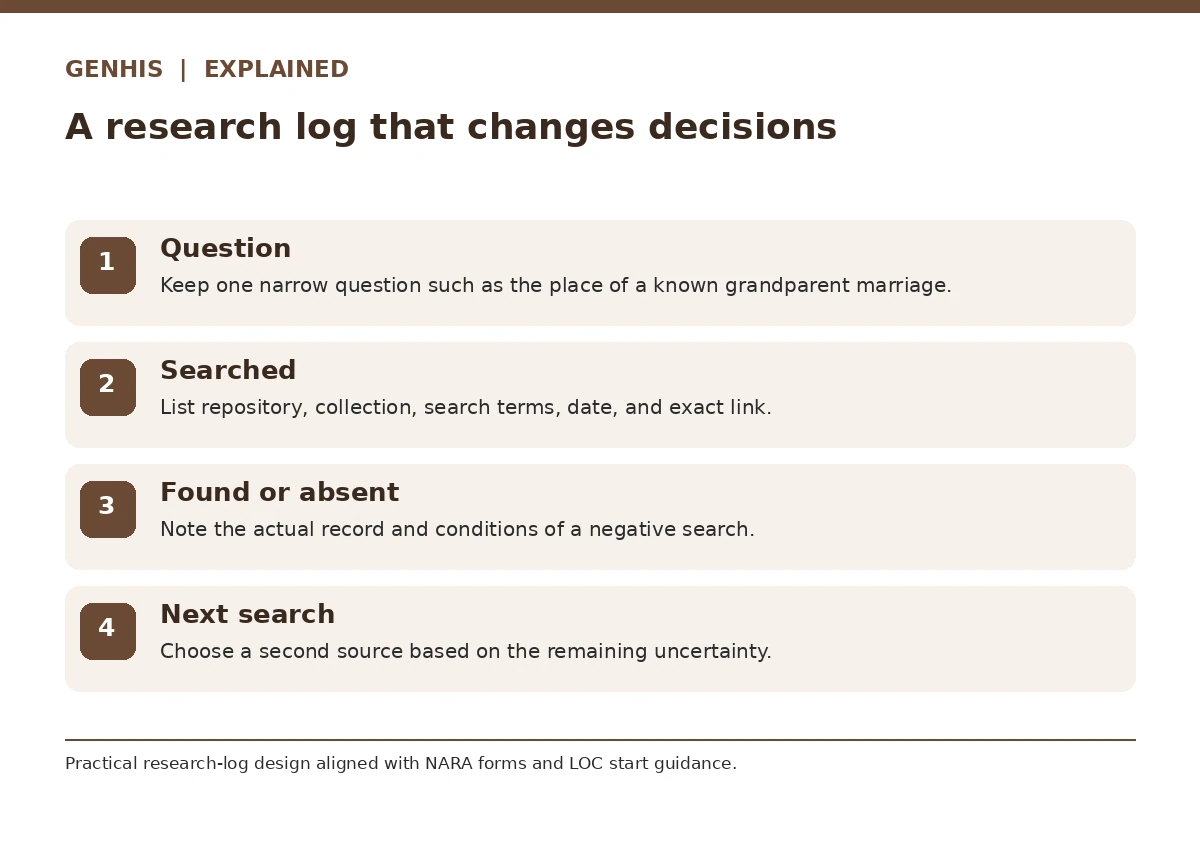
The sample result can be recorded in a four-part log: Claim — an approximate marriage and location; Source sought — the responsible marriage register or index; Result — pending, no original viewed yet; Next step — verify the place and request the correct record if available. A search result labeled “no matches” means only that the specific search failed; it does not establish that the marriage never occurred. Working with invented placeholders is safer than presenting an unverified historical record as a successful discovery.
Keep a Research Log That Can Guide the Next Search
For every attempt, record the date, repository or website, collection title, any date or geographic coverage stated by the custodian, search terms and variants, filters, and result. If you see a record image, note its citation or persistent link and transcribe the fields relevant to your question. If you only see a search-result index, say so. Screenshots of search pages alone may not preserve essential collection context, so capture the actual record reference when possible.
A useful log entry is not merely “searched online, nothing found.” Instead write: “Searched the named collection for two documented surname spellings; checked only indexed entries in a stated place and date range; no candidate consistent with known household details.” That statement makes the limits of your negative result visible. A later researcher can repeat the search, question the filters, or identify a nonindexed volume you never examined. Return to the one question and ask which evidence would most strongly confirm or reject your working answer.
Decide Where to Search Next, Not Just Which Website
A record is created and retained by an institution with a specific jurisdiction. U.S. federal records, state civil registrations, local property books, religious registers, and privately held papers do not live in one comprehensive database. The National Archives explains that it holds major federal series, while many state, county, local, and organizational materials are elsewhere. Identify the event’s place and likely record creator before selecting a search tool. This reduces irrelevant hits and guards against treating database coverage as proof of a person’s absence.
Use catalog descriptions to ask whether the collection covers the locality and period in question; whether images are indexed, browsable, on-site only, or restricted; and which alternate repositories may hold copies. Do not assume a date range, charge, privacy rule, or digitization status simply because another state or website handles similar records differently. If the original series is missing or inaccessible, a newspaper, directory, probate file, cemetery source, or surviving related record may provide a different angle—subject to its own evidentiary limits.
Recognize Four Beginner Errors Before They Spread
The first error is jumping from a shared surname to a relationship. The second is treating an automatically suggested record as proof without opening it. The third is using an unsourced family tree as if it were a certificate. The fourth is silently replacing a conflicting date with the date that fits your preferred story. Instead, preserve all observations, separate primary documents from later compiled assertions, and mark contradictions. If a branch depends on an inference, label it as provisional in both your log and any diagram.
A fifth trap is trying to solve too many ancestors at once. Keep the first project deliberately narrow: one person, one event, one place, and one next document. When you finish, write a two-sentence conclusion stating what the evidence establishes and what is still unknown. This repeatable output is the foundation for later research, whether you use a spreadsheet, paper forms, genealogy software, or the free charts offered by NARA. No particular platform guarantees accuracy; a traceable explanation does.
How We Research and What These Sources Establish
Our examples are deliberately fictional teaching cases, not identified historical people. We distinguish what a source reports from a reasonable hypothesis and what is unknown. This guide is informational, not a determination of family identity. Links below lead to the custodians or authors of the methods described; source availability and site interfaces can change. No paid partner relationship is asserted. See the affiliate disclosure policy (verified on GenHis on October 19, 2026).
Archives.Gov: Nara Begin — NARA explains starting from known relatives and looking for names, dates, places, relationships and multiple local repositories.
Archives.Gov: Nara Forms — NARA provides ancestral charts, family group sheets and census forms for recording findings.
Ask.Loc.Gov: Loc Start — Library of Congress advises beginning with known family, interviewing relatives, gathering family papers, and independently checking published trees.
Familysearch.Org: Fs Records — FamilySearch gives targeted indexed-record search guidance and cautions that some online material is not indexed.
Begin with a document you already possess that names a person and an event; then choose a record that could independently test a single uncertain claim.
Yes. Begin with what you know, ask permission to consult family papers, and record unknown dates as unknown rather than approximating them silently.
A small tree of supported relationships is more useful than many unsourced branches. Each new link should be documented before you move farther back.
Record the spelling shown on each source and compare location, age, household and relationships before deciding two entries refer to one person.
Stop when you can state what you searched, what the record supports, what remains uncertain, and which source is the best next test.