
The Genealogical Proof Standard (GPS) is a five-part test for whether a family-history conclusion has been responsibly researched and explained. The Board for Certification of Genealogists identifies reasonably exhaustive research, complete and accurate citations, analysis and correlation, resolution of conflicting evidence, and a soundly written conclusion. These are connected requirements rather than five points awarded for having five documents. This guide explains what each requirement does and uses a fictional same-name problem to show how the requirements work together. It is not a certification or a determination about any real family.
Begin with a claim that could be wrong
The GPS is most useful when you can write the exact claim under examination. “Mary Lane was the mother of Joseph Lane” is a kinship assertion; “an index contains Joseph Lane” is a source observation. Their proof needs differ dramatically. Make the question specific about people, place, approximate dates, and the proposed relationship. Record other candidates before you become attached to one explanation. The GPS is a method for measuring the credibility of an answer, not a rule that every genealogical note must become a long formal paper.
In our wholly invented example, two adults named Joseph Lane appear in the same general region. One later document gives an approximate birth year; another offers a residence and occupation. Neither item by itself determines which Joseph belongs in a proposed family. The goal is to distinguish identities, not to collect mentions of the name. Each new statement must be evaluated for what it reports, how the informant knew it, and whether it addresses the same individual.
Requirement one: research broadly enough to test alternatives
“Reasonably exhaustive” does not mean searching every database on earth. It means pursuing sources that could reasonably answer the question and accounting for evidence that might contradict your favored claim. A convenient census index can be a useful beginning but may be inadequate where same-name people overlap. Test independent record classes, track alternate spellings, examine geographic neighbors where relevant, and investigate the record-creation context. Describe meaningful negative searches with their coverage so a future reviewer can judge what was actually attempted.

For the Joseph example, a targeted set might include an original census image, a contemporaneous land record, and a relevant civil or religious register, if such records exist and are accessible for that place and period. That is an illustration of source types, not a claim that any particular county has preserved them. A research conclusion can remain unresolved after a responsible search. The standard asks for a defensible scope, not manufactured certainty.
Requirement two: supply citations that permit checking
A citation should identify the actual item used: the document or entry, its container or collection, a locator such as image or page when present, and the custodian or access route. If you viewed a derivative index, cite the index rather than implying you inspected the original register. If a record image is inaccessible, say so. Accurate documentation lets another person relocate the information and determine whether your reading is justified. A list of platform homepages is not equivalent to citations to specific records. For a step-by-step method, see how to cite genealogy sources so anyone can retrace a record.
Consider two researchers who both write “Joseph Lane, 1890.” One has a named ledger and page; the other copied a profile from an unsourced family tree. The strings look similar but are not comparable source trails. The GPS does not magically upgrade derivative information or require decorative punctuation. It does require complete and accurate references to the items used in support of the conclusion.
Requirement three: analyze sources and correlate their claims
Separate three questions: what physical or digital source you used; how well the person supplying a particular statement likely knew it; and what that statement demonstrates about your research question. An original source can contain mistaken information; a document created long after an event can still provide a lead but needs further checks. Direct evidence that answers a question explicitly may be wrong, while several indirect clues can form a persuasive argument when their origin and independence are understood.

Place the Joseph records into a comparison matrix with dates, places, household associations, occupations, and informants. Look for repeated distinctive combinations rather than matching one surname. Ask whether two websites transcribed the same underlying document; those are not necessarily independent corroboration. Correlation means explaining patterns and differences, not tallying how many search results favor the same hypothesis.
Requirement four: investigate significant contradictions
If one record identifies Joseph as living in one county while another apparently places him elsewhere on the same day, possible explanations include two people, a recording error, or different interpretations of the date. Do not silently select the convenient record. Describe the conflict, compare the source and informant contexts, search for evidence that discriminates between possibilities, and explain why the surviving answer is better supported. Some apparent discrepancies, such as minor age variations, may prove inconsequential after analysis; others change the identity conclusion entirely.
Conflicts may remain unresolved. When the contradiction could materially affect parentage or identity, an unqualified assertion is not justified. Mark it open and provide the best next research test. BCG’s examples of proof writing stress that opposing evidence belongs in an argument, not in a hidden drawer. The standard protects against overconfident lineage extension as much as it helps support positive findings.
Requirement five: write reasoning others can follow
The conclusion should directly answer the question at the strength supported by the evidence. A short, source-cited statement may suffice where independent documents agree and no meaningful conflicts exist. More complicated cases may need a proof summary or argument showing the reasoning step by step, explaining rejected alternatives and remaining limitations. BCG distinguishes these writing products and discusses why complex contradictions need explicit analysis. Long prose alone is not proof; a concise, accountable explanation can be stronger than a dramatic family story.
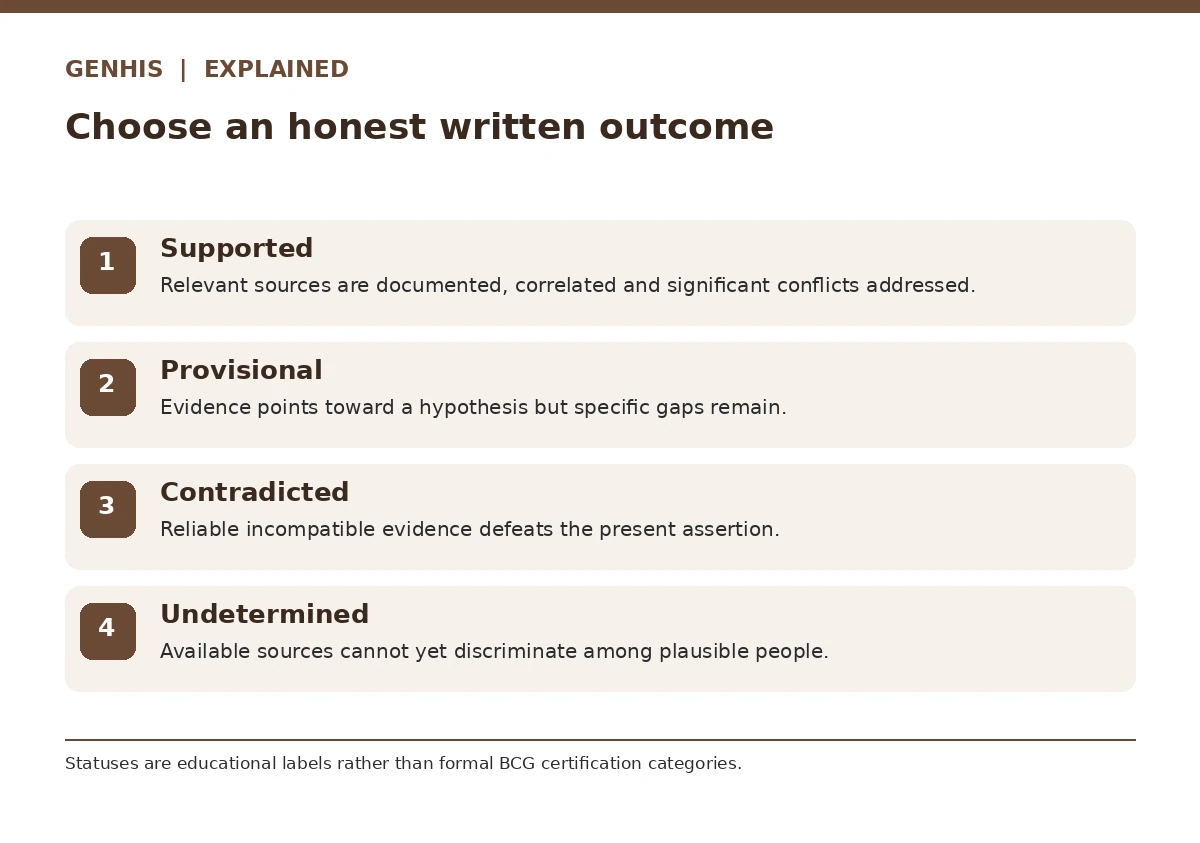
For the invented Joseph case, a responsible write-up might conclude that the records currently distinguish two possible individuals but do not establish which was related to the proposed parent. That is a meaningful research result. It reports what the evidence permits and names the missing link. Saying “probably the right Joseph because the age looks close” without evaluating alternatives would not satisfy the standard.
When the standard is not a certainty machine
The GPS applies to claims about identities, relationships, and events, but evidence can be incomplete or unavailable. A proof-oriented research process does not assign absolute probabilities, validate all oral traditions, or turn a published genealogy into an original record. Standards also cannot compensate for a misread document or a missing search result from an unexamined collection. Conclusions remain open to revision when better evidence emerges. For the fuller picture, see our guide “Genealogy Evidence Explained”.
Use GPS questions early in a project rather than waiting to write a final family history. Record source provenance as soon as you consult an item, annotate contradictions instead of “correcting” them away, and keep hypotheses separate from verified statements. The companion GPS checklist is a practical go/no-go audit for one proposed claim; this article is the conceptual explanation of why the five components matter. Our guide “Genealogical Proof Standard Checklist to Audit One Family Claim” goes into more detail.
More Research Method Guides
How We Research and disclose limitations
The five-component framework is cited from the Board for Certification of Genealogists’ standards, with supporting explanation from FamilySearch’s overview and BCG materials about proof statements and arguments. All example names, locations, and potential record types are instructional constructs; no historical individual or archive holding has been asserted. A genealogical conclusion is not automatically legal proof of identity, inheritance, citizenship, or biological kinship. Consult qualified professionals where those separate decisions matter. Read the site’s affiliate disclosure; this guidance contains no claimed compensated recommendation.
BCG Ethics and Standards — The BCG states the five elements of the Genealogical Proof Standard, including conflict resolution and reasoned written conclusions.
FamilySearch Genealogical Proof Standard — FamilySearch discusses the five GPS components and the role of sound reasoning in family-history research.
BCG Proof Arguments — BCG explains how proof arguments account for contrary evidence and clearly explain the research conclusions.
BCG Proof Statements — BCG describes source-cited proof statements in thoroughly documented contexts and when shorter forms of proof writing may be sufficient.
Five: reasonably exhaustive research, complete accurate citations, analysis and correlation, conflict resolution, and a soundly written conclusion.
No. Research scope must be reasonable for the specific question and sources likely to answer it, including evidence that might contradict the proposed answer.
No. The information may have errors; verify the informant, source context, identity and independent corroboration.
Yes. If the records cannot distinguish candidates or explain material contradictions, the responsible conclusion is that the relationship remains undetermined.
No. It is a genealogy research and reasoning standard, not a genetic assay, medical determination or legal certification.