
A genealogy source citation should let someone else locate the exact item you used and judge how much context you saw. `FamilySearch, 2026` or `county records` cannot do that. A reliable citation identifies the document or entry, its container such as a register, volume or collection, a page or image locator when available, the holding repository, and the online access path if you consulted a digital copy. The necessary pieces change by source type; precision matters more than memorizing one punctuation style.
This guide builds citations from an item outward, shows how to distinguish a scanned page from an indexed extract, and provides fictional fill-in patterns without inventing archive call numbers. It is not a demand that every beginner master a particular citation manual immediately. Instead, record enough detail during the first viewing that a future researcher can retrace the document and see its limitations. Citations preserve provenance; they do not automatically validate the historical assertion inside the cited document.
Identify the Exact Item Before Copying a Link
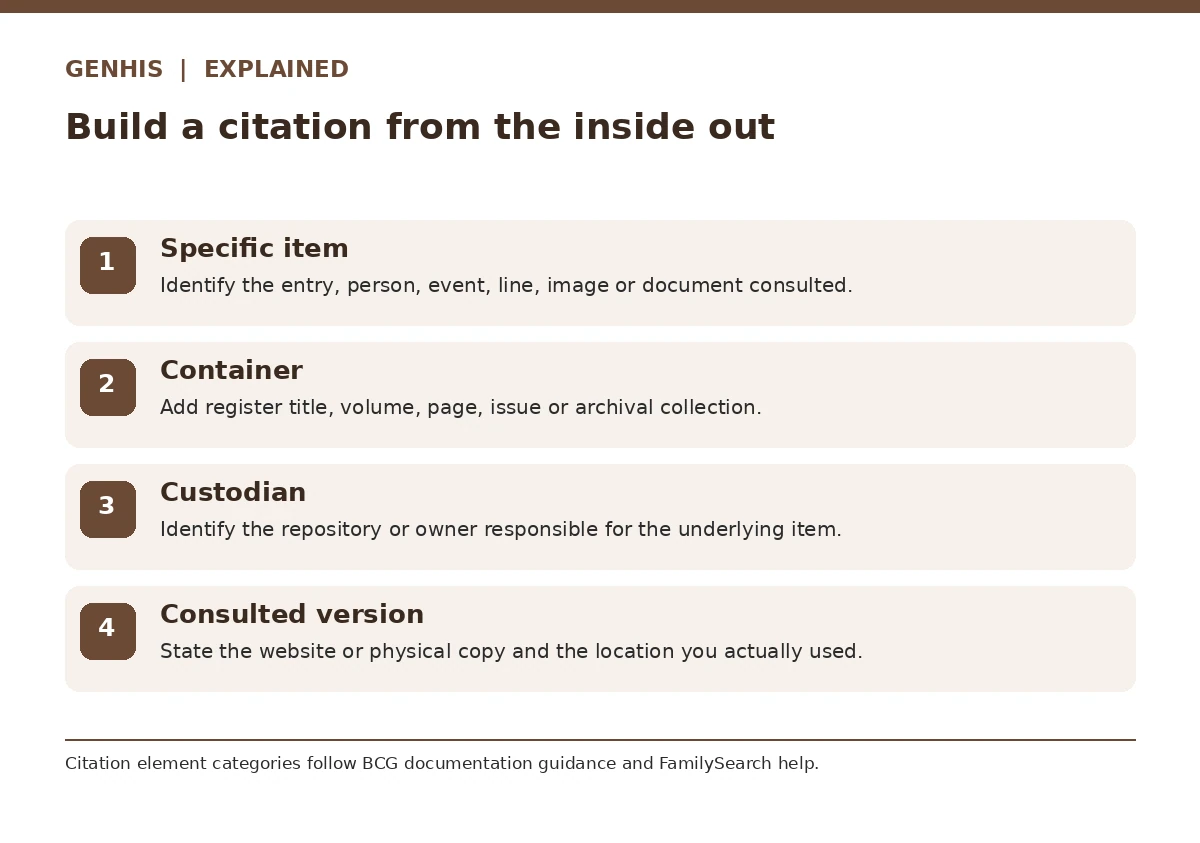
Start by naming what you actually examined. Was it an original paper register, a digital image of that register, a transcript, an index result, or a family history narrative citing something else? If the item appears on a page containing multiple households, note the particular household or line as well as the image or page number. In a bound volume, the book and page can be as important as the individual’s name. When writing down the event, preserve the source’s wording and distinguish that wording from your later interpretation.
Work outward from item to series, custodian, and access provider. A digitized document may reside physically in a local archive while its searchable image is hosted by a commercial or nonprofit site. In that situation, mention both the underlying collection and the site you actually used. Avoid attributing a copy to the digital host as though that host created the historical record. The Board for Certification of Genealogists emphasizes two purposes of a citation: helping readers relocate the source and helping them understand its quality and limits.
Capture Enough Detail While the Image Is Open
Save the title exactly enough to identify the source, the issuing person or institution where relevant, volume and page identifiers, collection name, repository, archive catalog identifier when supplied, and URL or image path for the consulted version. Record the date on which you accessed online material when the relevant style calls for it. A permanent link is helpful when provided, but it does not replace page details if a collection is rearranged. If the image is restricted or you are allowed only to read it, keep a detailed note without violating access or reproduction terms.
FamilySearch’s historical-record help explains where its `Cite this Record` information can be found. Use the generated citation as a useful foundation, then verify that it refers to the specific item you viewed and includes the location needed to retrieve it. Some interfaces display an index first and a scan later; do not silently imply that you saw the scan when you opened only the index. A discrepancy between the image and the automated index may be important evidence about transcription accuracy.
Use a Fill-In Pattern Without Fabricating Archive Details
For a digitized register, try the instructional pattern: `[issuing office or record creator], [register title], [volume or date range], [page or entry number], [person and event]; [repository and collection reference if shown]; digital image, [website and stable URL] (accessed [date]).` Each bracket is a field to fill from the actual item. If a field is missing, investigate it or state its absence; never make up a roll, volume or page number just to achieve a polished citation.
For a paper document in family possession, use `[creator or document title], [date as written], [physical description], [current private custodian or repository, described with appropriate privacy], [specific identifying marks]`. Do not publish a living custodian’s private street address merely because a detailed citation seems to require it. The citation needs to be traceable within appropriate consent and privacy boundaries. If sharing restrictions prevent full public identification, maintain a fuller private citation and an intentionally limited public version.
Match Citation Detail to the Source You Used
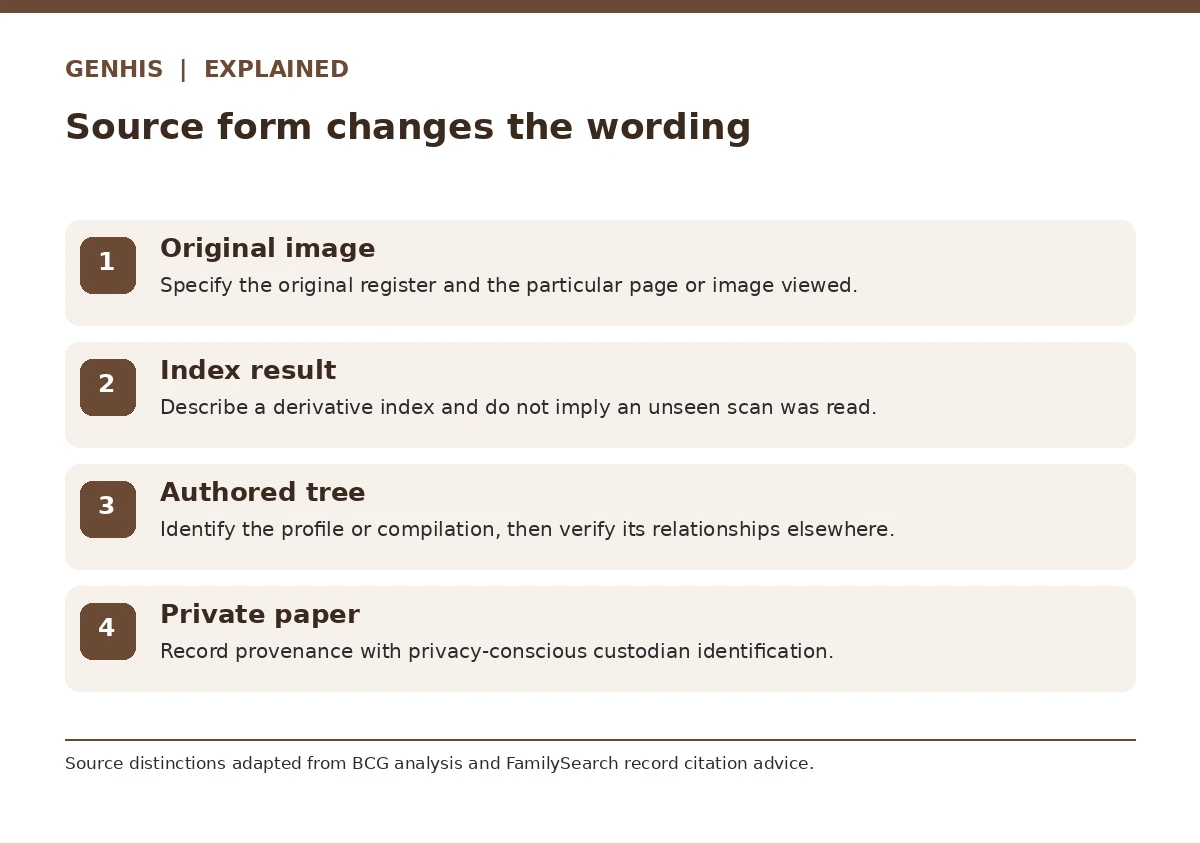
Books need author, title, publication details, and page number. Newspaper articles need newspaper title, publication date, issue or edition as appropriate, article title, page and the digital collection used. Online family trees need the tree or profile identification, contributor or platform when available, URL, access date, and the precise claim consulted. Citing a tree correctly does not prove its relationships; a cited original document is still needed to test the proposed connection.
For a database index, explain the index’s nature and what record set it purports to summarize, using only information actually supplied. If no image accompanies it, call it an indexed entry and consider whether an original can be located. For oral testimony, document the speaker, date, interviewer, recording or transcript format, access conditions and permission to retain or share it. Record disagreement with documents separately rather than altering the citation to make a statement more convincing.
Check a Citation by Trying to Retrieve the Item Again
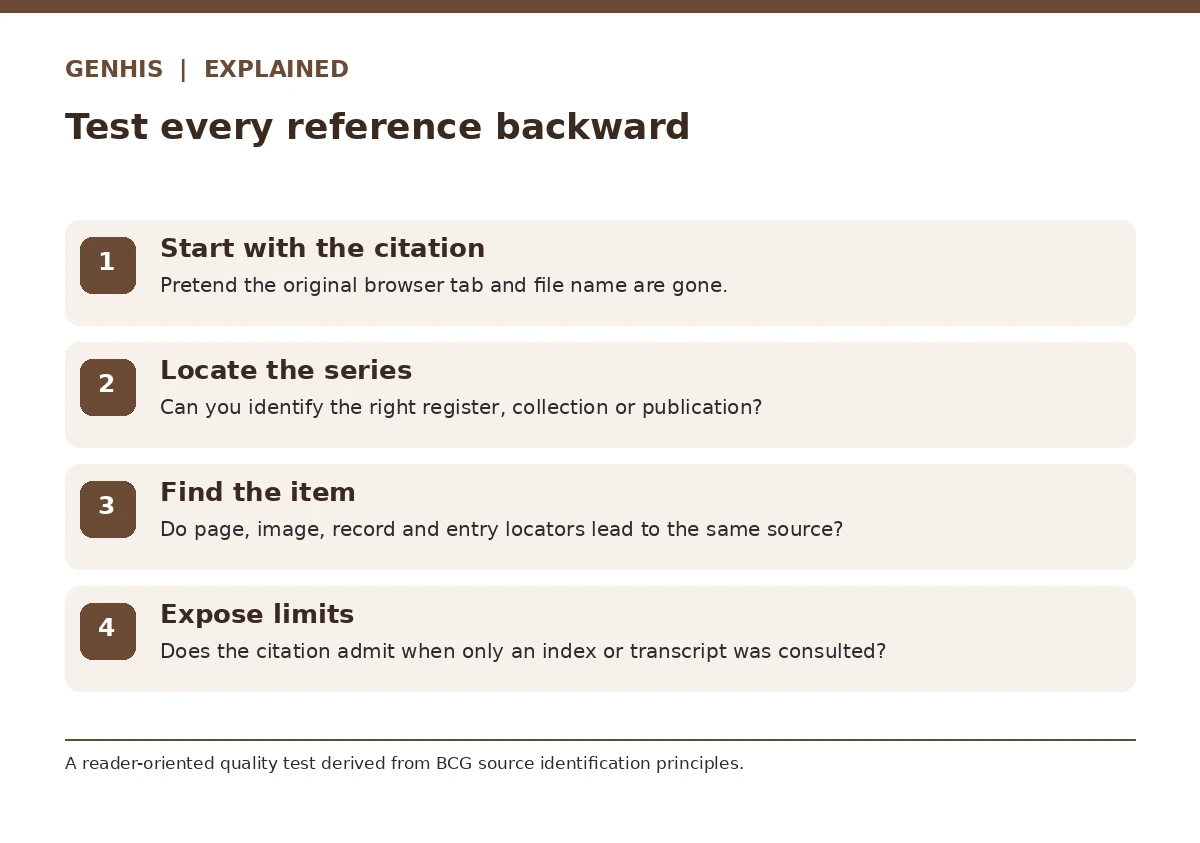
Before you declare a source complete, attempt the reverse route: start only with your citation and see whether you could find the item. Can you reach the right collection, page or image without relying on the original browser tab? Does the citation make clear whether you saw an image, an abstract or an authored interpretation? Could another researcher recognize when you have confused two people with the same name? The retrieval test is a practical quality check that can expose omissions early.
Imagine an entirely fictional notation `vital records, page 42`. Without a jurisdiction, office, date range and collection title, that locator is nearly meaningless. Adding a fake archive number would make it worse. Instead, search the actual catalog for the missing description and leave the incomplete citation flagged until you have it. If the item is later moved to another website, append the new route or an update note while preserving which version originally supported your analysis.
Put the Citation Next to Every Substantive Claim
Attach citations to facts in your tree, timeline, case notes and research report at the point where the source matters. A single bibliography at the end of a long family narrative may not show which record supports a particular relationship. For indirect evidence, you may cite several items that contribute different pieces of an argument. When two records conflict, preserve both citations and describe their information, informants and limitations before reaching a conclusion.
Do not confuse a citation with permission to publish a person’s private details. Ethical restrictions still apply, particularly to living family members and privately shared letters. And remember that a perfectly formatted reference can lead to a mistaken transcription or a document about a namesake. Source appraisal and identity testing are separate analytical tasks. Documentation lets a reviewer spot the mistake; it does not make the underlying claim unquestionably true.
How We Research and Handle Citation Examples
The Board for Certification of Genealogists explains the purposes and standard elements of source references, while FamilySearch describes how to retrieve citation details for records displayed in its interfaces. We adapted these principles into readable fill-in examples, not official archive citations. All bracketed examples are deliberately incomplete because no actual item is being cited. Collection numbering, repository locations, rights, and access dates must come from the document and custodian you actually use. There are no endorsed vendors or paid arrangements in this guide. See the GenHis affiliate disclosure.
BCG Citing Your Sources — BCG source-citation discussion explains identifying an exact item and preserving enough contextual detail to understand and relocate it.
FamilySearch Historical Record Citations — FamilySearch Help Center describes where to locate source citations for historical records and images in its search interfaces.
FamilySearch Add a Source — FamilySearch explains creating manually entered sources with identifying titles, citations and contextual notes in Family Tree.
BCG Source Appraisal — BCG explains how to assess original and derivative records, informant knowledge, source independence and evidence roles in genealogical analysis.
Consistent style helps, but an accurate, retrievable description of the specific source is more important than decorative formatting.
No. Check it against the item actually viewed and add a volume, image, page or other locator if available.
Yes, identify it as an index or derivative entry and do not claim to have examined an unseen original.
Never. Verify the identifier with the item or catalog, or note that it remains unavailable.
Document author, date, description and provenance while respecting the private custodian and consent requirements for sharing personal information.