
FAN Club genealogy studies an ancestor’s Friends, Associates, and Neighbors because the people around a person may appear in records that the ancestor’s name search misses. The method is often called cluster research and is associated with genealogist Elizabeth Shown Mills. It can reveal a promising place, distinguish namesakes, or suggest a family connection, but a shared address, witness signature, or migration pattern is not proof of kinship. This guide builds a documented network map around a fictional person and shows how to test links without turning every acquaintance into a relative.
Define the subject and the relevant community
Begin with a named research question, approximate time span, and a place grounded in a real source. “Where did the family of R. Morgan live before a documented move?” is a reasonable cluster question; “who were all the Morgans?” is not. The period matters because associations can change as people marry, change employment, relocate, or appear in different neighborhoods. A community might be a street, congregation, work setting, tenant group, or series of witnesses in records; it need not align with a modern administrative boundary.
The word “FAN” is a memory aid, not a guarantee that each person fits one permanent social category. A witness may be an associate without being a close friend; a neighbor may occupy adjoining property without ever interacting with the household. If an online database labels relationships, inspect the cited underlying record and avoid treating the platform tag as historical proof. Some record types mention social connections explicitly, while others require cautious reconstruction.
Extract connections exactly as recorded
Open the best available version of a source and capture the date, locality, record creator, original wording, and citation. Collect explicit links: a person named as marriage witness, someone recorded in an adjacent census household, a business co-signer, an estate appraiser, or a person in a congregation register. Record what the document establishes and what it does not. “Recorded on the following census line” is more defensible than “best friend.” A document may be derivative, incomplete, or inaccurately indexed; preserve those qualifications.
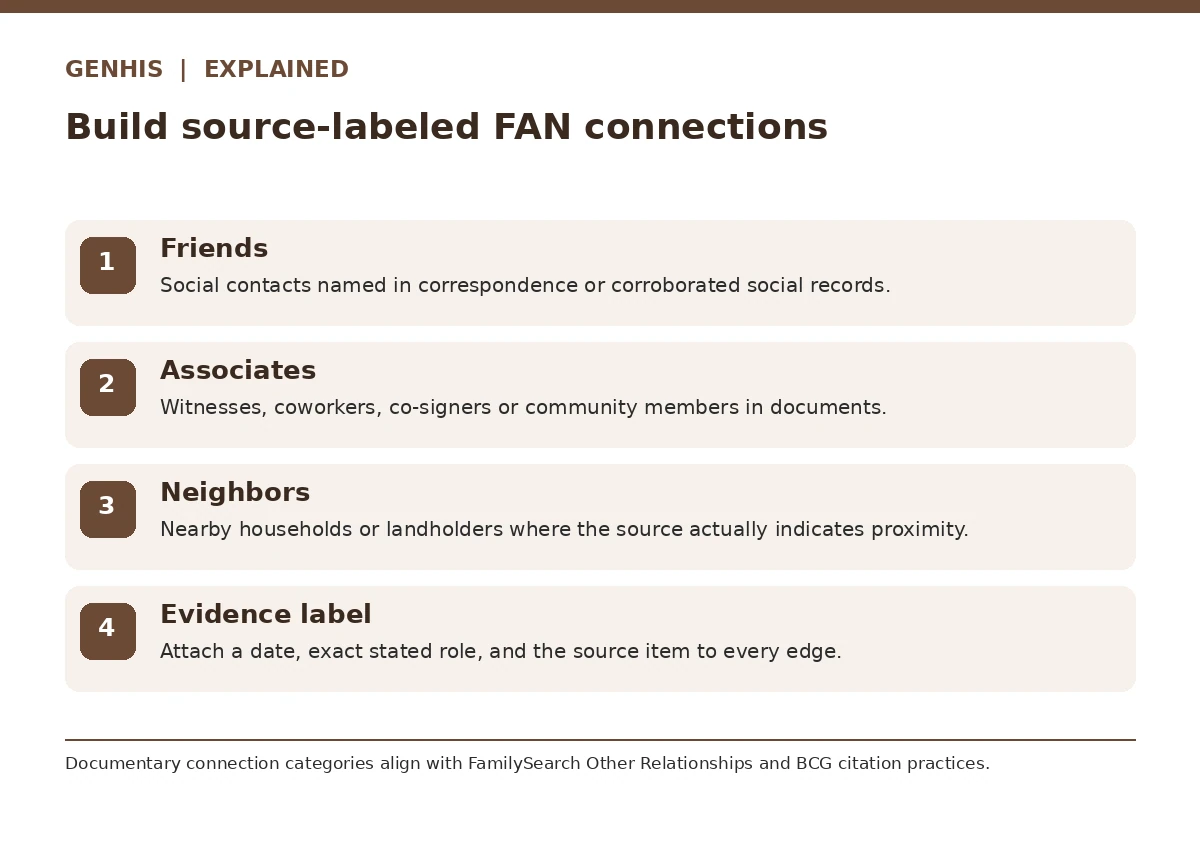
Keep a link register with five fields: subject, associated person, source item, documented connection, and possible significance. Make each edge source-specific. Two names in a deed may indicate a legal transaction, not a biological relationship. A godparent entry indicates a particular religious or social role in the relevant context, not necessarily the child’s biological aunt or uncle. Different societies, communities, and periods used record labels differently, so investigate their local meaning before inferring a family structure.
Compare repeat appearances and independent records
One coincidence is a weak lead. More informative patterns may include the same independently identifiable witness across several dated transactions, or a group of neighbors later appearing in the same destination locality. Check whether the documents are independent: two digitized copies or indexes of one record should count as one underlying observation. Use names, places, occupation, ages, signatures where possible, and document dates to discriminate among namesakes. Do not collapse records merely because two people share a surname.
For illustration only, imagine that R. Morgan appears in one town with M. Bell named as a transaction witness. Later, a separate, genuinely independent document in another place mentions an identifiable M. Bell and the same R. Morgan. That creates a route for testing migration, not proof that they moved together or belonged to the same family. A third person named Bell might be unrelated. State the question each candidate source could answer before searching it. Our guide “Genealogy Research Plan Template for Testing One Family History Question” adds more detail on this.
Use neighbors to improve geographic searches
Historical boundaries, enumerator routes, and property relationships affect what neighborhood data can establish. An adjacent census line may reflect proximity in an enumeration sequence, not necessarily shared property ownership. A land plot map may provide different information, and boundary changes can move record custody to a different jurisdiction. The National Archives explains that maps may reveal historic locality names, administrative changes, or selected named landowners, but not every map series covers every period or family.

Make a dated locality timeline for the subject and each promising associate. If two independent records place the same person in both a departure and destination community, investigate county, religious, legal, and tax collections in those specific time windows. Document alternate explanations: the associate could be someone else with the same name, or the people may have moved independently. A cluster clue should determine where to search next, not become a genealogical conclusion by itself.
Prioritize people with discriminating information
Cluster research can grow without limit. Rank associates by the quality and uniqueness of their documented links to the question. A named witness whose occupation and property connect two records may be more useful than a common surname among twenty neighbors. Test sources that could separate competing explanations: land conveyances for an owner, estate connections for a possible heir, parish entries for a documented sponsor, or migration-era tax rolls. Availability and the information recorded vary across jurisdictions; never assume a particular source exists.
Keep two columns in your network notes: confirmed documentary relationship and possible kinship hypothesis. The first must quote or describe the source; the second explains why an inference is plausible and what would disprove it. If a record identifies a person’s role as “servant,” “employee,” or “enslaved,” use careful historically grounded terms rather than implying ordinary voluntary friendship or family. Treat such sources within their specific legal and social context, including power imbalances.
Know where the FAN method stops
An association can be real yet irrelevant to parentage. Multiple connections can still derive from one inaccurate published compilation. Do not conclude that an individual was a sibling because they shared a witness, birthplace or surname. Apply source evaluation, analysis, and conflict resolution before making a family link. If you cannot distinguish two same-name associates, preserve both as separate candidates. A network graph is a navigational tool, not a DNA relationship predictor or a certified proof argument.

Protect privacy by excluding living people’s addresses, private correspondence, and unsolicited sensitive relationship theories from public maps and shared notes. Consent may be needed before sharing contributed family material. If a cluster clue suggests adoption, non-parental relationships, or another sensitive possibility, record it privately as a hypothesis until supported and appropriate to discuss. This tutorial intentionally uses invented names rather than live-person examples.
Build a small network map you can verify
Draw the focal person at the center, with surrounding nodes representing only people supported by at least one real citation. Label each line with its documented link and date, not a guessed family role. A useful three-pass exercise is: extract five promising associates; select two who recur in independent material; test one alternative location or identity for each. Summarize which proposed link became stronger, weaker, or unresolved. The result is a prioritized search plan and a defensible source inventory.
For recordkeeping, export a text list alongside any graphic. Diagrams cannot capture every uncertainty, and they are difficult to cite if their edges have no record references. Revisit the map after new evidence appears rather than forcing new individuals into the old hypothesis. The general brick-wall guide explains the wider diagnostic process; this page concentrates on how social connections generate discriminating research leads. Our guide “Genealogy Brick Walls” goes into more detail.
More Research Method Guides
How We Research and disclose limitations
The method draws on FamilySearch’s documented Other Relationships categories, its research guidance on historical community connections, and the Board for Certification of Genealogists’ standards of correlation and source evaluation. The FAN label is associated with Elizabeth Shown Mills; the example network and workflow are our own teaching tools, not reproductions of a published chart. Context, archives and record fields vary by jurisdiction, so local definitions must be checked. Read the site’s affiliate disclosure. No affiliate payment or partnership is claimed here.
FamilySearch Other Relationships — FamilySearch lists nonfamilial documented relationship types such as neighbors, employment, households and godparents.
BCG Ethics and Standards — The BCG states the five elements of the Genealogical Proof Standard, including conflict resolution and reasoned written conclusions.
FamilySearch Brick-Wall Guidance — FamilySearch describes extending research to family and other records when familiar direct-line searches stall.
NARA Genealogy Maps — The National Archives describes maps that can document historical locality names, changing jurisdictions and selected named residents.
FAN means Friends, Associates and Neighbors, a way to research the community around a person to discover otherwise missed evidence.
No. Enumeration proximity provides a clue about that record sequence; it does not by itself establish biological or legal kinship.
Add people named in relevant documents as witnesses, nearby households, coworkers, godparents or other associates, and cite each precise link.
Prioritize well-identified people who recur independently or can test a specific place, date, migration or namesake hypothesis.
No. The role must be interpreted within its historical and religious context and supported by additional independent records before concluding kinship.