
What can a last name tell you about your family history? Potentially less than a surname search result suggests—and sometimes more, if the spelling can be tied to actual historical records. A name can preserve traces of language, naming practice, occupation, place, or a change in how someone was described. It cannot, by itself, establish who your ancestors were. This guide provides a claim-by-claim reliability test for stories you may encounter on surname-history websites, inherited family notes, and online trees. Its examples are hypothetical rather than descriptions of real surname lineages.
Define the four kinds of claims about a surname
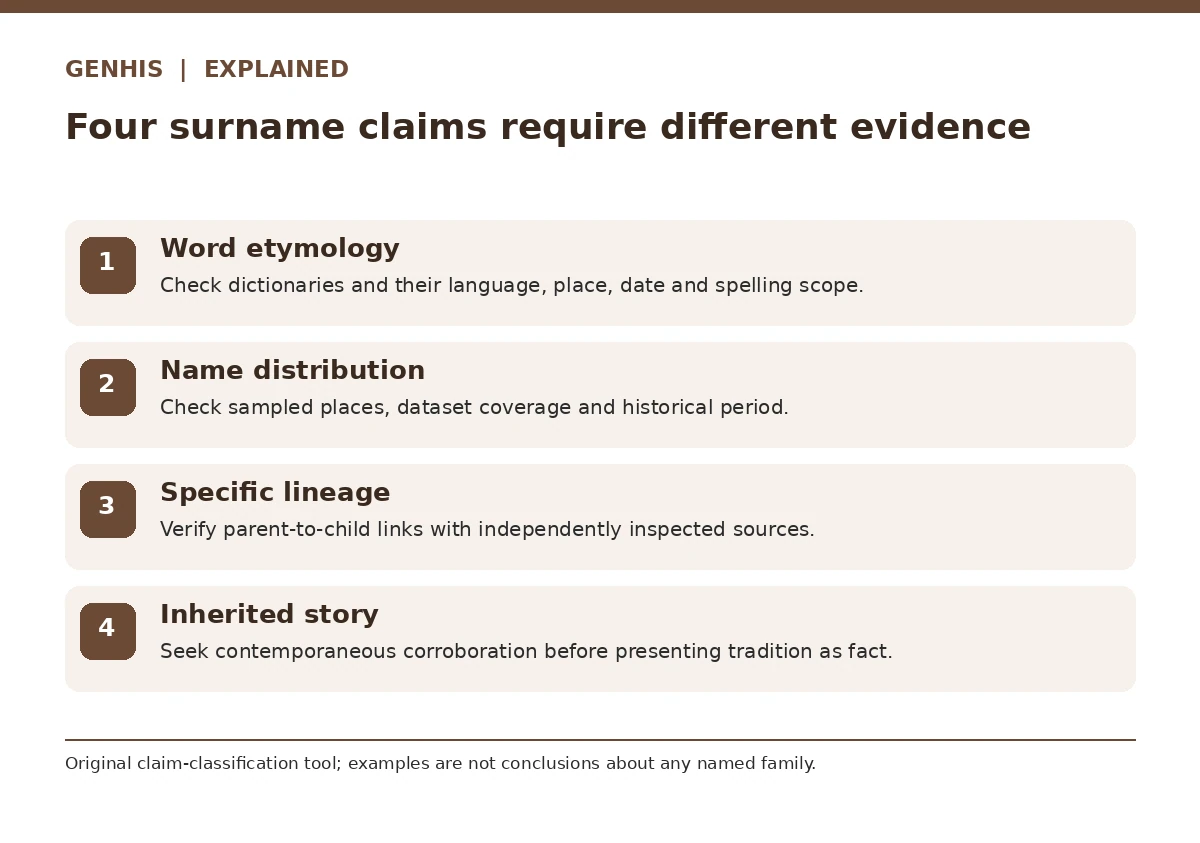
A lexical claim says a surname form has a particular linguistic derivation. A distribution claim says that the form appears in certain places at specified dates. A genealogical claim says named historical people belong to your ancestral line. A social-history claim says a family adopted, transmitted, altered, or discontinued a name for some reason. These are related but require different evidence. A well-supported dictionary entry does not automatically prove descent; a concentration on a modern map does not establish a medieval origin; and a family story about a changed name is still a story until documents clarify it. Our walkthrough on how to find the origin of a last name using historical records sets out each step.
When you see “your surname means…” ask “in which language, region, period and spelling?” When you read “your family came from…,” ask whether the underlying records identify a particular ancestral person. A surname meaning may be relevant background to a researched branch, but the same spelling may belong to unrelated branches. Different communities also use different systems: patronymics that change each generation, multiple parental surnames, marital changes, or other traditions. FamilySearch’s surname overview is a helpful introduction, not a universal rule for every culture.
Use a claim-strength ladder instead of a catchy origin story
Label each assertion in a surname history as documented, suggested, or unknown. “This register spells the identified person’s surname X on a specified date” can be documented with a direct citation. “A credible dictionary attributes this word form to a place-name” may be documented as a scholarly etymological proposal, but not as an ancestral relationship. “Therefore my family emigrated from that place” is an inference that needs a line of independent records. “Everyone carrying this surname shares a coat of arms” lacks a defensible family connection unless evidence demonstrates a particular grant and lineage.
Write the supporting evidence beside every sentence of your surname narrative. If the document only gives a locality where a person lived, do not silently convert it into their birthplace. If a later source reports a prior nationality, distinguish the recorder’s terminology from a modern political identity. A historical community might speak one language while the local records use another. A modern database may simplify several scripts into Latin letters; that transliteration should be labeled rather than confused with a preserved original spelling.
Do not mistake a name for ethnicity, rank or genetic kinship
Names can be shared by unrelated people; people who are biologically related may have different names; and naming customs differ among societies. A surname is therefore not a reliable ethnicity test. Nor does a surname alone give any right to a specific heraldic device, title, inheritance, or special status. A surname page may describe a historically prominent person with the same spelling without documenting your connection to them. Treat that as information about that person, not as your family tree.
Adoption, step-relationships, enslavement, colonial administration, marriage, chosen names, religious change, and other historical processes can complicate how names pass between generations. Handle those contexts with care and use sources specific to the family, period, and jurisdiction. Avoid flattening them into a one-line “original family name” claim. If exploring sensitive questions affecting living relatives, preserve privacy and obtain appropriate consent. A name cannot establish medical genetics or genetic ethnicity, and this article makes no such claims.
Distinguish spelling variation from an actual name change
A record may faithfully reproduce a locally used form but still differ from another document. Transcription and indexing add separate possible errors. FamilySearch provides examples where an image and index disagree and explains that a correction to an index is not automatically a correction to the original. Compare the actual images if available. Separate three fields: original record spelling, indexed spelling, and normalized form you use for searching. Their disagreement may be important evidence, not clutter to delete from your tree.

Suppose an invented ancestor is written as “Renaud” in one source and “Renault” in another. That difference alone does not prove a legal change, an emigration event, or two separate identities. Test age, household, occupation, place and intervening documents first. Conversely, do not insist that two people are identical because their surnames match, especially in a large city or when the first name is common. The correct result may be “unresolved,” which is more useful than a false certainty that future researchers will repeat.
Write a surname history with evidence grades
For an individual branch, construct a chronological name trail with dated citations. Each row should include person, role of the record, spelling shown, language or script if established, associated relatives only when stated, and confidence in identification. Then draft three short paragraphs: what the documents show, plausible linguistic or geographical interpretations, and what has not yet been established. Keep an explicit boundary between named people linked by records and people who merely share an attractive surname.
A family-history narrative is stronger when it admits limits. You may state that a documented ancestor used a particular surname in a particular parish while also saying that no earlier spelling has been proved. You may describe several dictionary explanations without arbitrarily selecting one. Also, you also may cite a distribution map for its stated statistical time period while refusing to interpret it as a birth record. These are not weaknesses; they make the account testable and prevent invented pedigree links.

More Research Method Guides
How We Research: assess each proposed claim independently
We reviewed FamilySearch explanations of surname categories, alternate names and indexing discrepancies. The evaluation ladder is an editorial tool developed for this guide, not a published formal grading system or a certification of any surname. Examples are fictional and no heraldic, ethnic or genetic lineage is established. Readers should verify a name’s historical language and the coverage of relevant local records rather than assuming global rules. Find method sources linked below; see our affiliate disclosure. We make no paid surname-product recommendations or affiliate claims here.
FamilySearch: What's in a Surname? — FamilySearch describes surname-type categories, variation in spelling and differing traditions of name transmission.
Also, FamilySearch indexing errors — FamilySearch distinguishes errors in the image of a record from errors in its searchable index.
FamilySearch recording changed names — FamilySearch recommends documenting variants and distinguishing birth names from legal or commonly used names.
FamilySearch surname search — FamilySearch offers possible surname meanings and origins, not proof that unrelated families share a genealogical line.
No. Identical or similar surname forms may have separate histories and do not establish shared descent.
No. Such claims require independently verified historical grants and a documented family connection.
A linguistic association may be a clue; a surname alone cannot verify an individual’s ethnicity or ancestry.
It is a research lead unless its particular ancestor links can be independently checked using cited records.
A dated chain of documented spellings and identified people, with separate citations for linguistic interpretations.