
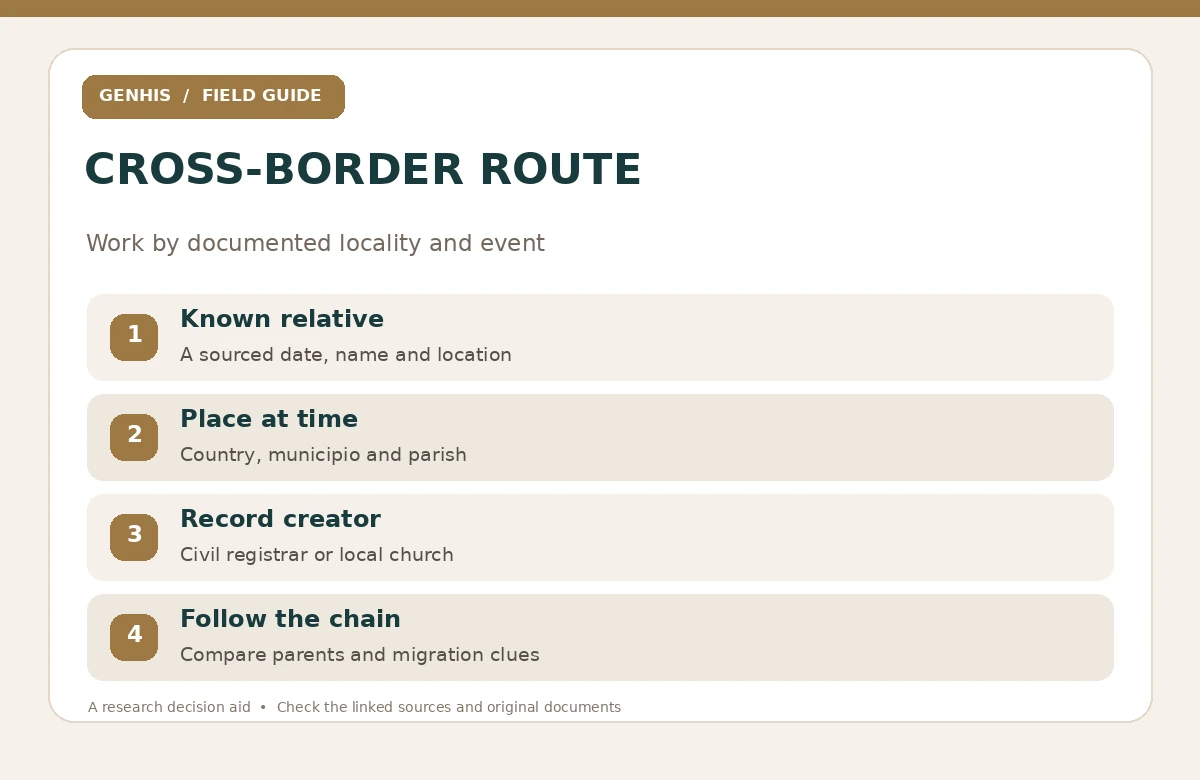
“Hispanic ancestry” is not one archival jurisdiction. A documented family might have records in Mexico, Puerto Rico, the Dominican Republic, Central or South America, Spain, the United States or several countries over successive generations. The useful first decision is not which large surname site to buy; it is which locality and government or religious institution recorded a particular event. Start from a confirmed family member, locate one dated birth, marriage or residence, and move backward from that place. Avoid treating language, a surname or a regional DNA label as proof of an individual’s nationality or descent.
Build a location timeline instead of a single country label
Write down the exact city, district, parish or municipio in each source about the oldest verified generation. A U.S. census may give only a country; an older marriage or border-crossing card may identify a municipality, an address or parents. Place each source on a timeline showing when the individual lived there. Multiple countries in one family are common and should not be collapsed to one national archive based on a later relative’s cultural identity.
Do not assume a modern administrative unit existed under the same name a century ago. Country, province, department, municipality and parish responsibilities can change. For every target year, identify which authority produced civil registrations and which ecclesiastical organization produced religious events. A town clue written in English might use a shortened or translated name; preserve the original spelling and verify it against contemporary maps or local finding aids.
Interpret two surnames as clues, not a fixed formula
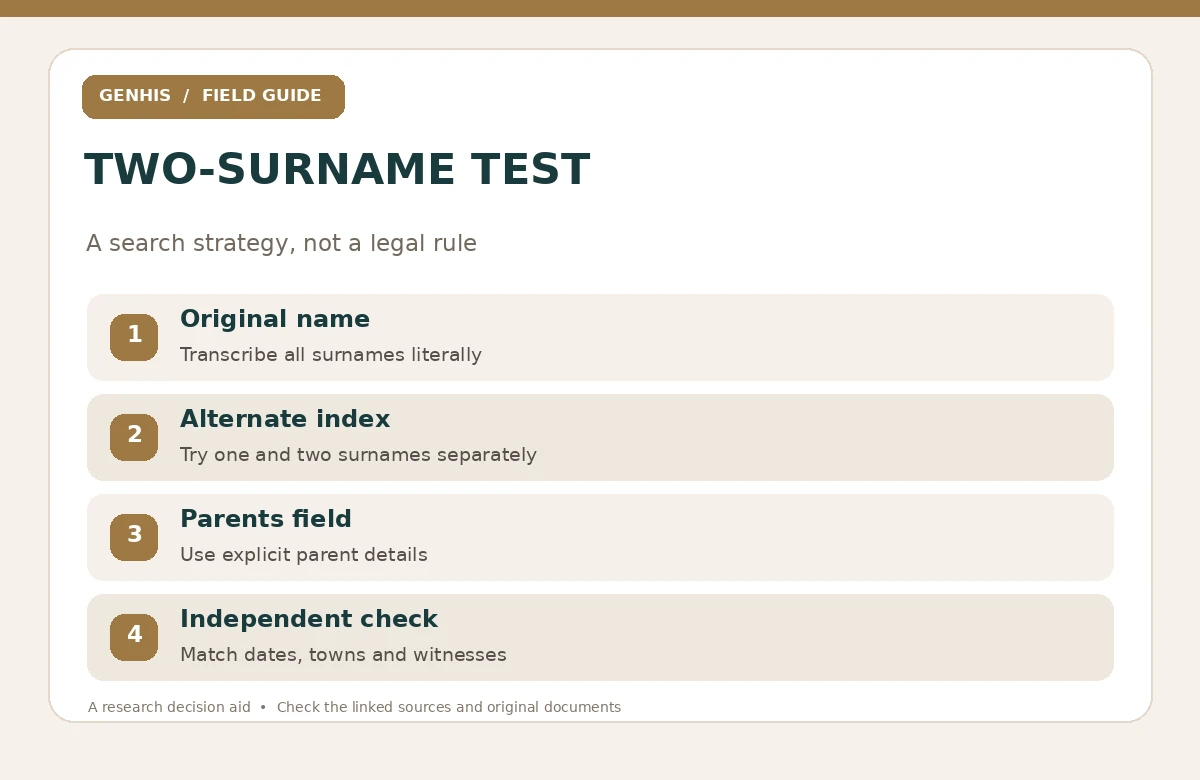
Many Spanish-language records use paternal and maternal family names, but practices differ by country, century, family and recording official. A person may use both surnames, one surname, a spouse’s name or an altered form after migration. Indexes may mistake the second surname for a middle name, which can hide a promising entry. Search known name combinations in several orders while keeping literal transcriptions of each original document.
If a certificate shows two surnames, do not assign a named mother or father based on ordering alone. Read the parents field, witness information, place and stated relationship. A hypothetical Rosa García López found in a U.S. index might correspond to a record indexed under López, but that remains a search possibility until the birth details or relatives agree. Similar naming patterns are useful hints, not standardized proof of a particular marriage or parent-child link.
Use country-specific civil and church guides
FamilySearch’s Mexico research guide directs beginners to identify an ancestral town, then use civil registration and Catholic Church material as appropriate. The same general decision applies elsewhere but the dates, jurisdictions and church coverage differ. Civil birth, marriage and death certificates may provide parents and ages, yet data fields change across times and places. Baptism, marriage and burial records can supply earlier evidence where civil collections are missing or began later. Our guide “Ashkenazi Ancestry Research” covers a related question.
Do not promise that every Catholic parish is digitized or indexed. A Dominican Republic FamilySearch collection, for instance, consists of locally created parish and diocesan records with its own specific dates and access context; it does not cover every Caribbean family. Confirm an individual collection’s description, creator and year range before searching. Where a record only exists in an archive, request the appropriate book and entry through the approved procedure without sending private documents about living relatives unnecessarily.
Choose a border or migration record for the route taken
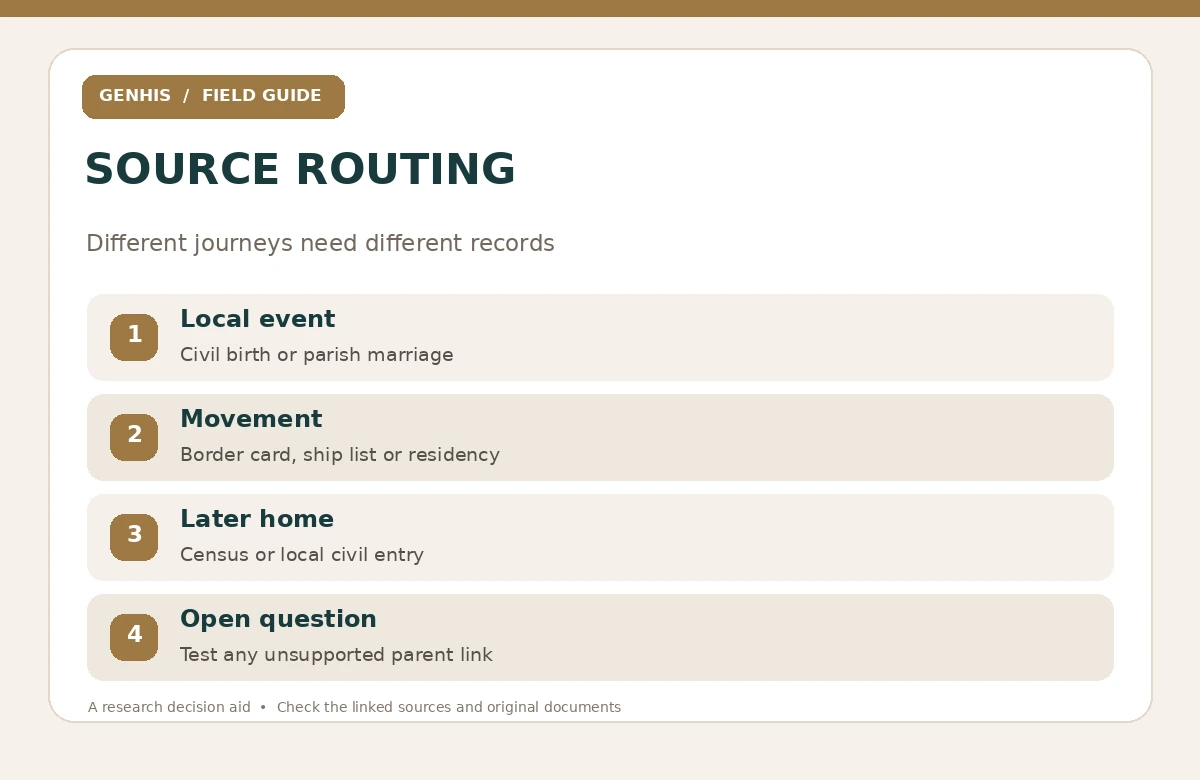
The National Archives describes Mexican border-crossing record series from approximately 1903 and notes that individual card manifests were used in particular circumstances. Such a card might contain a point of entry, final destination, age or occupation. It does not prove that every migrant crossed through that station or that records exist for every year. Also distinguish a migrant’s last residence from birthplace and from citizenship, since those concepts are not interchangeable.
For a Puerto Rican family or another group whose legal and migration history differs from foreign immigration, first establish the relevant citizenship and jurisdictional context rather than forcing the story into a U.S. foreign-entry template. Caribbean, continental and U.S. territorial cases can involve distinct kinds of civil documentation. Use the actual route and era indicated by records, not a generalized narrative about “Hispanic immigrants.”
| Record or tool | What it can contribute | What it cannot decide |
|---|---|---|
| Civil registration | State-recorded birth, marriage or death | Country and local start dates vary |
| Parish register | Baptism, marriage or burial context | Religion and surviving coverage differ |
| Two surname forms | Search combinations and family clues | Surname order cannot alone establish parentage |
| Border card or arrival | Route, destination and reported identity | Coverage varies; entry is not birthplace |
Read local terms and note the informant
Records may use words such as bautismo, matrimonio, defunción, natural, legítimo or vecino with meanings conditioned by time and local practice. Consult reputable period-specific glossaries and do not recast historical labels as moral judgments. Copy each phrase that directly bears on identity. A marriage informant might name parents from memory; a baptism entry records a ceremony and potentially godparents, while a civil registration addresses a government event. Neither automatically resolves the truth of a long-standing family claim.
When two documents conflict, make a three-column comparison: original statement, who supplied it, and which external record could test it. A person’s age at a border crossing may be approximate, and an infant’s baptism may occur after the birth. Protect modern records of children and living relatives: do not publicize their legal identities, addresses or private papers as a price of building an online family tree.
Write a research plan for one cross-border link
Choose a specific question such as “Which municipality recorded the parents of this documented bride?” List the two strongest known sources and the one uncertain link. Prioritize the birth or marriage register in the correct jurisdiction, then supplement it with a border card, census, burial or parish index. Search nearby years only after checking what the collection’s dates and indexing status really cover. Document negative searches with filters and volumes used. For the fuller picture, see our guide “1930 Mexico Census”.
The outcome should be a cited chain of people and places: confirmed U.S. person, documented overseas event, named relatives if the source states them, and any conflict needing resolution. A broad label such as Hispanic, Latino or Spanish-speaking should not stand in for individual history. Preserve the family’s own description and uncertainty with care. The best next step is usually one original register in the correct town, not a global ethnicity claim.
How We Research These Sources
We reviewed the FamilySearch Mexico research framework, country-specific Central American collection details and the National Archives description of Mexican border card manifests. The guide deliberately refuses to treat the term Hispanic as a single record jurisdiction, or a double surname as automatic proof of parentage. Rosa García López is an illustrative invented example. Collections differ widely in language, indexing, date span and legal access. Before using any family example publicly, verify the original item and protect information identifying living relatives.
More Research Method Guides
Verified Sources and Privacy Notes
Source descriptions reviewed: FamilySearch research sequence for Mexico: hometown, civil registration, Catholic parish records.; National Archives Mexican border-crossing series and individual manifest card context.; Example of collection-specific Central American colonial census records and fields.; Example of country-specific Dominican parish and diocesan collection scope.. Respect the terminology and self-identification of families. None of these steps requires publishing a living relative’s registration or border-crossing information. The article recommends historical research resources without a commercial endorsement. Read the GenHis disclosure statement for general site practices.
No. Records are maintained across distinct countries, municipalities, religious bodies and periods. Begin with a dated place.
No. Naming customs vary, and indexes can reorganize names. Use explicit parent names in original sources.
Only if the specific record states a birthplace; a border event alone documents an arrival or related administrative act, not all prior life.
No. They document different events and may have different dates, creators and evidentiary limitations.
Follow one documented person across each dated locality, identifying that place’s record creators before continuing backward.