
Italian parish records are often the next source when a civil index stops short of the generation you need—but they are not stored in one national church database. Baptisms, marriages and burials were created by local parishes, with possible copies or transfers held by diocesan archives. Start by proving the ancestor’s comune or smaller settlement, the event date and the likely parish. Italy’s Portale Antenati is invaluable for many civil records held by State Archives, but its civil images should not be mistaken for a comprehensive national set of parish registers.
Identify the comune and smaller settlement first
Obtain the most precise Italian birthplace from an immigrant’s marriage, naturalization, draft registration, passenger arrival or family papers. An Italian comune may contain several frazioni and parishes; the historic ecclesiastical assignment may not match today’s civic boundaries. Record the name as written in the source before normalizing its spelling. An American paper naming a large province or nearby city is only a starting point for tracing the family to a particular parish. Our guide “Polish American Genealogy” goes into more detail.
Confirm that the locality existed with that name during the ancestor’s lifetime. A settlement may have been reorganized or assigned to a different diocese, so searching the modern metropolitan cathedral first can miss the actual register. Use old maps, diocesan lists and archive finding aids where available. Put the specific event, likely year and candidate parish in your log, and rank candidates rather than emailing every institution with a surname-only request.
Read civil records before requesting parish copies
The Italian archival portal Antenati presents selected civil records held in the Italian State Archives, including births, marriages and deaths, as well as other genealogically relevant series. A civil birth record can help identify both parents, a detailed residence and an approximate baptism timeframe. But an Antenati search-result page is not a parish register, and absence of a scanned act from a particular year is not evidence that no record was created locally. Our guide “Sicilian Birth Records” adds more detail on this.
The central Italian State Archive explicitly says it does not hold all civil or parish registrations used for ordinary genealogical research. It directs researchers toward a birthplace’s comune, parish or diocese and relevant State Archives. Before using a screenshot of a civil act as proof of a church baptism, compare the dates and determine what each creator actually recorded. Church sacraments and government vital events have related but distinct documentary purposes.
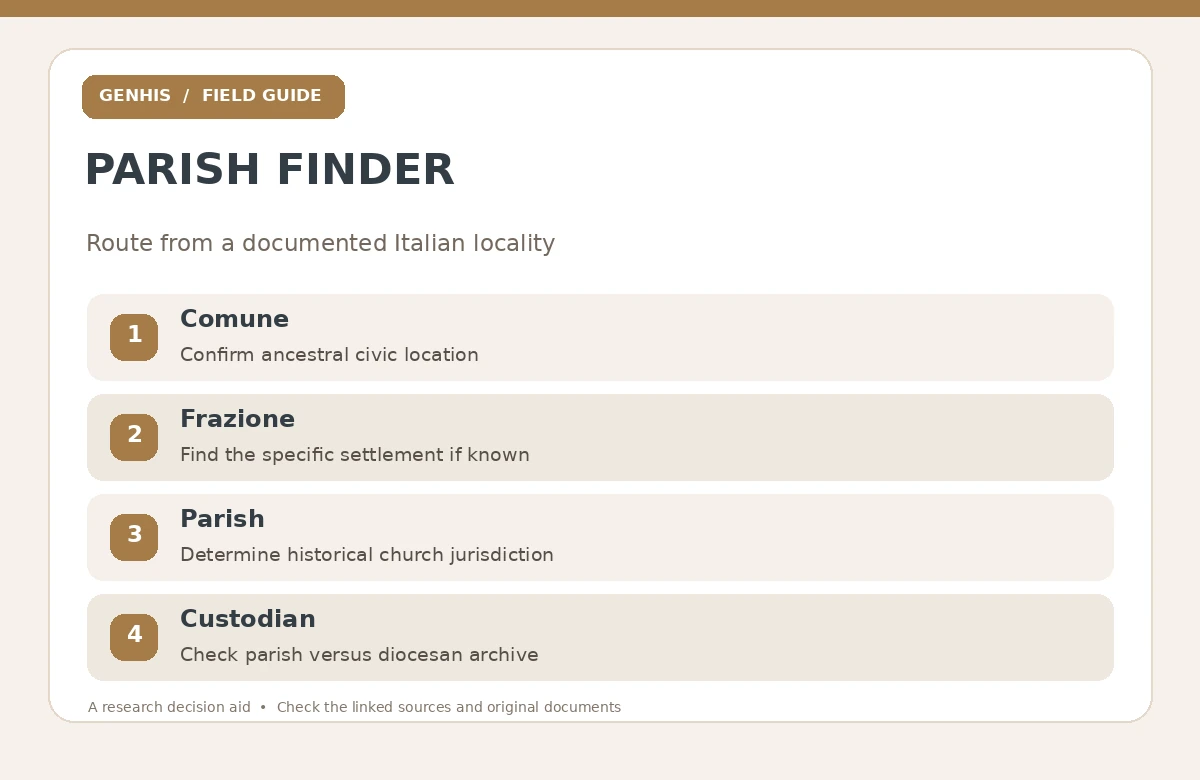
Route the request to a parish or diocesan archive
Once the town, approximate year and faith tradition are established, identify the historical parish and its current custodian. Parish offices may hold their own books; older registers or copies may be in diocesan archives. Not all archives provide digitization, public access or remote lookup services. Verify current catalog and contact guidance on the relevant institutional website before requesting a copy, and do not assume an archive can search every surname across its diocese.
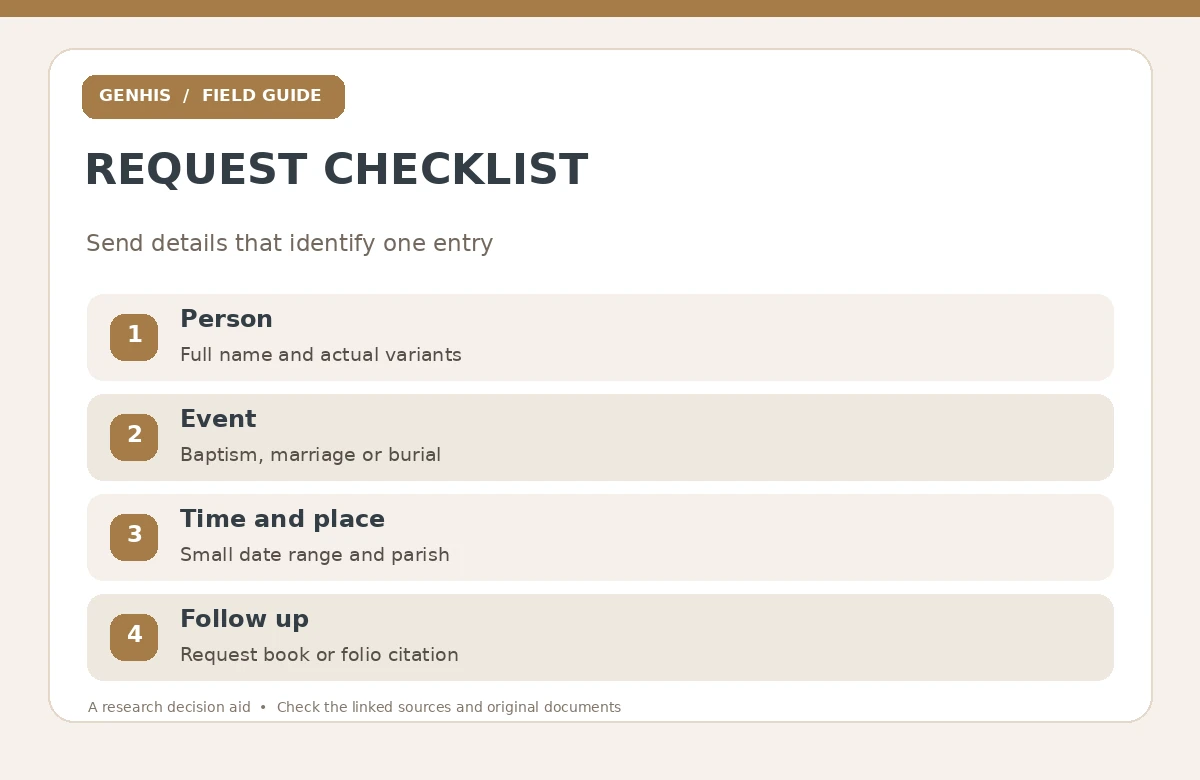
A focused request provides the ancestor’s full name as documented, possible spelling variants, event type, date range, named parents or spouse, town and parish if known. State why you believe that repository holds the correct book and ask for its holdings dates and procedure. Be prepared that an archive may require appointments, fees, permissions or a narrower record reference. Never present an unreceived response as evidence that an entry was confirmed.
Interpret baptism and marriage entries accurately
Baptism entries often include the child’s name, parents and godparents, but the recorded event is a religious rite. A baptizing priest may add a date of birth, yet you must read the exact text rather than infer that every baptism date equals birth date. Marriage registers or marriage investigations can sometimes name parents or places of origin. Their survival and level of detail vary widely by parish, region and century. Burial records similarly may record a church event rather than a civil death certificate.
Godparents and witnesses are valuable clues to social networks but do not automatically prove blood relationships. Likewise, a marriage dispensation can be informative only after the actual document and legal reason have been read. If a child’s surname differs from the father’s recorded name, preserve the original entry and investigate naming practices rather than “correcting” the archive in your database. Distinguish transcription from inference in each citation.

| Record or tool | What it can contribute | What it cannot decide |
|---|---|---|
| Portale Antenati | State Archive civil vital record images | Does not equal all church register holdings |
| Parish archive | Sacramental register for its congregation | Exact parish and survival need checking |
| Diocesan archive | Transferred books or authorized copies | Holdings and access vary by diocese |
| Municipal office | Civil registration for the comune | Not necessarily historic church rite |
Handle handwritten Italian and Latin cautiously
Depending on date and location, registers may use ecclesiastical Latin, Italian or regional forms. First transcribe the exact date, names and parish. Check common abbreviations against other entries written by the same hand; a title or patronymic can resemble a surname. For partially legible words, note alternative readings and take a wider page image showing headers and neighboring lines. A modern translation should be labeled a translation and never replace the original form in the evidence record.
A hypothetical example: a civil marriage certificate names a bride’s father and a nearby hamlet. A parish index has a similarly named woman two years younger. To decide whether they match, compare named parents, husband, residential details and book entries. It would be unsafe to merge them because an uncommon surname appears only once in a web search. Maintain two candidates until another independent original identifies the same person.
Create a parish evidence and request checklist
Record the complete citation: church or repository, parish, sacrament, register volume, year, folio or entry number and image or archival reference. Include a transcript indicating whether each kinship claim is stated directly or inferred from several sources. Save the relevant civil record separately with its own citation. This prevents a single typed family-tree entry from obscuring two quite different archival documents.
If an office cannot find the event, ask whether registers survive for those dates, whether a neighboring parish served the frazione or whether books moved to the diocese. A nonresponse is not a negative search; record it as “request pending” or “holding unknown.” The deliverable is a clear route to the most plausible register and a documented request, not a fabricated certificate or a guessed date of a sacrament. If you want the full process, read how to find German ancestry records by town and date.
How We Research These Sources
The Italian Ministry of Culture’s ICAR overview describes Antenati as an archive portal for State Archive materials, while the Central State Archive distinguishes its holdings from local comune and parish or diocesan registers. We checked the record-creator distinction before drawing the three route diagrams. All example persons are hypothetical, and the guide does not assert digitization of a specific parish. Actual register dates, physical custodian and remote-request policies have to be checked for the named comune and diocese.
More Research Method Guides
Verified Sources and Privacy Notes
Source descriptions reviewed: Italian state archival description and coverage of the Antenati civil-record portal.; Central State Archive guidance that ordinary genealogical parish and civil records reside with other custodians.; Firenze State Archive explanation of historical civil images and potential parish duplicate.. Church access and privacy rules vary, especially where recent sacraments involve living people. Contact appropriate custodians and avoid publishing identifiable modern records without consent. There are no commercial parish-search referrals here. Our affiliate disclosure notice explains the website’s general policy.
No. Antenati chiefly provides State Archive records, especially civil registration. Parish and diocesan holdings require separate checks.
Use immigration and family records to identify a comune and ideally a frazione before choosing a parish.
Not necessarily. A baptism book records a ceremony; it may state a separate birth date if the individual entry includes one.
No. They may suggest an association worth investigating, but an independent source is needed for the claimed kinship.
Provide documented name, event, approximate date, parents or spouse, specific place and the narrowest possible book reference.