
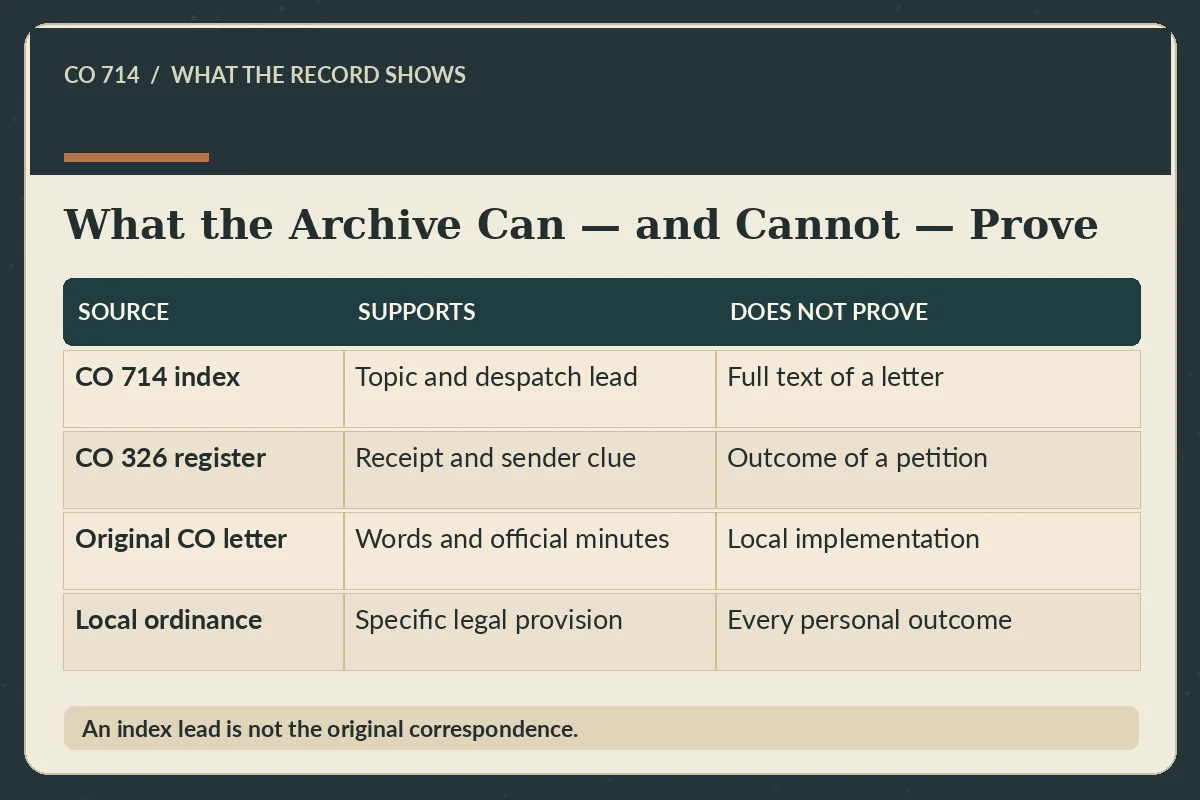
CO 714 holds Colonial Office subject indexes for correspondence from 1815 to 1870. These are contemporary finding aids that can point to an original letter, not transcripts of all the documents in it. Search a colony, year and historical subject heading, then use the date and sender to identify the relevant original correspondence volume. The National Archives index guide warns that indexing may omit some letters and may preserve older vocabulary. An index hit therefore starts the investigation; it does not prove a claim about an individual.
Choose the Colony and Historical Year First
Write down the colony’s contemporary administrative name, the year of the alleged event, and the event type before searching. A modern country label may cover several historical jurisdictions, while a colonial government may have changed its name or administrative relationship. Do not assume that a person mentioned in a family story was writing directly to London; the relevant item may be a governor’s despatch summarizing someone else’s petition.
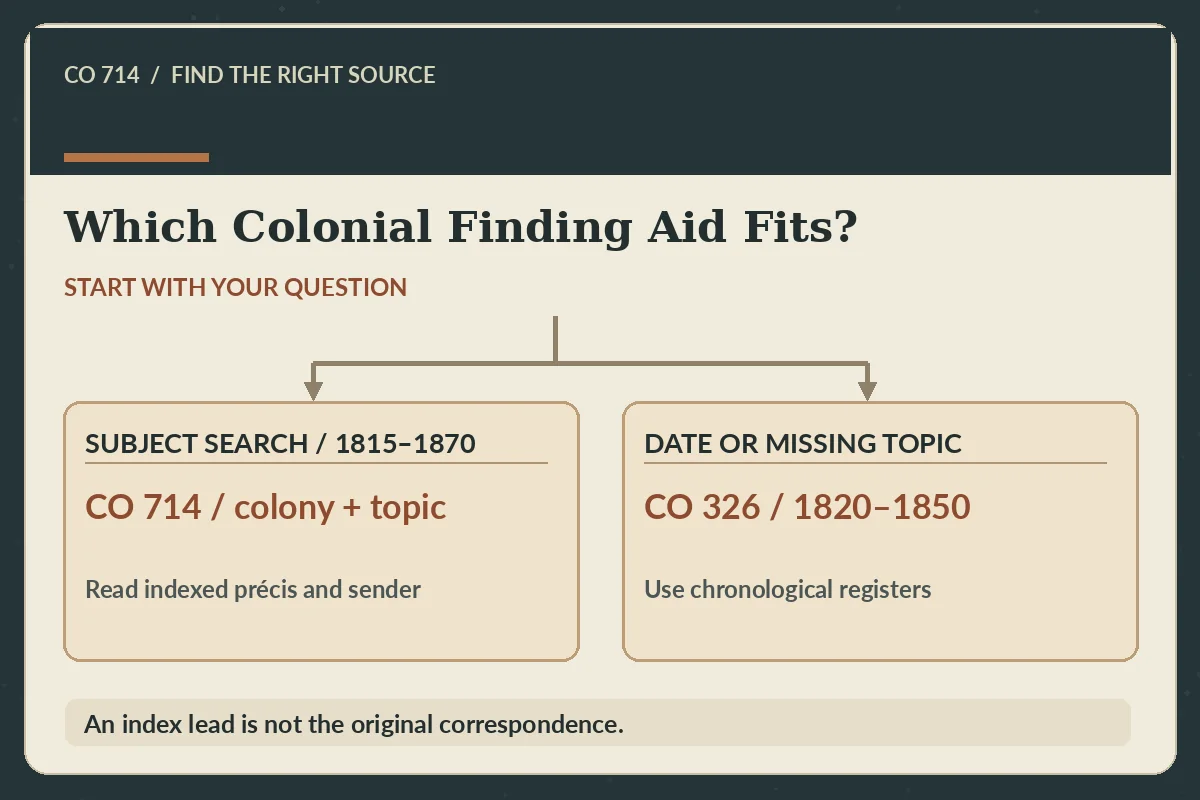
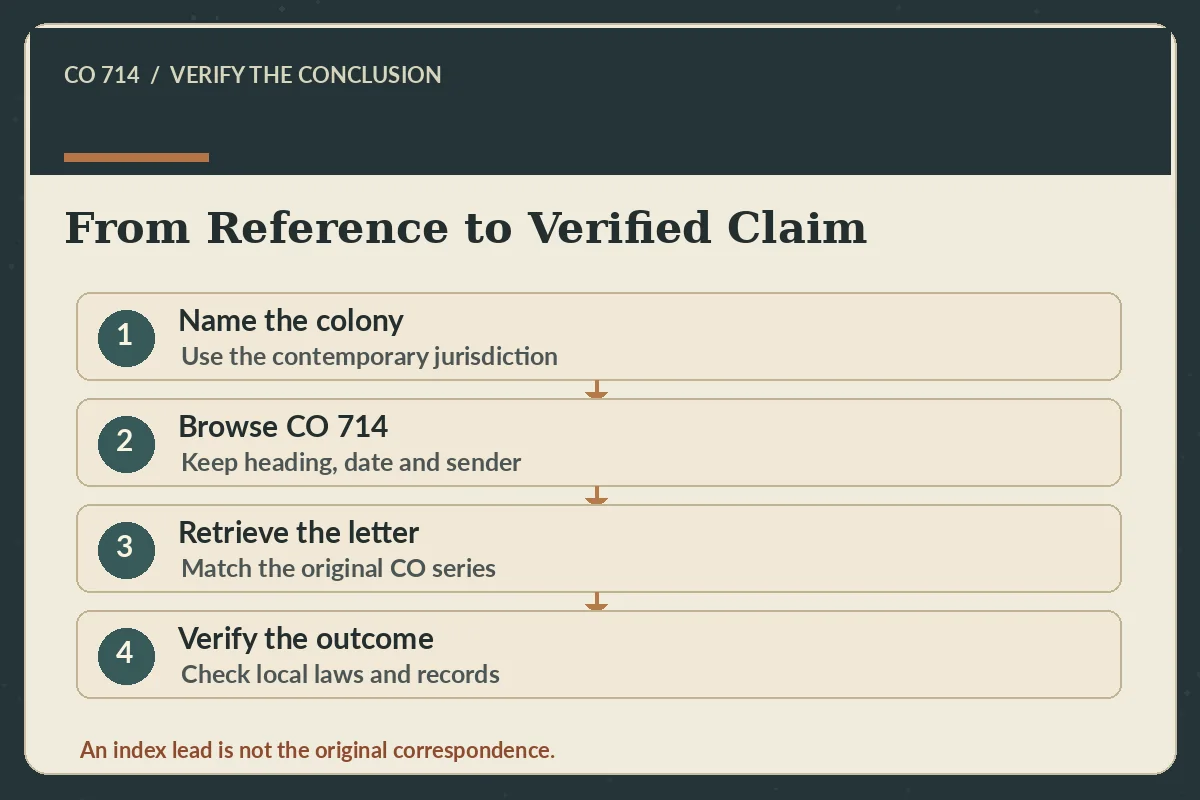
Start Discovery by limiting the reference to CO 714 and adding the colony name and period. Separate the index volume reference from the eventual original correspondence reference in your notes. For a date near a boundary year, inspect adjacent index volumes and verify how the catalogue dates each volume. The official guide makes clear that different indexes exist for different colonies rather than one universal alphabetical name index.
Translate Subject Headings Without Altering Them
CO 714 indexes are organized by subject keyword. Clerks selected headings according to their administrative interests, and the label they chose may not match the words a modern researcher would expect. For research about disease control, look for period headings such as quarantine and public health as well as more specific terms. Transcribe outdated or discriminatory terminology exactly for source tracking, but explain it in neutral modern language when writing the history.
Check adjacent alphabetical entries and likely synonyms, not just one precise search phrase. A request about a school may be filed under education, grants, religion or a governor’s name. Even a very precise-looking index summary may omit the subject you care about because the clerk indexed only the main topic. Maintain separate columns for the original heading, your modern gloss, and any alternative heading checked.
Recover the Original Despatch From the Index
An index entry is useful when it provides the colony, year, date and sender category. The National Archives demonstrates this method with a Barbados quarantine item dated 2 May 1832: CO 714 supplies the clue, and the researcher then finds the matching governor’s correspondence in CO 28. That example is a search illustration, not a general claim that every colonial file has been item-indexed or digitized.
Use the particular colony’s original correspondence series and inspect the relevant annual volume. Preserve the precise piece and item reference when it appears. A catalogue title for a whole volume may be too general to reveal an individual letter, so browsing or reading-room consultation can be necessary. Distinguish the date a despatch was written, when it arrived in London and when officials minuted or answered it.
Test Missing Results Against Registers
An empty index search is not evidence that a complaint or petition never existed. The archival guide notes that the subject indexes may concentrate on governors’ correspondence rather than all letters from individuals or organizations. For 1820–1850, CO 326 registers offer an alternative chronological route. For later years, identify the appropriate Colonial Office register system rather than forcing a CO 326 reference onto every date.
Registers group incoming communications by their date and sender and can reveal matters that no subject index describes. Make a second search log showing which sender groups and register pages were checked. Record whether the register supplies a number, a linked item or simply a brief summary. A register can document that officials received something while the original enclosure has not survived or remains unlocated.
Keep a Colonial Decision Separate From Its Outcome
Suppose a despatch discusses a proposal to establish a new school, improve a road or regulate immigration. The CO 714 entry may establish that correspondence occurred and the original letter may reveal the governor’s recommendation. Neither document automatically proves that the school opened, the road was built, or a named person traveled. Confirm implementation through local ordinances, budgets, gazettes, construction files or independent passenger material where such sources survive.
If an official reply is attached, read its wording: approval in principle, a request for more evidence and a final signed authorization are different actions. A forwarded petition is not proof the government accepted every allegation. Make an outcome column with ‘stated’, ‘proposed’, ‘ordered’ and ‘independently verified’ rather than compressing these into an invented single event.
Record a Reproducible Index-to-Document Trail
Your evidence sheet should include the archive, CO 714 volume, index heading, page, colony, year, sender, summarized date and the target correspondence reference. Beside the original letter, record the author, recipient, enclosures, marginal annotations and disposal marks. Keep the index summary quoted separately from the letter’s actual words. If a transcription of the letter differs, make the discrepancy visible rather than silently correcting the clerk’s vocabulary.
Cite the original document wherever possible. If only the index was consulted, say exactly that and do not write as though the letter had been read. A subject heading may point to several despatches; number the leads and resolve each separately. Images or photographs of an index should include sufficient page context to preserve column headings and the source citation.
Resolve Unanswered Names and Colonial Custody
Colonial Office files are chiefly records of government administration, not a complete register of everyone living in a colony. The absence of a laborer, enslaved person, petitioner or official’s name from a London index cannot be used to infer the absence of their experience. The original records of former colonial administrations often remain in successor local archives rather than in CO holdings at Kew.
When identifying people, compare correspondence with contemporary civil, church, court and local records as appropriate. Avoid treating a governor’s description of an Indigenous or colonized community as an unfiltered account of that community’s perspective. Note who created the document, for whom, and why. If the trail ends at an index reference, identify the gap and continue with the local custody search.
More Research Method Guides
How We Research Sources and Boundaries of Proof
Our research method starts with the official subject guide and compares it with a second archival source. We record the holding archive, series, piece, document date, compiler and whether the document itself was inspected. A catalogue description is a lead, never a substitute for reading the original. We distinguish an administrative statement from a later event and a plausible interpretation from independent confirmation. Not every person, date or place can be proved from a surviving record; damaged, missing or unindexed items are noted explicitly. For information about our commercial relationships, review the affiliate disclosure.
No. Indexes may emphasize governors’ despatches and omit other incoming correspondence.
The National Archives describes Colonial Office subject indexes covering 1815–1870.
No. Record the contemporary colony and alternative place terminology as well.
Try the appropriate Colonial Office registers, including CO 326 for 1820–1850.
No. Read the original and seek a decision and independent evidence of implementation.