
Search Queensland’s 1851–1908 naturalisation index, then locate the actual court oath or administrative source behind the result. Its multiple creating agencies and the shift to Commonwealth naturalisation in 1904 mean an index row is not an all-purpose proof of arrival, birthplace or citizenship.
Identify the creating agency behind a Queensland index hit
Queensland State Archives maintains a Naturalisations 1851–1908 name index built from several kinds of records. The official dataset specifies Supreme Court oaths, the Colonial Secretary’s Office and Government Residents Office material, as well as entries drawn from Queensland Votes and Proceedings for 1880–1885. An online surname result therefore cannot be assumed to represent the same form in every year. Start by finding the person’s exact index entry and recording its listed source, dates and item reference.
If the index gives only a name that resembles the ancestor, treat it as a candidate. Add residence, approximate arrival period, occupation and a documented form of the surname before asking whether this was the same person. The right next step is the actual court or administrative record, not immediately a citizenship label in an online family tree. Keeping the creating agency visible prevents unrelated documents from being combined as a fictional “complete file.”
Separate colonial naturalisation from Commonwealth records
The State Library of Queensland explains that naturalisation was administered by colonies before the Commonwealth took over in 1904. An index titled 1851–1908 can still include later records or extracts even though the main constitutional responsibility changed. Treat 1904 as a routing question: which government and original office created the evidence for the event under study? Do not tell a researcher to look only in a Queensland colonial register for every post-1903 case.
If an ancestor arrived in Queensland in the 1890s but is said to have naturalised around 1910, begin with the documentary date of the ceremony or certificate rather than the arrival state. Search the National Archives of Australia’s relevant Commonwealth holdings as appropriate; the Queensland index alone is not evidence that no subsequent naturalisation occurred. Conversely, a pre-1904 Queensland oath can be a crucial lead even if an immigration list is incomplete. To go further, our guide “Western Australia Naturalisation Records, 1841–1903” shows how to find certificates.

Read the oath and supporting details as source statements
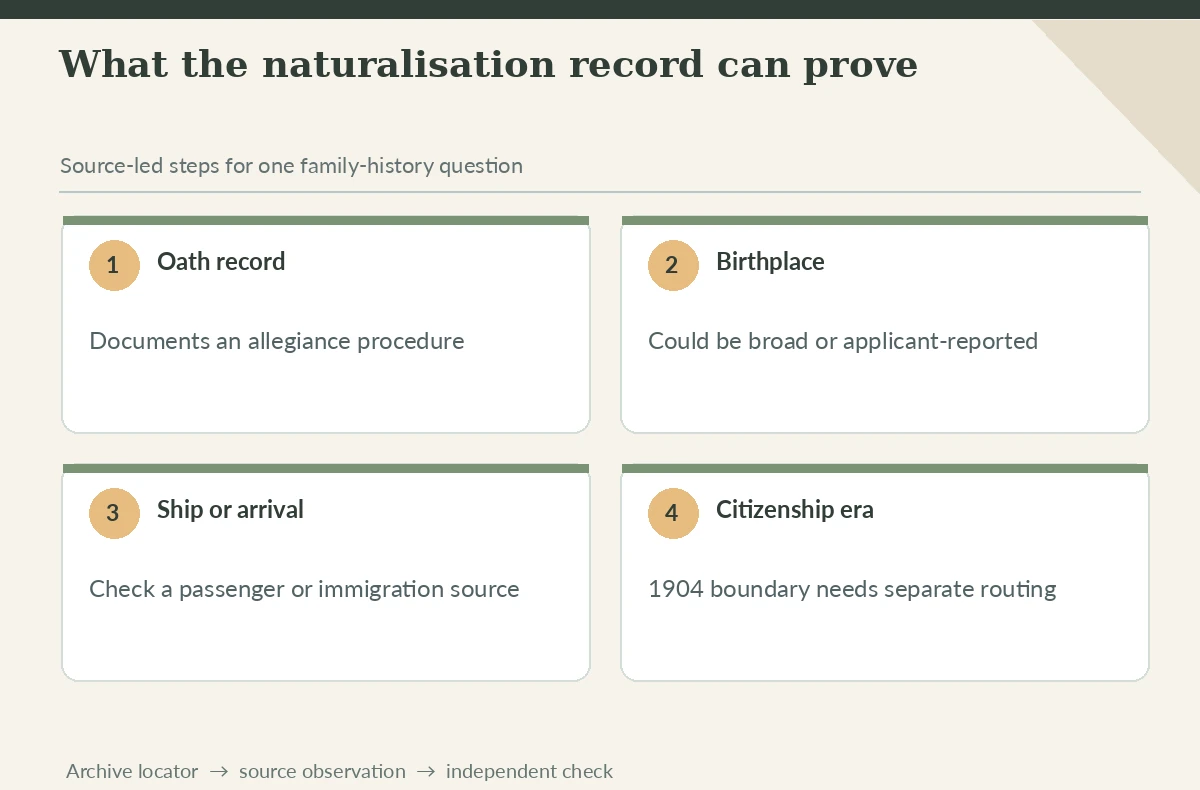
The State Library identifies potentially useful details in historical naturalisation records: full name, native place, occupation, age, arrival date and sometimes ship, with later documents sometimes supplying family status. What actually appears depends on the particular surviving document. An oath is strong evidence that a named person undertook a recorded procedure; it is not an independently verified transcription of the person’s birth abroad or the ship on which they crossed the ocean. For the same kind of choice in another place, see our guide “New Zealand Naturalisation Records Before 1949”.
On the original page, copy the record’s exact label for native place and preserve how broadly it is stated. “Germany” or “France” does not name a village, and a ship name supplied decades later may be misremembered. Record the date the person swore allegiance separately from any reported arrival or residence dates. Cite the item, folio and agency so each reported detail can later be checked against a passenger list or foreign parish register.
Use historical legal categories without applying them to descendants
Not every migrant was eligible or obliged to naturalise in the same way. The historical label “alien” is the language of nineteenth-century law, not a neutral description of a person’s identity today. People from within the British Empire were usually already British subjects, while women and families often had different practical incentives and legal positions. The absence of a woman’s name should never be interpreted as proof that she was not present in Queensland or lacked a migrant background. For the fuller picture, see our guide “Queensland Redeemed Land Orders, 1860–1906”.
When explaining the historical context, specify the date and source of a rule; do not import modern nationality categories into an earlier record. A person’s legal status, birthplace, self-description, spoken language and ethnic identity are separate questions. For genealogy, the most useful output is often a limited, sourced statement about the oath and the place reportedly given, not a sweeping conclusion about ancestral identity.
Test a naturalisation candidate against an arrival record
Create a side-by-side comparison with columns for full name, variants, age, occupation, native place, recorded naturalisation date, stated ship or arrival and current family-tree hypothesis. The naturalisation record is one column of evidence, not the answer key. Seek a ship list, marriage record, rate book or other dated record that can independently place the same person in Queensland. Be especially careful where multiple people shared an occupational surname or changed spelling after migration.
For a fictional Franz Weber, a court record gives an arrival year while a candidate passenger index supplies the same surname but an incompatible age. Do not resolve the mismatch by assuming the passport age was wrong. Search for another Franz, compare occupation and locale, and keep the conflicting candidates visible. A broad homeland claim may remain supportable while an exact village or voyage cannot yet be established.
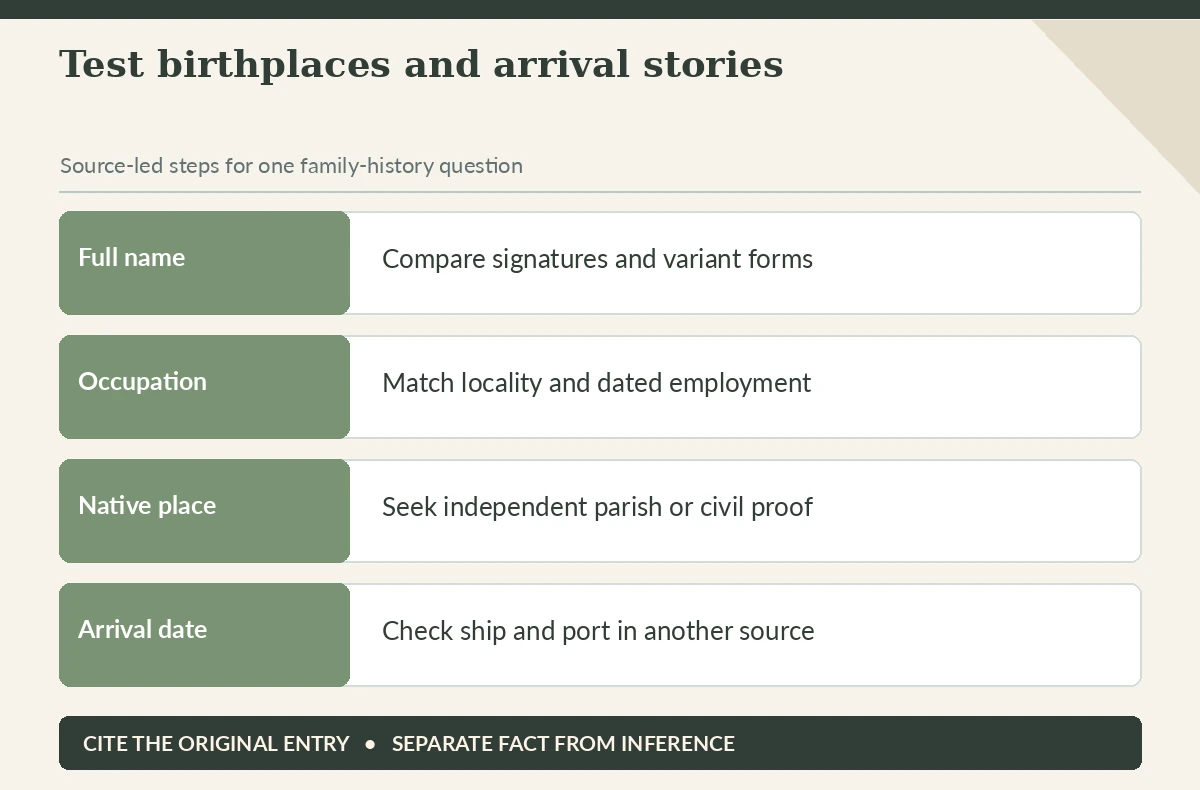
| Record checkpoint | Question to ask | Common false inference |
|---|---|---|
| Full name | Compare signatures and variant forms | Do not assume a separate event or relationship |
| Occupation | Match locality and dated employment | Do not assume a separate event or relationship |
| Native place | Seek independent parish or civil proof | Do not assume a separate event or relationship |
| Arrival date | Check ship and port in another source | Do not assume a separate event or relationship |
Treat missing records as coverage questions, not identity proof
No-result searches require three distinct tests: whether the person needed this procedure, whether the right creating agency and dates were searched, and whether the name might have been written differently. Court indexes and administrative papers can have different arrangements. Look for abbreviations, changed first names and phonetic spellings. Search the official catalogue by series and locality when the name interface fails; an index is not the entire archive.
An ancestor who arrived before Queensland’s separation from New South Wales also raises a historical jurisdiction question. The person may appear in records of the government that administered the area at the time. Document which repositories you checked and why. A negative search is meaningful only within known surviving coverage. Avoid the blanket conclusion that someone was “never naturalised” solely because one Queensland indexed query returned nothing. For the next step, our guide “South Australia Naturalisation Records Before 1904” explains how to find the original file.
Write a conclusion that distinguishes oath, arrival and origin
Once an original has been read, cite Queensland State Archives, its creating agency and series or item, full name, date, page or image ID. A concise finding could be: “This person appears in a named court oath record on this date and reported this native place.” If a separate passenger manifest confirms a ship, cite it separately. If birth registration remains unfound, say the reported origin has not been independently confirmed.
This separation produces a practical next step. A stated town points toward civil or parish records overseas; a ship and date point toward a port-specific passenger list; an occupation points toward a local directory or land record. When the original is not digitized, record the item locator and current access path without falsely claiming to have inspected it. A carefully limited conclusion is more useful than a fluent story built on one index row.
How We Research This Queensland Naturalisation Source
This guide was prepared from the Queensland Government and State Library archival descriptions linked below, checked October 22, 2026. We distinguish a name-index entry, the original record, and an inference about a person. Fictional names in worked examples are not transcriptions of any actual case. Historical records vary in surviving fields and availability; confirm the exact item and current access rules before requesting a copy. If a source has not been read in full, the article does not claim that it has.
More Records and Archives Guides
Primary Archive Indexes and Sources for Queensland Naturalisation
QSA name index from multiple record creators, including Supreme Court, Colonial Secretary, Government Resident and Votes and Proceedings extracts (www.data.qld.gov.au).
State Library of Queensland historical overview of naturalisation data, British-subject limitations and changing administration (www.slq.qld.gov.au).
QSA general indexed search and ArchivesSearch item route (www.qld.gov.au).
QSA open-data CSV resource for Naturalisations 1851–1908 (www.data.qld.gov.au).
Editorial disclosure: No paid recommendation or approved affiliate placement appears in this guide. See the GenHis affiliate disclosure. The records described are historical; protect information about living people, preserve the context of older administrative terms, and do not infer medical, legal or family facts that the original does not state.
No. The index draws on several record creators, including court, administrative and parliamentary records. Follow the entry to its actual series.
No. People who were already British subjects generally did not need this colonial process. Legal status depended on the historical period.
Some surviving records report such details, but not all. Applicant-provided facts need checking against passenger or other records.
Naturalisation became a Commonwealth responsibility from 1904. The Queensland index retains some material dated later; route later applications appropriately.
No. Eligibility, incomplete survival, spelling variants, coverage and different custodians can all explain a missing entry.