
The National Archives identifies RAIL 1204 as records of the Pullman Car Company, covering 1909–1985 and including minutes, agreements and share records. These documents illuminate the business of operating Pullman cars and negotiating with railway organizations; they are not a universal roster of attendants, a list of passengers or a guarantee that every planned service operated exactly as described. Use this series when the research question concerns a corporate decision, contract or shareholder relationship.
The official guide to railway records identifies the series among its resources on locomotives and rolling stock. A company file may explain why a particular car or route was proposed, but a contract dated in one year is not a dated photograph of the service in action. Start by deciding whether the family account concerns a shareholder, a worker, a journey or the history of a named vehicle.
Distinguish Pullman operations from railway ownership
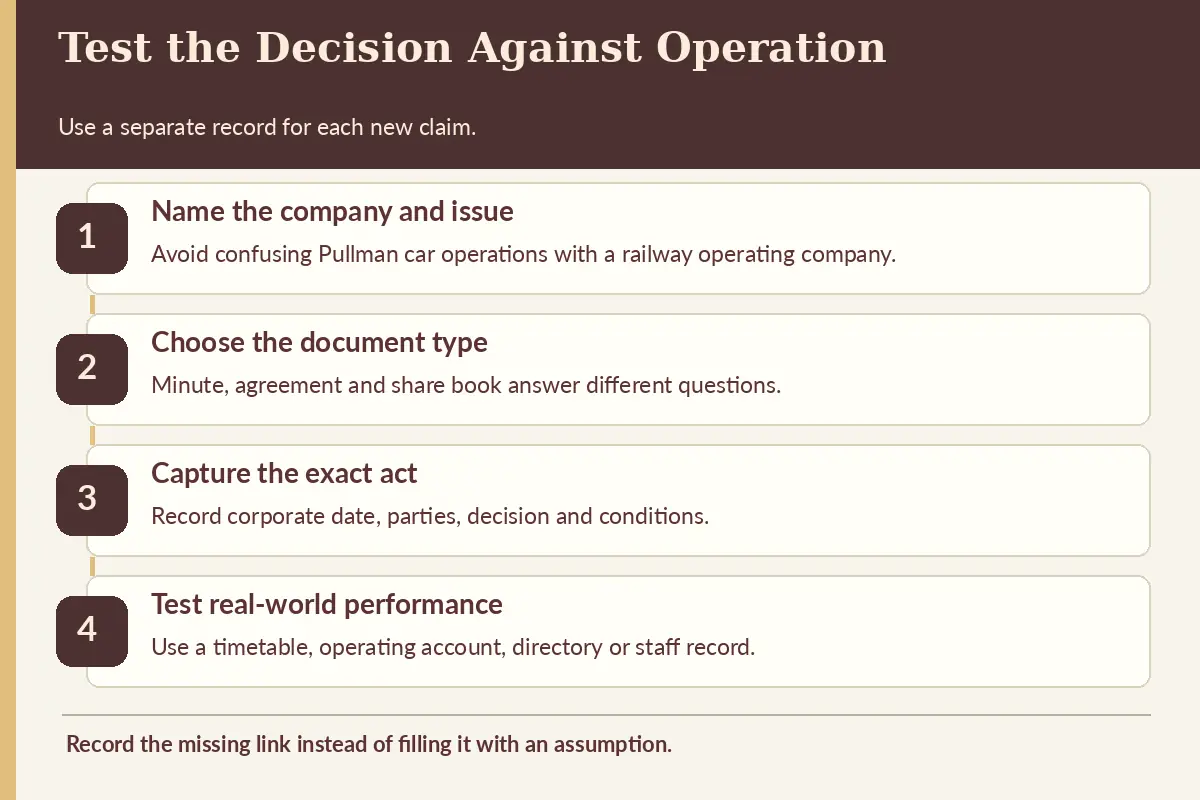
Before searching, establish the relevant Pullman company name, the railway operator involved and the time period. The name on a car or a publicity photograph may not identify the owner of the track or employer of the staff. Britain’s railway industry changed through grouping in 1923 and nationalization from 1948. Contracts can span or be renegotiated across those changes, so do not treat the railway’s later corporate name as evidence of the earlier contracting party.
Create a relationship table with columns for Pullman entity, railway company, type of arrangement, effective dates and supporting document. When a document refers to a route, determine whether it is a proposed service, a named working arrangement or a later amendment. This prevents an attractive narrative about a luxury train from replacing the exact commercial relationship that the archive documents.

Read board minutes as decisions, not outcomes
Minutes can record proposals, authorizations, votes and reports to directors. They may provide names of officers and dates of major decisions, but not the whole process by which a car was maintained or a journey completed. Look for the motion’s actual wording. A resolution to negotiate is not an executed contract. A decision to acquire or refurbish cars is not proof that the work was carried out. Record any conditions and references to supporting schedules.
Create an event ledger separating proposal, resolution, agreement, delivery and service. Each stage may need a different source. If a meeting report mentions a route only incidentally, avoid expanding that single mention into a continuous timetable. An absence in the minutes is not proof that a local operational event never occurred; company administrative papers are selective accounts of matters brought to the board.
Check agreement parties and the dates that matter
Agreements are particularly useful for the terms under which cars or services were supplied. Transcribe both parties, signatures or stated authority, provisions about fees or facilities where present, and the defined period. Note whether a page is a draft, signed document, supplement or renewal. A historical agreement can survive even if the intended service was later modified or abandoned. If terms say the arrangement begins on a condition, avoid using the document date as the operational start date.
To test implementation, compare a contemporaneous public timetable, railway working instruction, company report or dated press notice. Each has different weaknesses: advertising may describe an ambition, working instructions may change and a later history may compress several years into one line. Only after correlating such evidence should you describe a real route. When a named car appears, confirm that the name refers to the same vehicle and year.

Treat share records as property evidence, not passenger data
A share entry can point to an owner, transfer or financial holding if the relevant register identifies it, but shareholder names do not constitute an employee list. Nor does ownership prove a person traveled on the company’s services. Compare the shareholder’s identity with an independent address, probate paper, company filing or directory where available. If the company’s register names a trust or firm, do not replace it with a presumed family beneficiary.
Different types of ownership should be distinguished: shares in the Pullman company, ownership of railway stock and ownership of land or buildings are not interchangeable. The same person could be a shareholder and have no operational role at all. For someone said to be a steward or conductor, seek payroll, union, company or local records that actually describe employment; RAIL 1204 is not the default answer to every railway genealogy question.
Create a defensible corporate and local-history account
A trustworthy statement quotes the specific minute, agreement or share entry, provides its date and names the parties or decision exactly. Add a separate citation for the operational event you infer from it. If the record is not digitized, note the catalogue description and whether you have seen the actual pages. The National Archives warns that many railway collections must be consulted at Kew or by ordering copies, and not all railway records are centrally held.
Conclude with an evidence-status table: documented corporate action, external confirmation, competing interpretation and next record to search. This is valuable for a history of a station, hotel-linked Pullman service or family business connection. When the evidence establishes only an intention, retain the words “proposed” or “agreed,” rather than silently upgrading it to “operated.”
More House and Local History Guides
How We Research and Verify These Archive Routes
This guide is grounded in The National Archives research guidance, which identifies the collection purpose and relevant series. We retain the exact piece reference using Discovery, and read the original item whenever possible before assigning a date, role or person to a specific event. A catalogue description establishes a route to evidence, not every fact that the original item might contain.
Our diagrams are original explanatory illustrations, not photographs or facsimiles of archive documents. Dates given for a series are not guarantees of complete survival or personal indexing. This guide does not assume a paid relationship with any archive or copying provider; our affiliate disclosure explains the site’s editorial approach.
The National Archives describes Pullman Car Company minutes, agreements and share records dated 1909–1985.
No. Check an operating record, dated timetable or report of actual service.
Potentially, where a preserved share record names the person; inspect the original entry.
RAIL 1204 is a corporate record group, not a comprehensive passenger list.
Not usually for direct employment proof; search staff or payroll material held by the relevant employer.