
The National Archives describes annual port returns of fishing boats in series BT 145, with entries arranged by alphabetical ranges of boat names. The Merchant Shipping Act of 1894 required fishing boats to be lettered, numbered, registered and supplied with official papers. These facts give researchers a practical boat-first search. They do not make BT 145 a universal crew list or proof that a particular fisherman sailed in every year recorded. See the official merchant ship registration guide for the distinct purposes of the series.
If a family story says that a relative worked on a particular trawler or sailing smack, begin by finding the vessel as a historical object: name, port, identifying mark or number and date. Then seek person-level evidence separately. A record about a boat can clarify the setting for the story without naming the person who worked aboard it.
Fix the boat’s identity before a surname search
Write down the boat name exactly as it appears in the earliest dated source and collect alternative spellings. Fishing boats could change owners, port connections and names. Record port letters, registration numbers or other identifying markings only when a source shows them. Distinguish a photographed boat from the vessel of a similar name in a register. A modern fishing-port label must not automatically be projected onto an earlier administrative geography.
For a hypothetical family photograph labeled “Sea Venture, Hull,” do not select a BT 145 entry until the approximate date, boat type and available marks are compared. If two vessels share the name, maintain two entries in the research log. It is more useful to retain an unresolved boat identity than to create a misleading list of crew, relatives and voyages based on the first attractive name match.
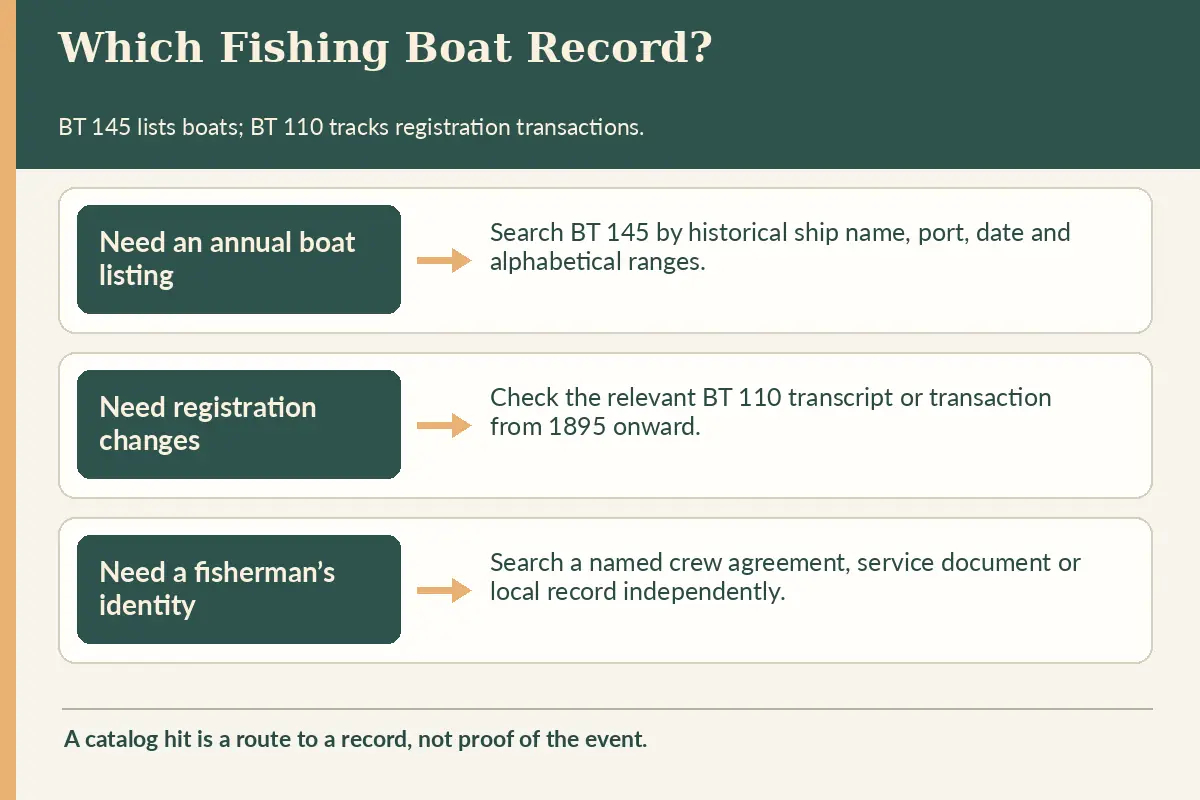
Use annual BT 145 returns for the year and port
Search the catalogue for BT 145 and consult the relevant piece description for the year and alphabetical ship-name range. The annual character of the series makes the date a crucial part of the query. Follow the order of the surviving book rather than assuming a single searchable web form includes all returns. Record the entry’s own spelling, number, port and any other details that actually appear, together with the piece and page.
One year’s appearance can document a boat in the return for that year; it does not guarantee that every month was actively fished, that the crew remained constant or that the vessel remained at the same port indefinitely. If a boat is missing from a given return, check the period, alphabetical range and alternative name before interpreting the omission. Missing coverage, filing practice and a real boat’s absence are different explanations.
Decide whether BT 110 is the correct next source
The same official guide identifies transcripts and transactions relating to fishing boats in BT 110 from 1895. This is a different documentary function from an annual port return. If the question concerns a registered ownership change, registration history or vessel particulars, examine the BT 110 material for the correct period and ship. Use the reference and identifying fields to ensure you did not connect a same-named boat at another port.
Do not assume that a registration change proves an actual day of fishing or that registered ownership equals a named captain’s working presence. A family business may own a boat while hiring different crews; an individual fisherman may serve on vessels owned by others. Keep an “ownership or registration” line distinct from “who was aboard.” Where a transfer is recorded, note its date and named parties, without projecting that arrangement through undocumented years.
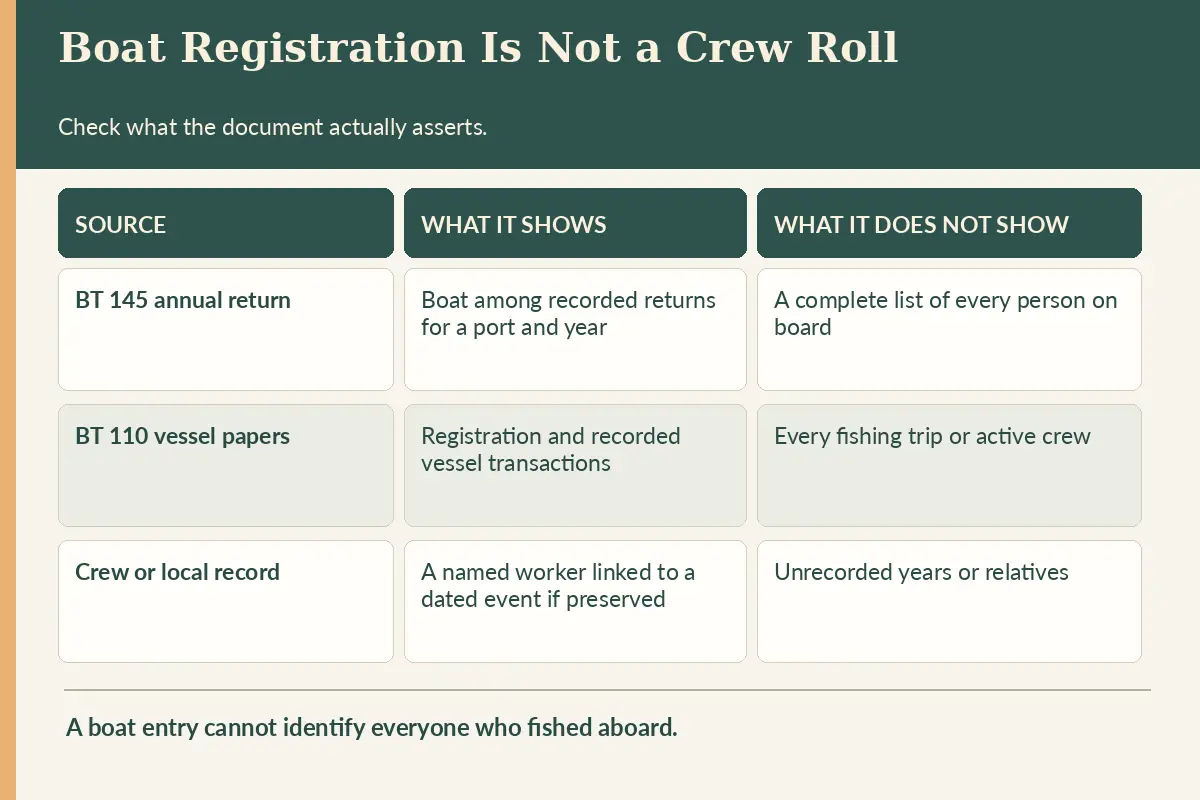
Find people through crew-level evidence
To test the statement “my great-grandfather sailed on this boat,” find a dated source that actually names him in connection with the vessel. Depending on time, locality and survival, a crew agreement, personal document, maritime incident record or contemporary newspaper account may help. Check whether it identifies a worker, owner, master or witness. These roles are not interchangeable. An indexed surname without a ship identifier is weak proof when a fishing port employed several people of the same name.
Compare age, home address, next of kin or other distinctive details only if they appear in reliable records. A boat named in a family letter does not by itself establish a voyage. A photograph of the boat with several unidentified people proves neither their identities nor their working roles. If no person-level evidence survives, a responsible account can still tell the verified history of the vessel and state where the family connection remains unproven.
Construct two timelines rather than one
Build a vessel timeline with years of BT 145 appearances, evidence of a name or port change and any BT 110 registration event. Beside it, construct the proposed fisherman’s timeline from independent sources: residence, occupations, marriages and named maritime records. Only draw a connecting line where a document specifically relates the person to the boat. This simple separation prevents a vessel’s long registration life from becoming an invented uninterrupted career for an ancestor.
Mark each source as original register entry, catalogue description, later transcript or family recollection. The distinction matters because a catalogue summary can omit the field needed to settle competing ships. Record unsuccessful searches by exact years and alphabetical range. If the surviving material is incomplete, an empty year should remain an evidence gap, not be annotated as a definite closure or sinking.

State a narrow, useful finding
An evidence-based result might say: “An annual fishing-boat return in BT 145 records a vessel of this name and port in [year]. A separate BT 110 record documents [specific registration event].” The statement about a named ancestor should follow only when a dated person-level document links that individual to the boat. Avoid adding a captain, crew list, route or catch to the finding merely because the vessel is in the register.
Preserve the full series, piece, return year, page and original spelling. Note which of the candidate boats was chosen and why. If later research discovers another boat with the same name, a transparent identity ledger makes the conclusion correctable without losing useful research. This is especially important when family stories preserve affectionate vessel names but not the official documentation needed to distinguish them.
More Records and Archives Guides
How We Research and Verify These Historical Records
We start with the official research guide from The National Archives to establish the series function, then check Discovery for the actual piece and current access description. A guide or index may lead to an original; it does not replace reading the original. We distinguish document dates from event dates and report claims only at the level that surviving evidence supports.
Illustrations here are original explanatory reconstructions, not reproductions of historical archive documents. Coverage ranges never promise complete preservation or name indexing. No paid archive relationship is implied; see our affiliate disclosure for editorial transparency. If an image or catalogue entry is all that has been viewed, we do not claim direct examination of its underlying file.
The National Archives identifies annual returns of registered fishing boats from ports, arranged by alphabetical ranges of vessel names.
Legislation in 1894 required fishing boats to be marked, documented and registered.
The official guide points to BT 110 from 1895.
Do not assume it does; the described returns are boat-registration evidence.
No. Check date, historical name, port, index scope and record survival before drawing conclusions.