
Identify the Small Fishing Boat Before Searching
BT 144 is a specialized set of British fishing-vessel crew agreements. Maritime research guidance identifies a 10% sample of records for fishing vessels under 80 tons beginning in 1884; the commonly cited span for the separate small-vessel sample is 1884–1919. It is not a census of everyone who fished from a British port. The first question is whether the vessel and year fall within the relevant small-boat category.
Start with the vessel’s registered name, port, approximate tonnage and, where possible, official number. These identifiers serve different purposes. A boat name can recur or change; a port may refer to registration rather than the place where the crew actually worked. The official number, introduced in the nineteenth century, is especially useful for linking a ship across records. It does not, by itself, identify the crew.
Keep two searches separate: a vessel search to locate the right agreement and a person search to decide whether a named seaman is the individual in your family history. A familiar surname appearing on a nearby boat is not enough. Use age, birthplace, occupation and other known details as competing identity tests where the surviving documents provide them.
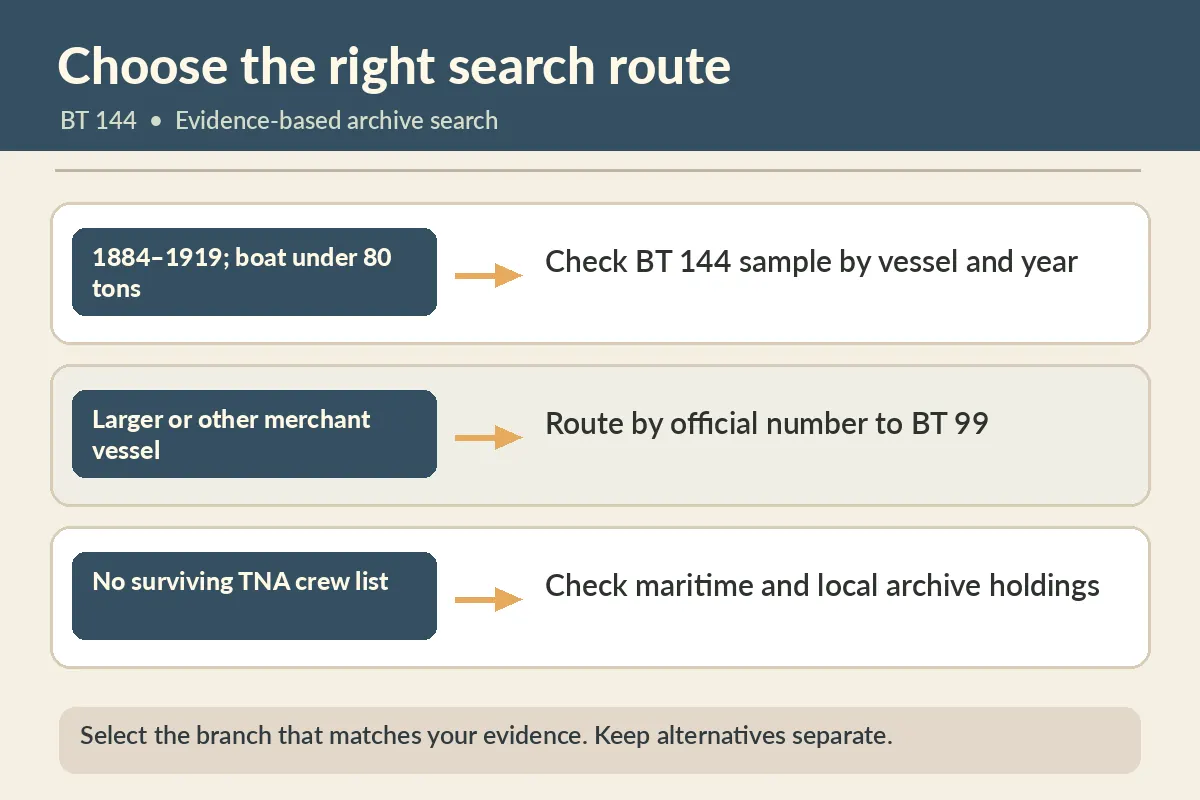
Choose BT 144 or a Different Crew Series
If the question concerns a small fishing vessel in the BT 144 period, begin with that sample and the date and vessel identity you can establish. The Crew List Index Project specifically distinguishes BT 144 from BT 99, the larger run of surviving merchant crew documents, and BT 100 for selected famous vessels. These groups are not a universal chronological succession; each describes a particular kind of survival or selection.
For other vessel types and later records, the National Archives guidance directs researchers through BT 99 and related repositories by ship number and year. Check the relevant custody before assuming a blank catalogue search is conclusive. Many agreements survive outside Kew. The Maritime History Archive in Newfoundland holds extensive British merchant crew agreements, while further material is found in maritime museums and local archives.
Do not infer that 10% means a random 10% of the names in every individual register. It is a survival and selection description, not a probability that proves the person was absent. A missing piece may mean the document was not retained, was deposited elsewhere, has a different vessel identifier or was indexed at a different level. Record which search avenue actually produced the negative result.

Read the Agreement as a Dated Service Record
A crew agreement often gives a crew member’s name, age, birthplace or capacity, and dates and places of joining and leaving. Actual fields and completeness vary with the form and period. Record the label on the original form instead of normalizing every person to “fisherman.” A cook, deckhand, mate or apprentice may be recorded with a more specific capacity relevant to identity and employment.
Crew lists and agreements document the relationship recorded for a voyage or reporting period. They do not necessarily offer a diary of daily fishing trips, catches or movements. A person listed on one document may have joined after other crew members or departed before the next return. Do not convert a half-yearly form into continuous attendance at sea without checking its stated reporting period.
Transcribe each candidate exactly and note uncertainties in handwriting. Build a vessel-and-person grid with ship number, port, date, recorded role and known biographical matches. Compare any repeated records to see whether the same person can be traced or whether two seamen share a common name. A discrepancy in age might be a clerical error, but do not decide that before testing other identifiers.
Trace Ownership, Voyage and Crew Claims Separately
A registration document can identify a vessel and its changing ownership but does not necessarily list its working crew. A crew agreement names a seaman for a specified period but may say nothing definitive about the vessel’s legal owner. A newspaper notice about a storm or landing may describe an event without listing every person aboard. Keep these records in three columns rather than merging them into a dramatic but unsupported family story.
If you need to establish that an ancestor was at sea on a specific day, check the dates of a surviving agreement and whether an official log or dated local report exists. Entry or discharge dates are not automatically dates of every sailing. Be especially cautious when a boat carried the same name as another registered in a nearby port. Compare the official number, port and vessel particulars before attaching an incident.
For nineteenth-century coastal communities, local port registers, fishermen’s associations, newspapers and cemetery records may supply independent context. They can corroborate a sailor’s identity or a vessel’s location but have their own limits. A fisher’s residence in a coastal parish does not establish the craft he worked on, and a master’s name on a register is not a full roll of those who crewed the boat.

Document the Search and the Unavailable Years
Cite the series, piece, document date, vessel identifier and relevant entry or page. If the source is held at another archive, cite that repository rather than treating the National Archives guide as though it contained the original. A strong citation makes it possible to repeat the search and check the exact crew member. Maintain a note about access restrictions or copy charges as they are encountered, rather than assuming digitization is universal.
Write a preservation checklist for every investigated boat: BT 144 searched; BT 99 if appropriate; Maritime History Archive index reviewed; relevant local holdings checked. Keep a separate column for years never checked. Do not mark them “no crew” and do not stretch a single surviving entry across several fishing seasons.
The practical outcome is modest but valuable: an identified vessel, a dated document naming a seaman, and a clear statement of what remains unconfirmed. If the BT 144 sample produces no result, the documented search path tells you which custodian or related record might still preserve the evidence. That is stronger genealogy than an unqualified claim that the ancestor never went to sea.
More Records and Archives Guides
How We Research and Verify the Archival Record
For this guide we checked the official series and research descriptions for BT 144 against the document categories, chronological boundaries and access limitations specified by the custodians. We separate series-wide statements from claims about a particular piece: the former establish a search route, while the latter require the piece itself. Our principal source descriptions are Findingoncrewlists Merchant Navy Ships Records Crew Lists Musters And Log Books Crewlist.Php. These sources support reference names and evidence limits; they do not certify an uninspected record as proof of an individual event.
Our verification worksheet records the claim, exact BT 144 reference, creation date, nature of the entry, names and roles actually written, independent source used for comparison, and any unresolved alternative. The illustrated search routes are teaching illustrations, not facsimiles of original records. Consult the affiliate disclosure for the site editorial and commercial policy. This article does not depend on an unverified paid provider or a claim of access to closed material.
It contains a sample of crew agreements for fishing vessels under 80 tons, beginning in 1884.
No. The surviving National Archives holdings are a sample; absence is not evidence that a seaman never served.
The commonly described BT 144 small-vessel sample covers 1884–1919.
Yes. A ship’s official number can help reconcile names and locate crew agreements for the right boat.
Read a dated crew agreement naming the person and verify the match against independent biographical evidence.