
Decide Whether You Need Haig’s View or a Unit Record
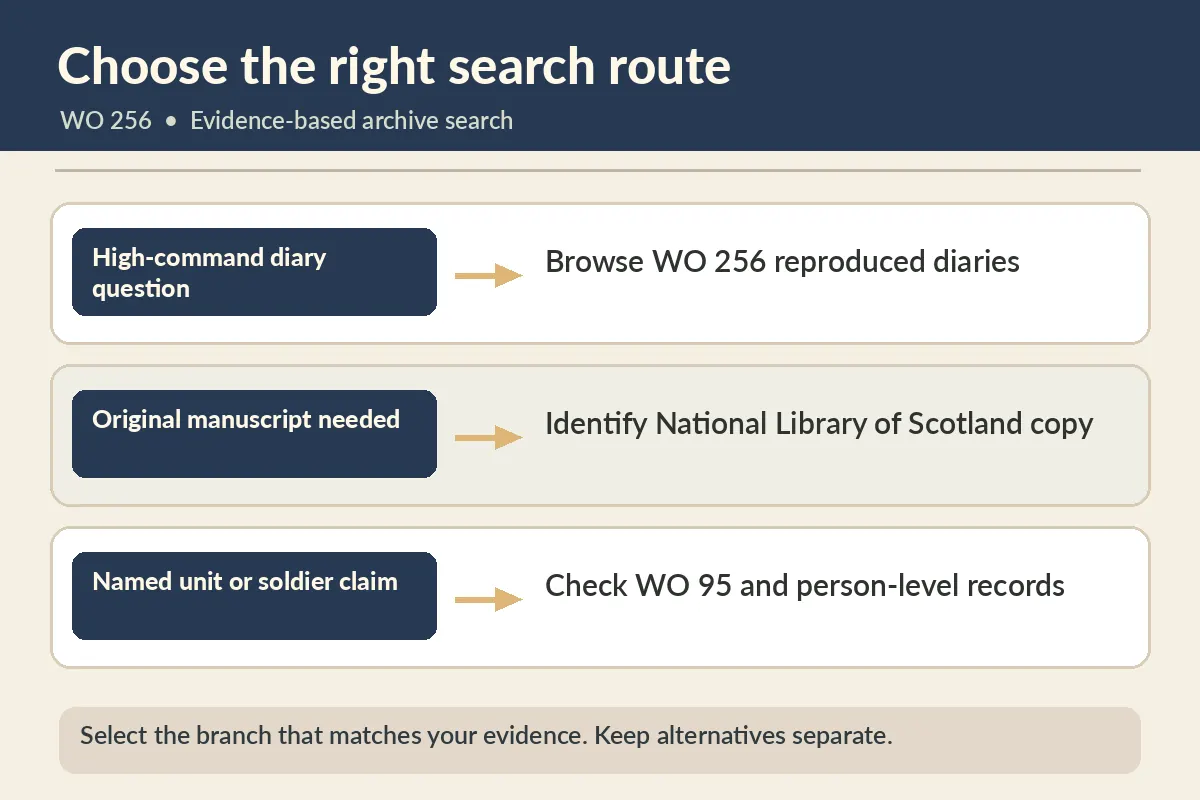
WO 256 is the National Archives series associated with the diaries of Field Marshal Sir Douglas Haig during the First World War. It is a valuable high-command perspective, but a diary entry is not a complete record of every unit or every soldier. Start by asking whether you want to understand Haig’s stated assessment of an operation or to establish what happened to a named regiment on a particular day. These tasks require different sources.
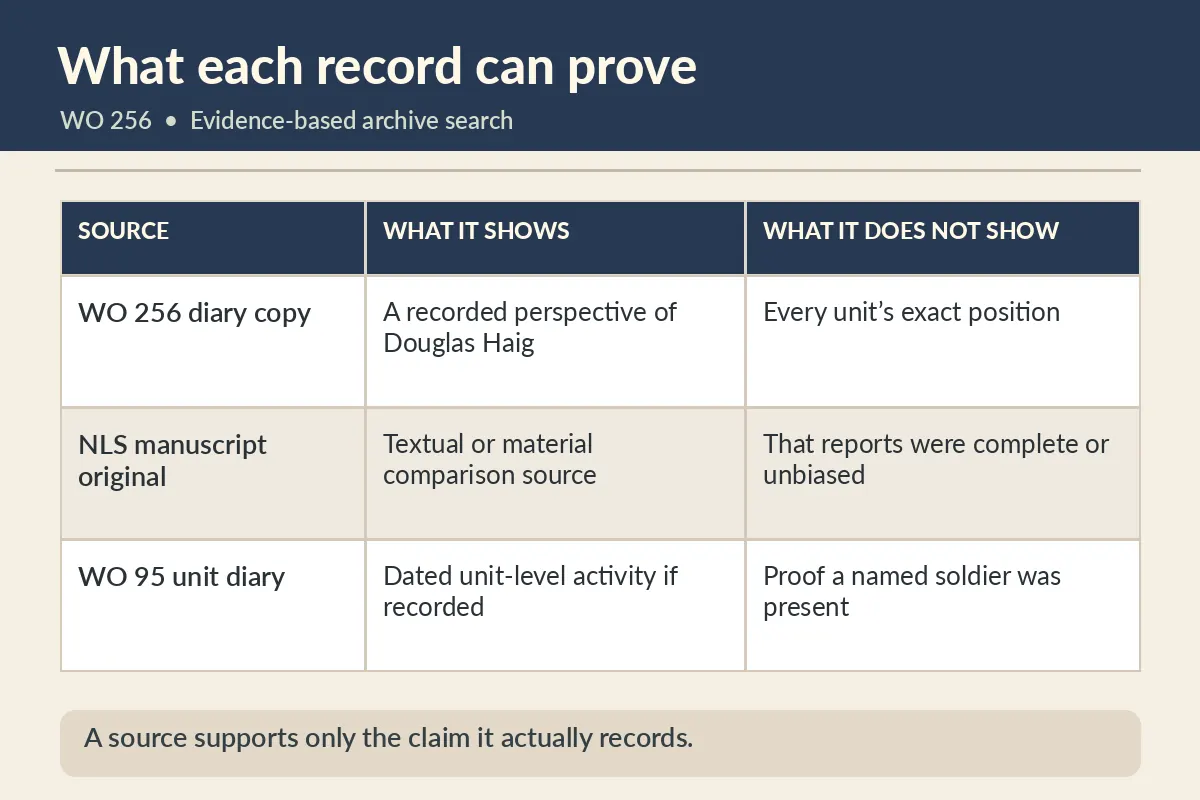
A commander might summarize reports received from elsewhere, describe meetings, record a decision or express a personal interpretation. An entry proves that a statement appears in the text you consulted; it does not automatically certify every event described. Treat the date of the entry, date of the reported incident and any subsequent editorial changes as potentially different. Preserve the exact wording in your research notes where permitted.
If your family-history claim concerns one soldier, first establish the man’s regiment, battalion and service interval from appropriate personnel records. A diary mention of a division is evidence about the commander’s view of that formation. It is not proof that all soldiers attached to the formation were present on the ground described at that moment.
Distinguish WO 256 Copies From the Originals
The National Archives gives an unusually important custody and rights warning for WO 256. Its copies of Haig’s manuscript diaries are held at Kew, but the originals are preserved at the National Library of Scotland. The two repositories should not be cited as interchangeable. If your conclusion depends on handwriting, deletions or differences between versions, investigate the original manuscript and its description.
A reproduction can preserve extensive text yet still need contextual checks. Identify the precise volume or piece, diary date and format consulted. If you use a published transcription or edition, name that edition separately; editorial decisions can influence presentation. Do not create a false impression of having examined original handwritten pages if your research was limited to a reproduction or published extract.
The National Archives special copyright guidance states that the diary copies have a rights holder outside the ordinary public-records framework. It permits private study and noncommercial research access under specified terms and directs researchers to seek permission for quotation and other uses. Check the current wording and the holder before reproducing substantial text or imagery. Our diagrams are modern teaching illustrations, not archival facsimiles.
Connect a Diary Entry to Operational Records
To test a stated movement, instruction or assessment, find the date and relevant formation, then consult independent operational material. The National Archives directs researchers to First World War unit diaries in WO 95. These diaries can show unit-level actions, locations and orders. They do not automatically prove the presence of every individual in the unit; separate service, casualty or other person-level evidence may be needed.
Compare records by exact date and time convention when available. An operation described by a commander on one day may appear in a unit diary as orders received earlier or as action reported later. Avoid assuming a narrative order of printed passages is the same as the sequence in which events occurred. Include delays in communication as a possible explanation for differences rather than treating every difference as an error.
A strong comparison note has columns for Haig’s diary statement, the WO 95 unit entry, the source date and the unresolved discrepancy. Do not call the second document independent merely because it has a different series number: a unit diary may repeat the same headquarters report. Where possible, look for an independent contemporary letter, war-office file or another direct record of the event.
Handle Orders, Opinions and People as Separate Claims
A diary may record that a commander considered an offensive, received news from a subordinate or expected a unit to act. Those verbs matter. Considering an operation is not issuing an order; issuing an order is not evidence that every part of it was carried out. Look for dated orders and after-action documentation before writing that a plan became a completed military action.
The language of wartime assessments can include broad judgments about allies, enemy strength or the morale of troops. Attribute the judgment to the author rather than repeating it as an objective measurement. When the subject is a historically marginalized military group or a contested campaign, compare perspectives and make clear what the archival source actually records. A senior officer’s diary is not the voice of every person involved.
If the text names a subordinate or correspondent, identify the person’s role and avoid treating proximity to a commander as evidence of participation in a specific battle. A staff officer, visiting general or messenger may appear in a diary in a different capacity from a front-line soldier. Reconstruct a family link only from separate identity and relationship records.
Present a Source-Aware War Timeline
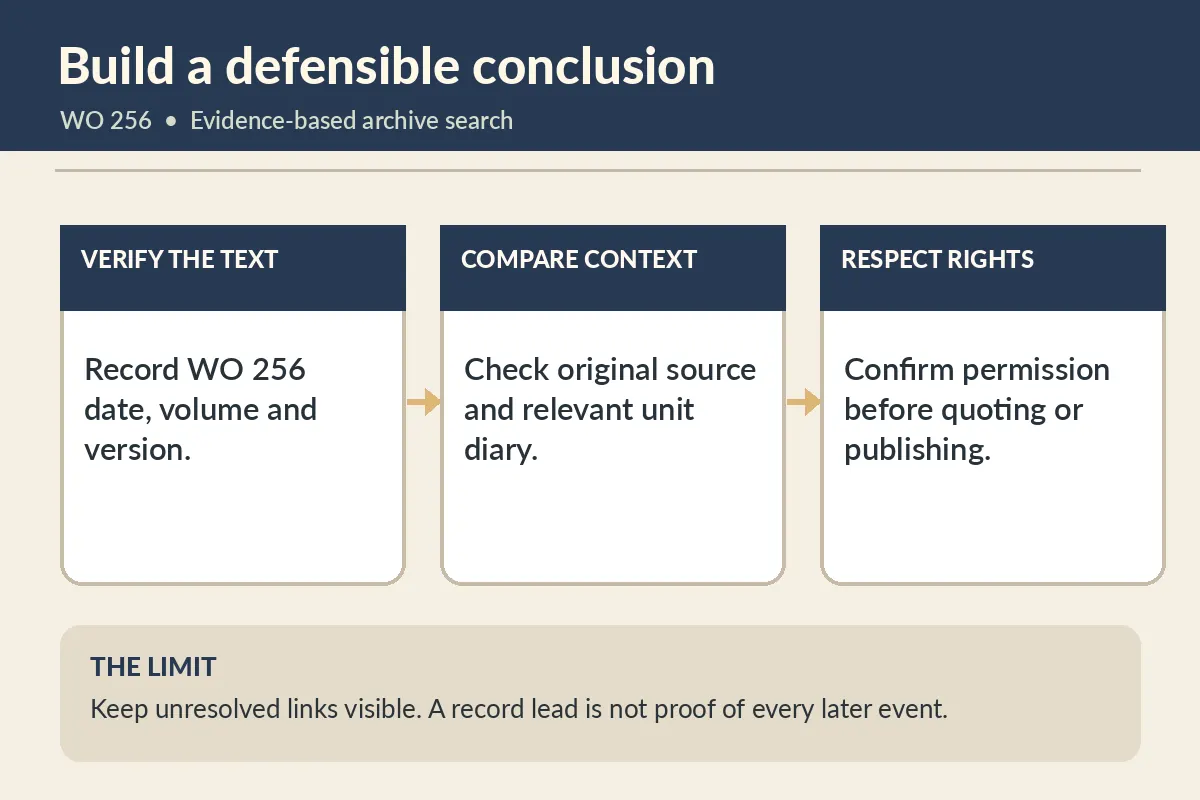
Record the WO 256 reference, date and consulted version in each timeline entry. Set the summary beside independent records with their own exact citations. Mark factual observations, reported information and the writer’s interpretations as separate categories. Where accounts disagree, explain the disagreement and note what record would resolve it. Chronological precision is more persuasive than an unsupported narrative of what “must have happened.”
When quoting or reproducing from the diary, check the National Archives terms and, if required, obtain permission from the appropriate rights holder. Do not assume the ability to consult or download a copy implies permission to publish it. A family or educational project can convey the finding in an original paraphrase with proper citation while respecting rights and keeping quotations appropriately limited.
The best result is a defensible layered conclusion: what Haig recorded; what a unit-level record supports; and what remains unknown about an individual soldier. That layered method makes a high-command source useful without elevating it into a comprehensive service record or overlooking the different custodians of the manuscript and reproduced diaries.
More Research Method Guides
How We Research and Verify the Archival Record
For this guide we checked the official series and research descriptions for WO 256 against the document categories, chronological boundaries and access limitations specified by the custodians. We separate series-wide statements from claims about a particular piece: the former establish a search route, while the latter require the piece itself. Our principal source descriptions are First World War Use Of The National Archives Materials British Army War Diaries 1914 1922. These sources support reference names and evidence limits; they do not certify an uninspected record as proof of an individual event.
Our verification worksheet records the claim, exact WO 256 reference, creation date, nature of the entry, names and roles actually written, independent source used for comparison, and any unresolved alternative. The illustrated search routes are teaching illustrations, not facsimiles of original records. Consult the affiliate disclosure for the site editorial and commercial policy. This article does not depend on an unverified paid provider or a claim of access to closed material.
The National Archives identifies WO 256 as reproductions of Field Marshal Douglas Haig’s First World War diaries.
The National Archives states that the originals are preserved at the National Library of Scotland.
No. Confirm the unit movement independently, then use individual service evidence.
Do not assume so. The National Archives identifies a separate copyright owner and requires permission for quotation or other uses beyond private study or noncommercial research.
Contemporaneous unit war diaries in WO 95, orders, correspondence and independent operational evidence as relevant.