
GWR Locomotive Registers offers a defined route into historical archives, not an instant family biography. Start with the exact series, record the date and administrative purpose of the document, and separate direct evidence from inference. This article explains what to look for, how to test competing matches and where the record cannot support a claim. It is based on archival guidance rather than an invented example of a named family.
For the initial search, note a specific person, institution, equipment identifier or place; a working date range; and the question to be answered. Check The National Archives research guidance before selecting an archival series. A catalogue description may guide you to a record, but a transcript or title is not the same as examining the page itself.
Begin with the engine, not a driver
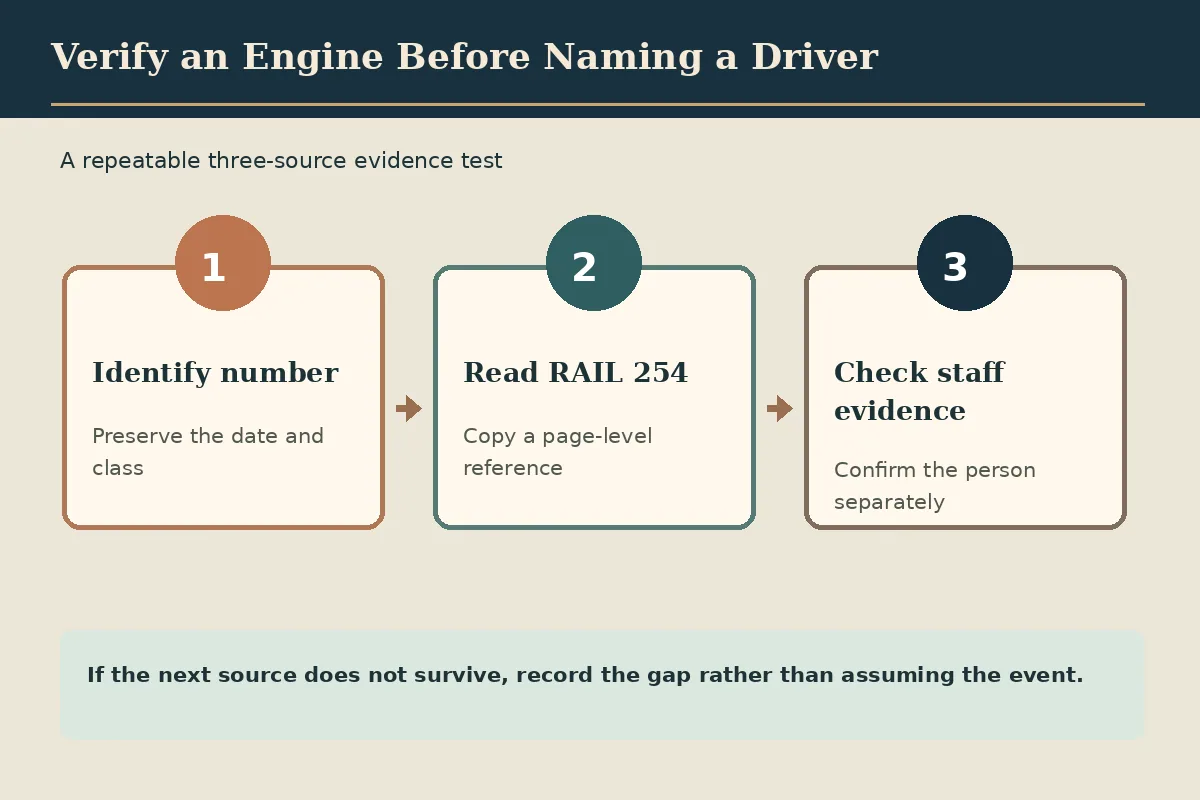
The useful starting point is a locomotive number paired with a date, railway company and type. A family story that an ancestor drove a particular Great Western Railway engine should be separated into two questions: can the engine be traced, and can the person be placed in that job? RAIL 254 helps primarily with the first. Record every apparent renumbering as an event to test, not a permanent identity assumed from a photograph.
The National Archives describes 50 continuing GWR locomotive and rolling-stock registers in RAIL 254. That phrase refers to records surviving within a collection, not a promise that each engine has a complete life story. Search the catalogue by reference and then inspect individual descriptions for relevant date spans. A locomotive class or a repeated number may create more than one candidate unless you also compare the period and technical identification.

Choose a register with the right evidence scope
Before ordering, write down the evidence you hope a register will provide: an engine number, class, works connection, transfer or withdrawal context. Such details depend on the actual volume and must be confirmed from the heading and entries. Do not assume that a modern spreadsheet transcription contains all marginal corrections or that a class description identifies the locomotive seen in your family photograph.
Search the railway guide for RAIL 254 and follow its reference into Discovery. Browse the result hierarchy until the piece date, description and access notes are clear. If a description is broad, ask for the specific register and retain its full reference. The archive warns that much of this material is not viewable online. A catalogue hit is a finding aid; the page of a register is the source you must actually read.
Test numbers, classes and date changes
Create an engine-identity table with columns for number as written, possible class, date of the entry, physical or operational description, original reference, and level of certainty. Compare each clue with a dated photograph, timetable, works record or another independent railway document. If a number has been reused, your date bracket becomes the discriminator. Do not merge an older engine and a later one merely because their numbers match.
An example illustrates the method without claiming a real railway fact: a photograph labeled 1905 shows engine 123, while a register transcription gives a number 123 in a different decade. The conflict is not solved by preferring the brighter image. First examine the date attached to each piece of evidence; next compare class and physical features; then trace any documented renumbering. Preserve the mismatch until a record actually resolves it.

Separate locomotive records from employment records
A register of locomotives records railway equipment. It does not normally establish who drove a particular train on a particular day. Even a station name written beside an engine does not prove a driver lived there. To test a family statement about a driver or fireman, locate company-specific staff records, appointment notices, wage registers or contemporary newspapers. An independently dated document should identify the person, role and railway business.
Beware of changing corporate identity. The National Archives guide notes that many British railway companies were grouped in 1923 into four large groups, but a vehicle history can cross earlier company boundaries or later periods. Record the company name in use at each date instead of assuming a document filed under GWR covers the same administrative circumstances throughout the engine’s working life.
Correlate a photograph, a register and a location
Treat a photograph as a separate source with its own provenance. Record where it came from, the earliest known owner of the print, whether the number is truly legible and whether the location is identified independently. Then compare visible details such as wheel arrangement, cab silhouette and lettering with dated railway evidence. Photographic appearance is a clue, not a mechanical proof of the image’s claimed year.
For house and local history, a station or works connection can lead to maps, valuation records and local newspapers. Those sources may establish how the place changed while the locomotive was in use. They do not prove your ancestor was employed there. Keep a place-history conclusion and an individual employment conclusion in separate rows so one plausible story does not automatically become the other.
Record gaps before accepting a family tradition
When a register entry is missing, document whether you searched the correct volume, adjacent numbers, variant class descriptions and a plausible date span. A missing hit can reflect poor indexing, a changed number, a volume outside the period, or records that did not survive. It cannot by itself disprove operation or a person’s work. Write the exact negative search scope rather than “the locomotive never existed.”
Finish with a short source-based statement: “This register associates the engine identifier with an entry dated X,” if that is what you read. Put any suggested driver, route and residence in a separate unconfirmed column pending independent evidence. That distinction is what turns a pleasing photograph into a defensible railway family-history study.
More House and Local History Guides
How We Research the Original Sources
The primary source for the series description is The National Archives research guide. Its description identifies the appropriate archival category and warns where a record is administrative rather than person-level evidence. The supporting source, a second National Archives reference, helps check historical context or piece-level holdings. Dates, fields and names must still be read from the particular original document; this guide does not claim to have examined an unidentified manuscript page.
Editorial method: record the exact reference and date, preserve source wording, classify the evidence question, compare at least one independently created record, and mark unresolved alternatives. We do not assume a family relationship, personal attendance, residence or construction outcome from a generic institutional description. If a record is unavailable, its absence is a search limitation. Read our affiliate disclosure; no paid provider endorsement or unverified commercial link is made in this research guide.
No. These are locomotive and rolling-stock registers; the driver requires independent personnel, operating or contemporary evidence.
Do not assume so. Inspect the Discovery descriptions and access instructions; the archive notes that many railway records need on-site consultation or copies.
Keep every number with a dated source and test class and identity before joining the entries.
No. A location linked to equipment is not a residential record for a named individual.
Record RAIL 254, the exact piece, folio or page where available, date, heading, and a precise transcription.