
Choose BT 41 for the Early Registered Company
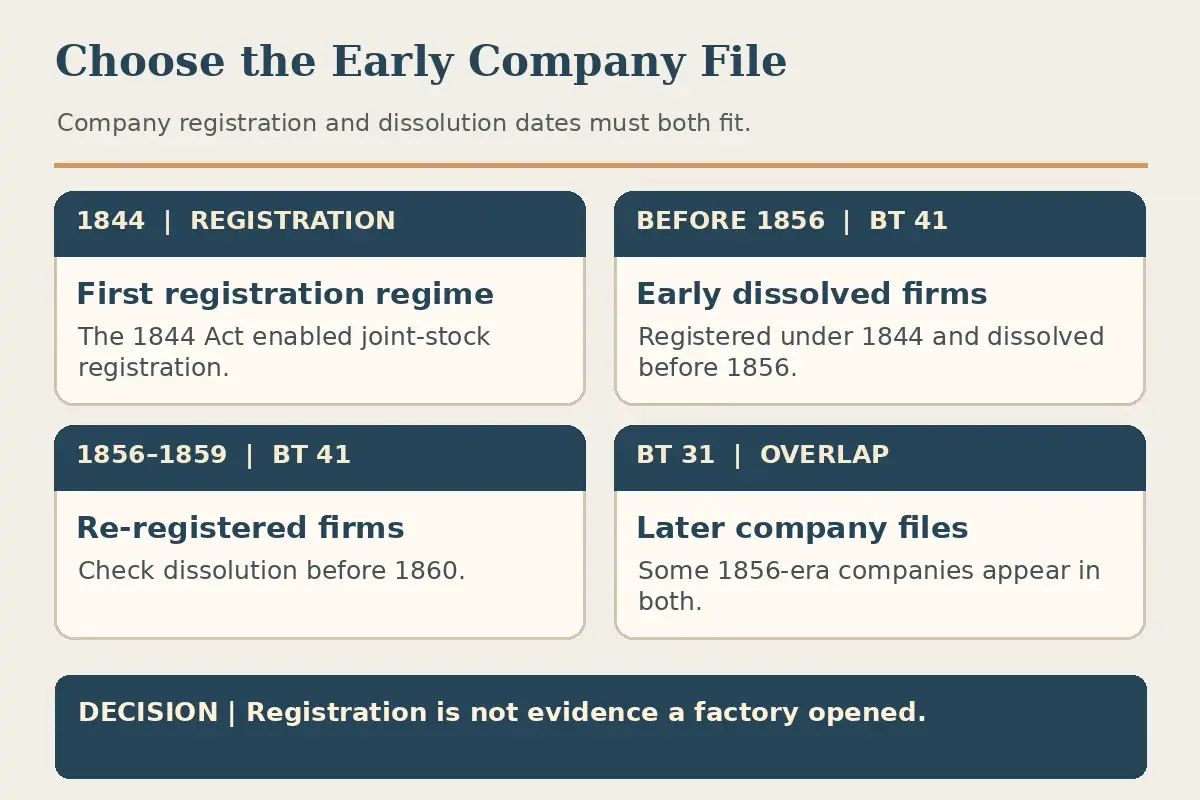
BT 41 contains registration files for early joint-stock companies, including those registered under the 1844 legislation and dissolved before 1856, and companies re-registered under the 1856 Act and dissolved before 1860. The National Archives identifies both General and Railway divisions. These files document legal formation, capital arrangements and dissolution procedures. They are not ordinary staff files or a full record of factory operations. Start with the exact registered company title and an approximate date of registration or winding up.
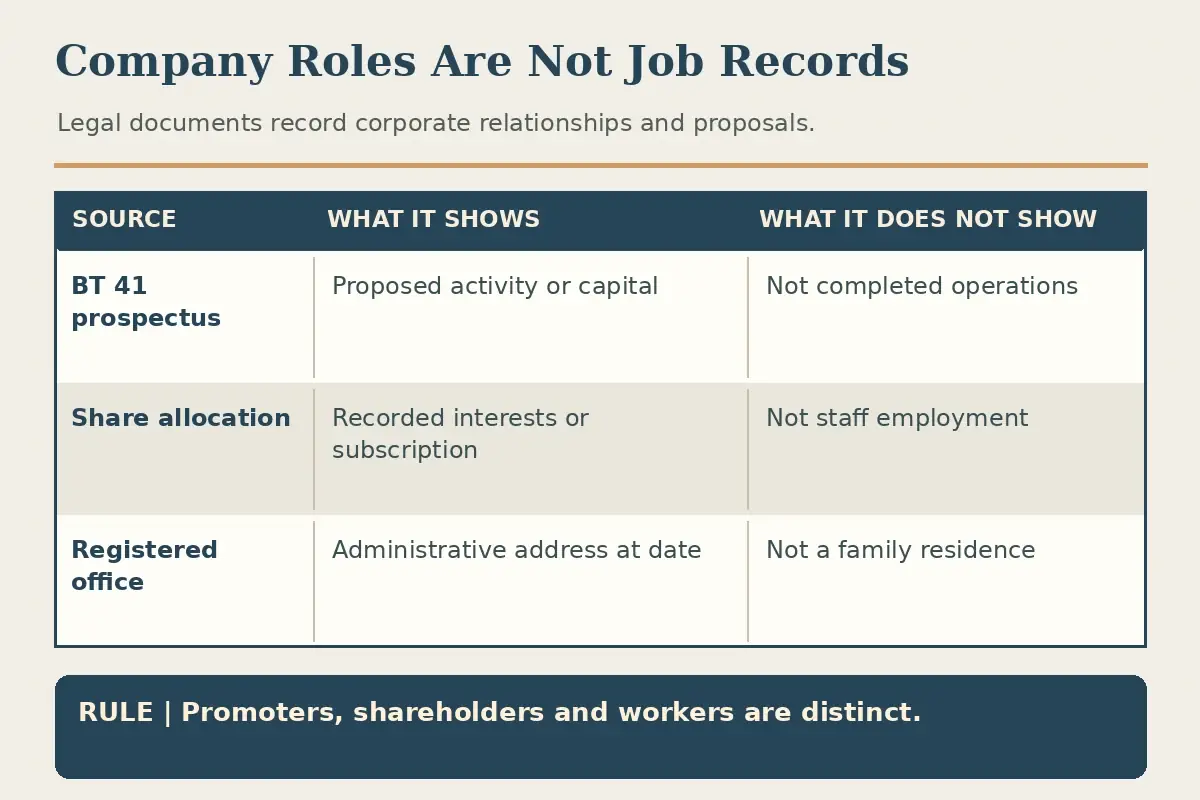
An enterprise can have several names: a prospectus name, a registered legal title, an abbreviated brand and a later successor. Do not treat a newspaper advertisement as evidence that a company registered under the same wording. Check directors, promoters and location with contemporary dates before combining records. Likewise a registered office address is an administrative address, not proof that machinery, employees or an owner’s family occupied the building.
The National Archives companies and businesses guide states that most company records in its custody are government registration papers, not corporate archives. It explains the narrow BT 41 dissolution date gate and provides a link to browse the series by company name. First decide whether the entity was a registered joint-stock company, a chartered business, a partnership or merely a trading name. Different legal forms leave different records.
Distinguish the 1844, 1856 and 1860 Boundaries
The Joint Stock Companies Act 1844 established registration as a route to corporate identity; the National Archives notes that earlier incorporation normally required a charter or private act. BT 41 includes the early files under this regime and the re-registered companies dissolved before 1860. It is therefore wrong to route every Victorian firm into BT 41 just because it traded in 1850. Ask whether it registered and when it was dissolved or re-registered.
The guide notes an overlap with BT 31 for roughly two thousand companies registered under the 1856 Act. BT 31 is mainly a later dissolved-company record series and is not simply a continuation of every BT 41 file. Search both when the statutory dates and company identity make that reasonable. If the title cannot be found, do not conclude the business never existed: a partnership, a company surviving beyond the relevant boundary or a changed name may explain the gap.
For railways, the railways research guide explicitly lists BT 41 for companies registered under the 1856 Joint Stock Companies Act. An incorporation file may show planned capital or promoters but does not prove the proposed line opened, trains operated or construction wages were paid. Parliamentary plans, engineering records and independent operating evidence serve those additional questions. Keep the corporate and physical railway histories apart.
Read Company Roles as Recorded, Not Imagined
A BT 41 file may contain a prospectus, company purpose and registered address, promoter and solicitor names, capital issues, allocations of shares or balance sheets. “May” matters: the exact surviving bundle could be incomplete. Build a working table with DOCUMENT DATE, LEGAL TITLE, COMPANY NUMBER IF SHOWN, ROLE, SOURCE PHRASE and REFERENCE. State whether a figure is authorized, subscribed, issued or paid-up capital; those are not automatically equal amounts.
A promoter might solicit investment without becoming a director. A person named as a shareholder might have no hands-on employment at the site. The solicitor is a professional representative, not an implied partner or family member. Even a balance sheet reflects information submitted or preserved for that accounting period, not a full chronicle of commercial success. A dissolved company file may mention winding-up events that occurred after trading activity had ended.
When studying an ancestor, correlate a BT 41 entry with a same-period census, directory, independent deed, probate file, newspaper report or other appropriately sourced record. A shared surname and city are insufficient for identity. If several companies reused a geographic or commercial label, seek company number, registration date and officers. Copy the actual legal title rather than normalize it into a familiar modern brand without evidence.
Test Operations and Buildings Independently
A registered office and a proposed industrial site can be in different cities. A prospectus may advertise the intended works or a planned railway alignment before any building was completed. Compare contemporary maps, rate books, local plans, trade directories and dated advertisements to determine whether premises were occupied or operations began. Do not use a certificate of formation as a substitute for physical evidence of a mill, a mine or a working railway.
The National Archives notes that original company registration records are generally not viewable online; finding an item in Discovery is not the same as reading its documents. Verify current copy or reading-room arrangements. The National Archives also notes it lacks files for companies registered in Scotland and Northern Ireland; use the appropriate national custodian for those jurisdictions. This is a jurisdiction choice, not an absence that a broader web search automatically resolves.
Distinguish legal dissolution from the closure of a factory and from employees losing their jobs. Assets can be sold and operations might continue under a successor. A business name may be transferred or revived. If the research question is employment, look for actual payroll, personnel, pension or union sources where they survive. Record when only an inference from company activity is possible; no corporate register can retroactively create a list of every worker.

More House and Local History Guides
How We Research Early Company Registrations
We begin with company form, registered name and statutory date, then select BT 41 or the documented alternative. The first chart routes the 1844 and 1856 registration context and the 1860 dissolution threshold; the second audits corporate roles against unsupported personal claims. The third shows how to move from registration to operating-site evidence without implying that one necessarily follows from another. An archival reference is not a confirmed biography.
Every claim needs the precise BT 41 piece, document type, date and page or enclosure where available. Check names, capital figures and address fields against the original document before reusing them. A catalogue entry or later company history can guide retrieval but does not substitute for a surviving registration return. If a namesake cannot be distinguished, label the possible match rather than merging careers.
The affiliate disclosure explains commercial transparency. This method needs no affiliate service to interpret a Victorian company file. Research quality improves when we say “named as a promoter on a dated registration paper” rather than claiming the person managed the factory or employed hundreds of people without actual independent evidence.
Early registered joint-stock companies dissolved before the relevant 1856 or 1860 boundaries, including a railway division.
Not from a promoter or shareholder entry alone. Seek independent employee or wage evidence.
The National Archives reports an overlap for some companies registered under the 1856 legislation.
No. An incorporation or prospectus is not evidence of completed construction or operation.
No. The National Archives advises using the catalogue to identify references and arranging access to originals or copies.