
Find the Manor and Its Accounting Year First
SC 6 contains ministers’ accounts: records of income and expenditure kept by bailiffs, stewards and other officials for manors, especially estates coming into Crown custody. The National Archives places manorial accounts broadly from about 1200 to 1851 and names SC 6 and DL 29 as the principal central series. These are financial accounts, not a universal list of residents. Find the historical manor, county, lordship or administrative holder before looking for an individual person named in a payment.
First separate the geographic parish from a manor, which may cross parish boundaries or share a name with other properties. Medieval spellings and abbreviations can vary sharply; record each variant as written. A manor might be administered by the Duchy of Lancaster, the Crown, a former religious house or a private owner, each with different record survival. The National Archives does not hold every manorial account. A local record office may preserve the relevant volume, even when the place is familiar.
Start with the official manors and manorial records guide and the Manorial Documents Register for location and custody. The MDR is an index to selected classes of manorial documents, not a reconstructed resident database; title deeds are not within its defined scope. Search manor, locality, county and date, then confirm whether the resulting item is an account, court roll, extent, survey or another type entirely.
Choose SC 6 Rather Than a Court Roll or Survey
The National Archives distinguishes SC 6 or DL 29 accounts from SC 2 and DL 30 court rolls and from surveys or extents in SC 11, SC 12 and related series. A court roll records court business and tenurial proceedings; an account records receipts, payments, arrears and stock or agricultural activity according to the document. A survey is more likely to describe tenants and holdings systematically. Do not send a reader to SC 6 with the promise that all households are named.
Use the printed Lists and Indexes V, VIII and XXXIV, and the later Supplementary Series II, for topographical access to ministers’ accounts, as the guide recommends. Copy the volume or piece reference and note the historical county division. A catalogue heading alone might describe several manors inside one bundle. The useful piece could cover a group of properties under a single official, so inspect internal headings before assigning a named entry to a particular estate.
Accounting periods may use regnal years, feast days or Michaelmas-to-Michaelmas conventions. Record the exact opening and closing terms rather than converting a single year label into a calendar-year claim. Some accounts were compiled after the events recorded and may include balances brought forward. A payment dated by accounting period may not show when cash physically changed hands. Keep the medieval label and your normalized interpretation in separate fields.

Read Receipts and Expenses as Different Statements
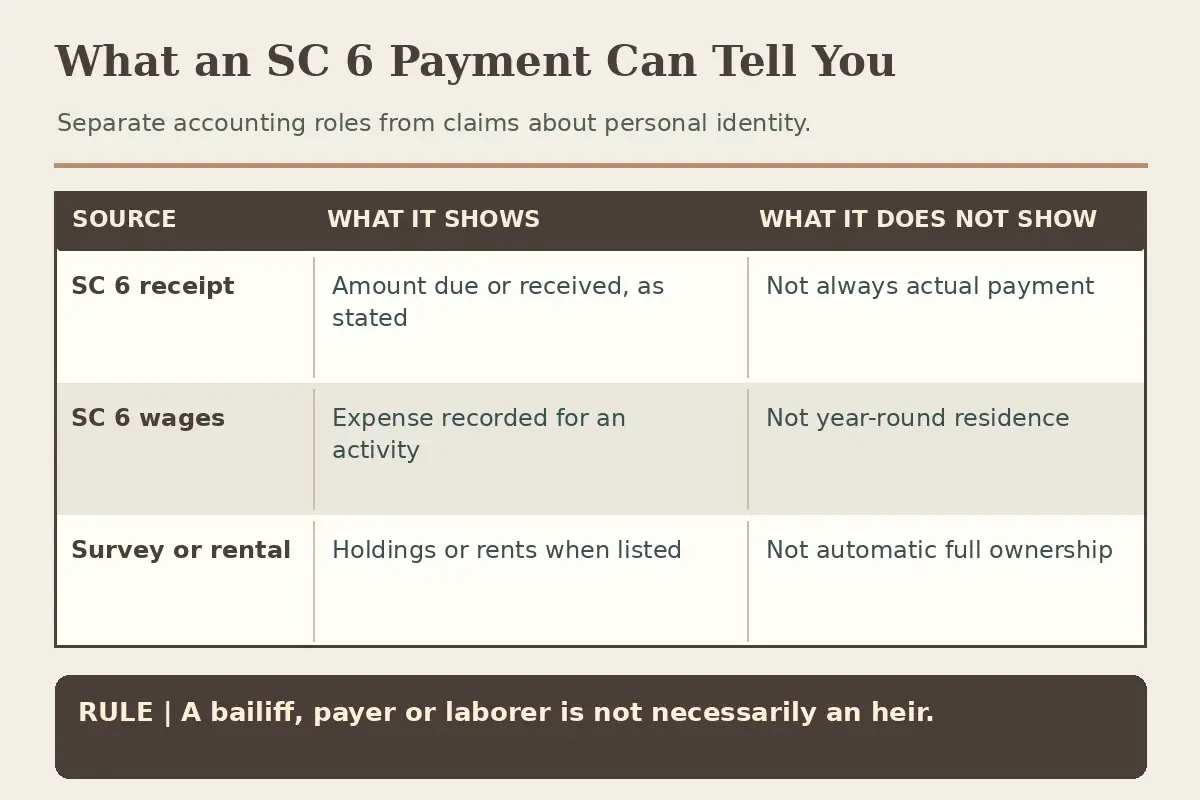
An account’s receipt side may describe rents, fines, agricultural proceeds or amounts owed; an expenditure side may describe wages, maintenance, carriage, supplies or allowances. Do not assume every term appears in every manuscript. Transcribe the original money units and do not silently convert or sum them across different accounting systems. Entries for arrears may repeat for several years without establishing a fresh payment. Mark whether a sum was due, received, expended or merely carried.
A steward named at the head of an account is an accounting officer, not necessarily an inheriting proprietor. A named laborer receiving wages may have worked locally, but the entry alone need not prove a full-year residence or kinship to another surname in the roll. A person paying rent might be an intermediary rather than the occupier. Copy the exact role and the phrasing around the name before adding it to a family-tree evidence table.
Use columns ACCOUNT PERIOD, MANOR, ENTRY TYPE, NAMED ROLE, ORIGINAL SUM, PAYMENT STATUS and CLAIM LIMIT. If a name occurs only in a printed abstract, distinguish it from a name verified in the original. Draw family conclusions only after checking another source with independent identity details such as tenancy terms, a court entry, a will or a locally kept rent roll. Even a matching occupation is supporting evidence, not instant proof of one person.
Check Staff, Land and Residents in Separate Sources
When someone is listed as bailiff, reeve or steward, determine whether the office is assigned in the account heading or merely inferred from context. The same individual might manage more than one estate, and the absence of an account for one year need not indicate departure. Compare successive accounting years to distinguish a repeated office holder from a name that appears once. A change of handwriting or filing order can create an artificial impression of continuity.
For tenant and household questions consult a relevant manorial survey, extent, rental or court roll if available, and preserve the distinction between tenure and residence. For a claim of legal land ownership seek a deed, inheritance evidence or appropriate enrolled legal record, not simply the appearance of a name next to a rent total. The MDR can indicate holding repositories but does not guarantee that the desired record survives or is digitally viewable.
Latin and historical account conventions present further limitations. Before 1733 many records may be in Latin, and names can be expressed in grammatical forms rather than their modern nominatives. A number or line at the edge might be a tally, subtotal or note, not a new person. When an entry is uncertain, quote a small diplomatic transcription and label the reading provisional. A cautious account can still reveal remarkable detail about work, crops and local economic change.

More House and Local History Guides
How We Research a Manor’s Financial Evidence
We choose the documented manor and accounting window, then identify whether the relevant document is SC 6, DL 29 or a local archive original. We transcribe the entry in its debit, credit or expense context before explaining it. A good result is modest and precise: a named officer accounted for specified estate income during a stated period. It does not establish residence, kinship, exclusive ownership or a complete local population.
Our diagrams show three separate tasks: selecting the correct documentary family, auditing what a money entry can prove and building a corroboration route for named people. A blank account year is logged as a survival or search gap unless the document explicitly supplies negative evidence. Dates should be normalized cautiously, and every conclusion needs a complete SC 6 piece and internal heading or page locator so another researcher can retrace it.
Check Discovery for actual item descriptions and current reading-room arrangements before assuming an image exists online. Be explicit if only a finding aid or summary was inspected. The affiliate disclosure is available for transparency; record interpretation does not require any commercial purchase. When the exact named person cannot be independently resolved, preserve a candidate rather than folding two medieval namesakes into one ancestor.
Accounts of income and expenditure prepared by officials managing manors; SC 6 is one principal National Archives series.
No. Names appear according to accounting needs; rentals, extents and court rolls answer different questions.
The National Archives lists DL 29 alongside SC 6 as another major series for ministers’ accounts.
Not by itself. It may evidence a recorded payment or work role, not continuous household residence.
Identify the historic manor, county and accounting period; use topographical finding aids and repository descriptions.