
To identify an earlier owner of registered land or a house in England or Wales, start with the HM Land Registry title number and decide whether you need a historical edition of the title register or a copy of a filed deed. These are different requests. The current title shows present recorded title information; a historical edition can provide evidence about an earlier date, if an edition exists. A deed might explain a transfer or right, but HM Land Registry does not retain every historic deed or an unbroken history of every building. Ownership is not the same fact as who lived at the address.
Identify the title number and the correct address
Begin at the official search-register service. Search by address or map location and note the title number, tenure and whether the registered land matches the property in your historical source. Street numbering can change and a single contemporary address can cover land that was previously divided or combined. Confirm the title plan’s general extent before assuming an earlier deed concerns the same parcel. The government cautions that title plans usually indicate general boundaries, not the exact legal boundary on the ground. A house name in a census is a location clue, but not a title number. If an address gives no result, the guidance offers an index-map search as a separate route. Record the search date and any alternative property descriptions.
Choose a dated historical edition rather than the current title
If you want to know who was registered as proprietor at an earlier date, seek a historical edition of the register. HM Land Registry explains that historical copies may exist for specified dates; the service cannot promise that any arbitrary year will have a preserved edition. For titles registered before 1993, contact the Registry with the title number or address and the dates to ask what is available. For property registered after 1993, the public guidance directs applicants to form HC1 for requested dates. Avoid silently importing the current proprietor’s name into a nineteenth-century timeline. Save each actual edition date you receive alongside the entry and title number. Where editions disagree with a family story, consider a different parcel, a transfer date, or a person who occupied but never owned it. A missing edition is not proof that ownership was unchanged.
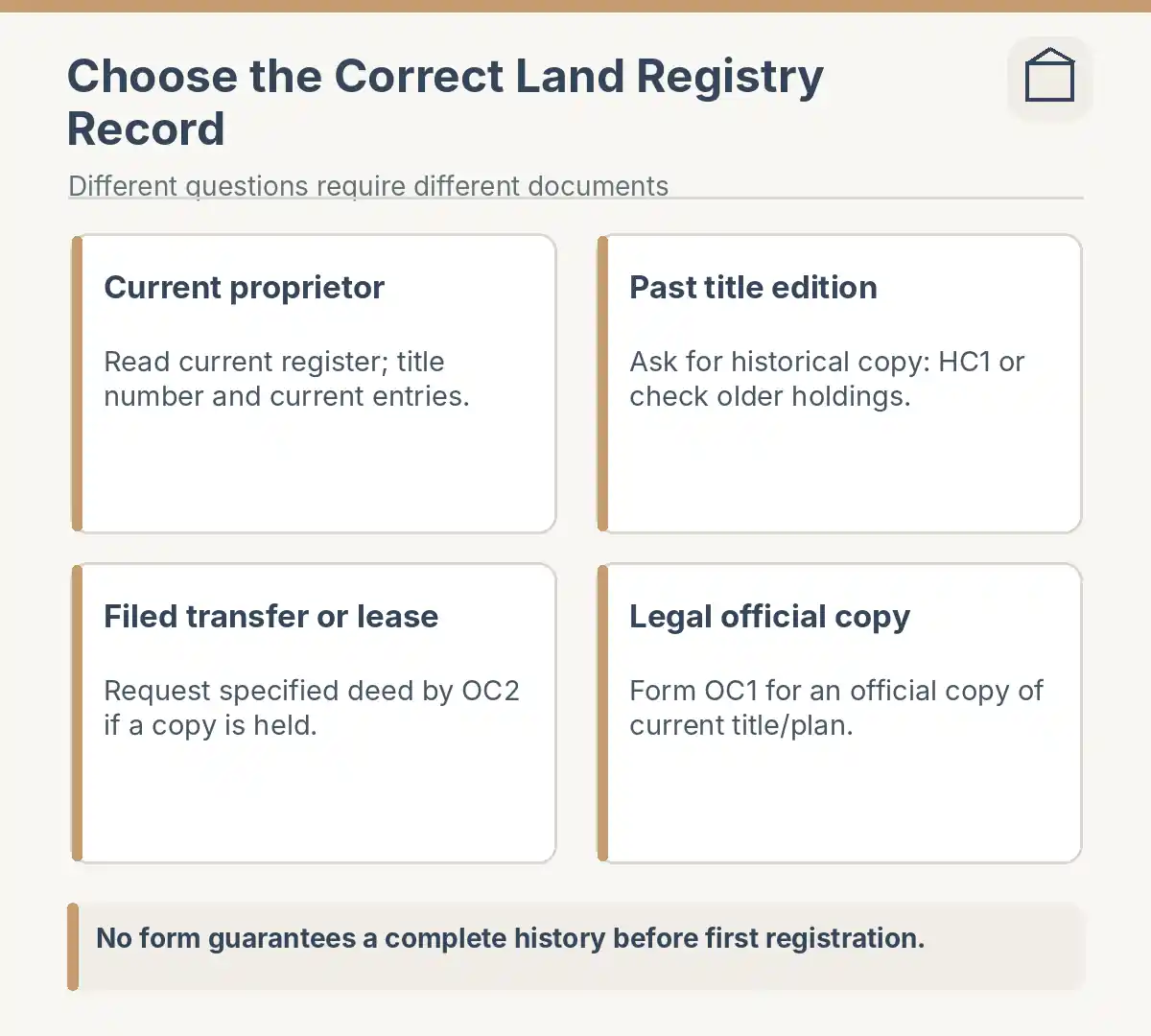
Use HC1, OC2 and OC1 for different evidence
Do not treat government form numbers as interchangeable. HC1 requests historical copies of the register or plan; OC2 is used for copies of specified documents such as a filed transfer, mortgage charge or lease; OC1 requests official copies of the current title register or plan for formal evidentiary use. HM Land Registry’s document-finding guide names these routes. A title entry saying a document is filed provides a clue to ask for that document, not a guarantee of an older bundle of parchment deeds. The current fee and application procedure should be checked at the government website when you actually order; they can change. List the document, request route, claim to be tested and what a successful copy would prove before paying.
Understand missing deeds and unregistered land
HM Land Registry says it does not keep original paper deeds and may have no scanned copy of a deed even when a property is registered. If the land is unregistered or the desired date predates first registration, there may be no matching historical register edition. Do not create a fictitious ownership chain to bridge this gap. Instead, search a preserved private deed bundle, local archive, estate records, probate, tax assessments or deposited maps according to the historical place and question. If you find a deed, read its operative parties, property description, transaction date and any cited earlier title, and compare them with later boundaries. Someone named as a witness, mortgagee or occupier should not automatically be entered in an owner column. The official deed-copy explanation explicitly cautions that a requested copy may not be held.

Compare a title proprietor with the people who lived there
For family history, keep two parallel timelines: title proprietors and household occupants. An owner may let the property, hold an interest through a company or trust, reside elsewhere or transfer title after a family moved out. A census, directory or electoral roll can document occupancy or a listing under its own eligibility and date limits, but cannot independently establish legal title. On a research grid note the title edition’s date, proprietor and exact property; beside it note the dated resident, type of evidence and whether addresses align. If names coincide, the title may support one person having both roles, but you must still distinguish what each source directly says. If a spouse appears on a deed but not the register, do not invent the reason. Inferences are hypotheses requiring supporting evidence.
Write a defensible property-history citation
Every historical-title conclusion should include the issuing institution, title number, edition date, property description, document type and how you acquired the copy. For a filed deed, identify the executed deed date and involved parties separately from the date the Registry sent it. Quote or summarize the precise entry that answers the question, not a broad assumption that the entire property remained unchanged. Preserve a scan or downloaded official copy according to its conditions, and retain the request details. If an archival map has a different plot number, create a documented correspondence using roads, boundaries and dated descriptions instead of asserting that the parcels are identical. Keep the limitation of the title plan’s general boundaries in the final narrative. This method supports an auditable historical ownership claim without turning addresses into unsupported family relationships.

For an example of the request decision, imagine a house known to have been sold in 1998. The current title gives the title number but not the family’s proposed 1975 owner. Request available editions for relevant dates and determine when the land was first registered; an earlier owner might not appear at all. If the register mentions a filed 1998 transfer, an OC2 request addresses that document, whereas HC1 addresses historical register editions. Maintain separate request receipts and source citations. Even where a historical edition names an owner, a 1975 electoral roll is still a separate source for who actually occupied the home. Our guide “Historic UK Company Records” adds more detail on this.
More House and Local History Guides
How We Research Historical Title Claims
We use the government’s historical title guidance and form distinctions, rather than treating third-party address data as official title evidence. We separate search results, supplied historical copies and inferred ownership between editions. Also, We also make no guarantee that a deed or earlier register survives for a particular property, and none of the hypothetical owner examples describes an identified person. Our affiliate disclosure explains any commercial links.
No. The current title is not necessarily a full chronological history. Request available historical editions for relevant dates.
The government directs applicants to HC1 for historical copies in the relevant public route for post-1993 registrations; older titles may first require checking availability with HM Land Registry.
Use OC2 to request copies of specified filed documents, such as a transfer or lease, where the register shows they are available.
Generally not. HM Land Registry warns that plans usually show general boundaries rather than precise ground boundaries.
No. Compare the title with independent, dated residence sources such as directories or censuses before reaching an occupancy conclusion.