
The Irish Reproductive Loan Fund can place a borrower and named guarantors in a specific locality during years when Irish household sources are scarce. Search it by county, local loan association and record type, not simply by the first surname offered by a website. The surviving originals belong to The National Archives in Kew, series T 91. The FamilySearch collection description explains that indexes can name a borrower and guarantors, while the underlying books may carry richer accounts. A guarantee is evidence of a financial role, not proof of kinship.
Understand the Loan Scheme and its Record Types
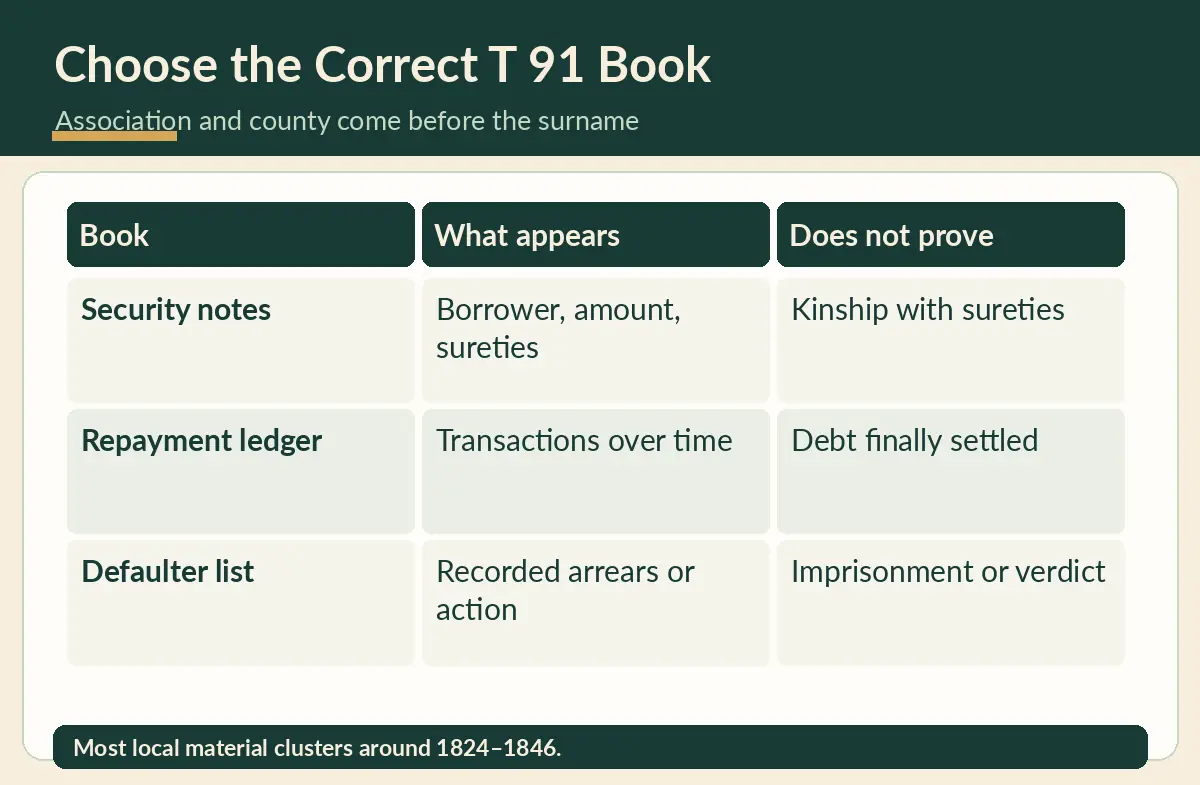
The fund supported small loans for poorer borrowers through locally run associations under county committees. Local records include security note books, loan ledgers, repayment books, account books and materials about defaults. Their purposes differ. A security note identifies an obligation or promise, while a repayment book reports transactions and a defaulters’ list reports a separate administrative stage. A person can recur in several volumes with different information.
The History Ireland account of the institution identifies records for Clare, Cork, Galway, Kerry, Leitrim, Limerick, Mayo, Roscommon, Sligo and Tipperary. That list indicates broad surviving geography, not even annual coverage for every village. Select a named local association and the years of its actual registers before treating a surname search with no results as conclusive.
Separate Broad Online Dates From Surviving Local Books
Online collections may advertise ranges such as 1810–1887 or 1821–1874 because their digitized or indexed sets include records beyond the principal working years. Most original local association entries are concentrated in the 1820s through the mid-1840s, and the Findmypast T 91 browse guide says 1824–1846 contains the bulk. Never assign that broad database span to each security notebook.
A precise negative search states the association, volume, dates covered and how the pages were searched. “No hit for 1840” means little if the surviving ledger for the relevant townland starts in 1843. A change of local district or a neighboring association may explain an apparent absence. Do not assume ten-county survival extends to every parish within those counties.
Search by Borrower, Guarantor and Association
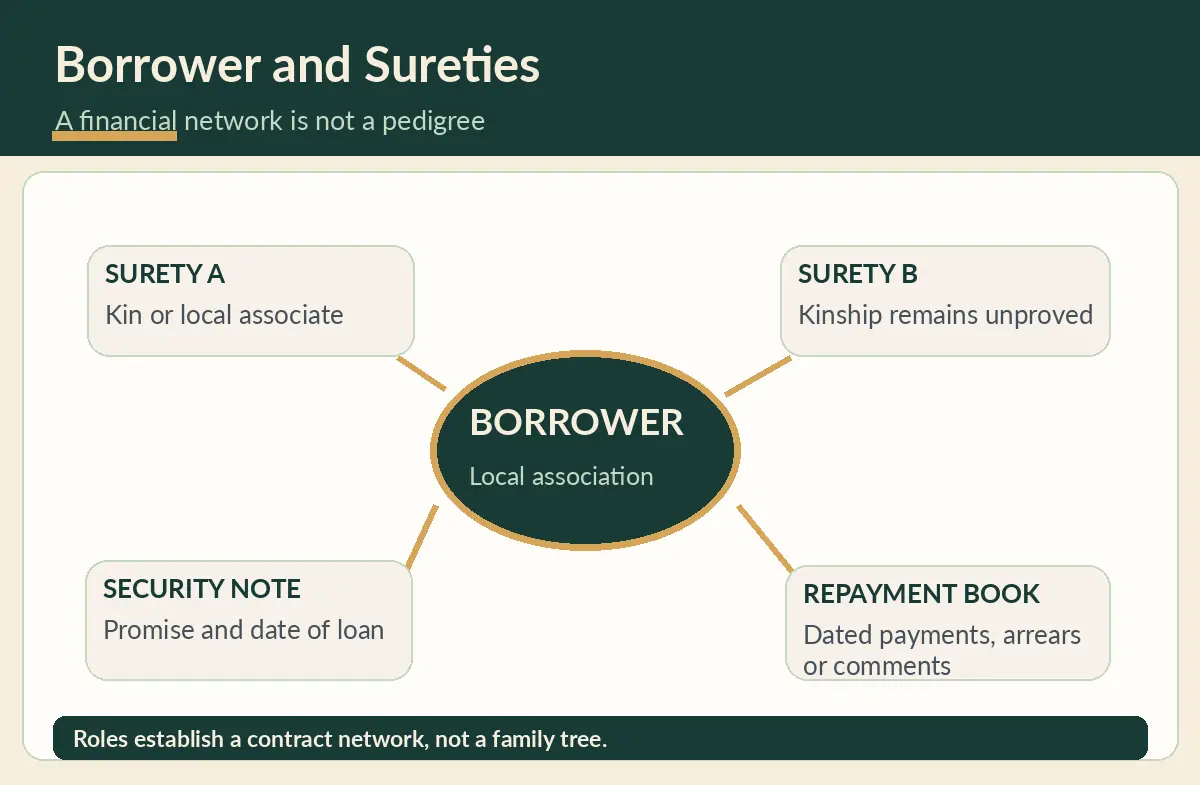
Write down the borrower’s name, suspected townland or parish, approximate date and occupation if known. Search those variants in the FamilySearch index and use the commercial archive-reference browse to find the correct association and volume. Try a guarantor’s name independently: the same individual may secure loans for several borrowers. The results can define a social network, but the nature of each connection needs testing.
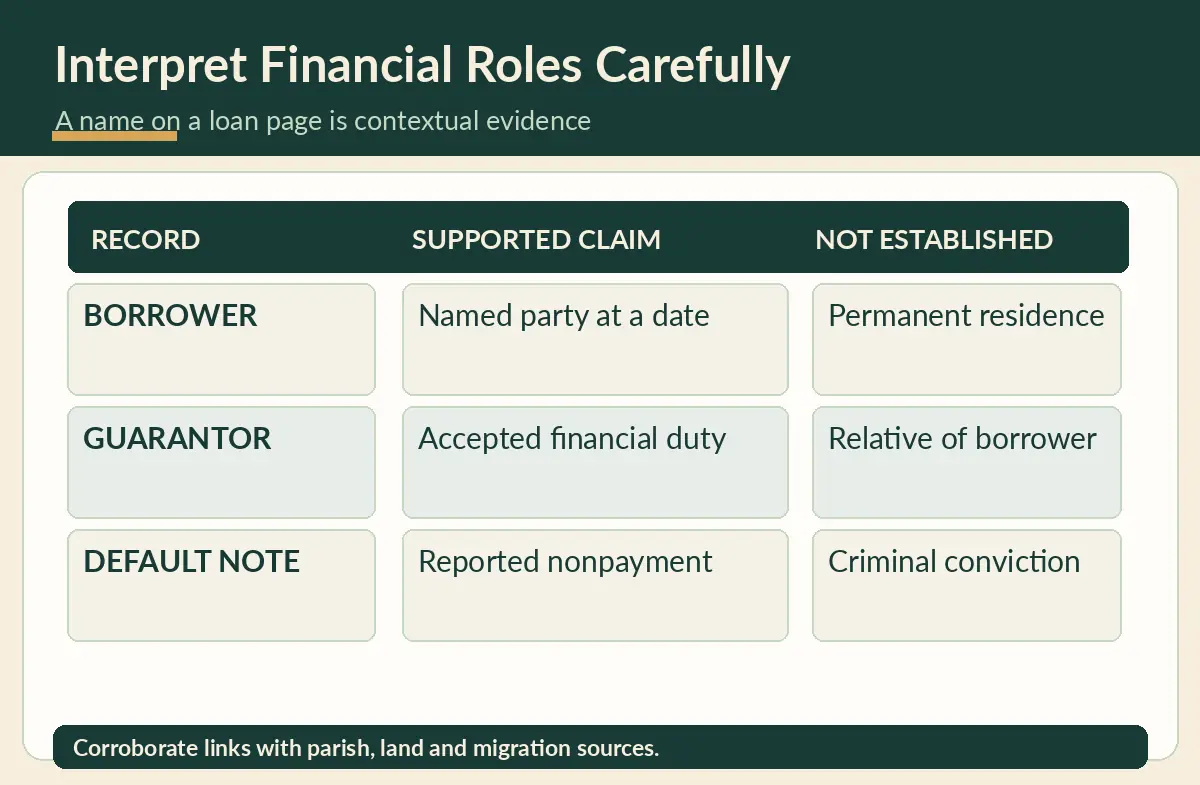
For every promising name, note whether the result describes a borrower, surety, witness or official. These are separate roles and should appear in separate columns of your working table. A shared surname between borrower and surety can suggest kinship but also common local naming; a different surname does not rule out kinship. Transcribe addresses, occupations, money amounts and relevant dates before attaching the entry to a family tree.
Read Security Notes and Repayment Entries as Evidence
A security note may name the borrower, sureties, local residences, loan amount and date. It can record who promised repayment, while a later ledger may show sums received, missed installments or an administrative note about the account. That difference allows a researcher to establish that a transaction was recorded without claiming it was actually settled. Compare the original page headings and adjacent accounts so columns are not misread.
If a register mentions illness, poverty, emigration or death, preserve the official’s wording and note the evidentiary limits. A repayment notation is not a death certificate, and an emigration comment is not a passenger manifest. The note can narrow a search for another source, such as a civil or ecclesiastical event, while remaining a reported observation whose informant may be uncertain.
Test a Hypothetical Three-Person Loan Network
Imagine a fictional borrower Mary Kelly with a loan in 1842 and sureties Patrick Kelly and Ellen Burke. You can document a three-person financial association at the date of the entry. You cannot infer that Patrick was Mary’s brother or Ellen was her mother. Construct a locality grid with townlands, occupations and repeated associations across transactions. Identify which other same-named people could fit.
Test the suggested relationships through parish sacramental registers, surviving civil records where relevant, property valuation, estate papers or carefully dated local directories. In particular, a common surname on two nearby pages might reflect two unrelated households. If the same guarantor appears for a different borrower, a neighborhood or occupational relationship may explain the contact. Record the interpretation as probable, possible or unproved with reasons.
Use Loan Records Alongside Pre-Famine Sources
For a family absent from the 1901 census because its members had moved or died long before, T 91 may be a valuable contemporary place clue. Compare the locality with tithe applotment records, Griffith’s Valuation at a later date and parish registers where they survive. Those sources were compiled for different purposes at different times; they cannot simply be overlaid as if a person occupied one holding for thirty years without interruption.
A separate emigration story should be checked against destination records. If a fund’s account book notes an intended departure, write “recorded as planning to emigrate” until a passenger, destination census or other source supports a completed move. The same caution applies to default entries: nonpayment, court action and detention are not equivalent events and should never be collapsed into a dramatic family narrative without evidence.
Keep Reproducible References for Each Ledger Entry
A source reference should identify The National Archives, Treasury series T 91, the exact T 91 volume number, the association and county, the particular leaf or image, and the role of the person cited. Add a provider’s transcript record ID only as a supplementary access aid. This makes the claim independently retraceable even if a commercial interface changes or a name index is corrected.
Capture both the loan date and each payment date if available, not merely the year printed in search results. An older amount may be written with historical monetary units that require careful reading. Where writing is unclear, retain an uncertain transcription instead of inventing exact figures. Search nearby pages for continued entries before assuming the account ends at a page break.
More Records and Archives Guides
How We Research Irish Fund Records in T 91
We verify the repository series identification, find a specific county association in the browse inventory and inspect the original transaction rather than relying on an index label. Our worksheet tags each name as borrower, surety, witness or administrator, and every kinship proposal must be linked to an independent source. A missing index hit is reported as a search outcome, not evidence of absence from Ireland.
Access differs between providers. Check whether an image is available through a free collection, subscription or archive request; our affiliate disclosure applies to outside referrals. A useful result is a fully cited association-and-volume entry with a list of testable family questions, not an unsupported reconstruction from financial guarantors.
No. Surviving material concentrates in named associations in ten counties in Munster and Connacht; a missing locality may not be represented.
No. A surety or guarantor might be kin, a neighbor or another associate. Prove any proposed relationship through independent evidence.
Begin with the county and local association, then a security note or loan ledger; repayment and defaulter books can supply additional dated evidence.
Database spans may include related and outlying documents, while the majority of surviving local fund records are concentrated in 1824–1846.
No. A noted default or court summons is not proof of conviction, imprisonment or final debt settlement.