
For a First World War Royal Navy medal entry, the crucial first question is which service and rank category the person belonged to. The National Archives divides the ADM 171 campaign rolls among officers, ratings, Royal Marines and several reserve branches. A name found on a medal roll supports a specific entitlement or issue record; it does not, on its own, place a sailor on a named ship during a battle. Start with the official medal guide and its category table before searching exact names.
Choose the Right ADM 171 Volume Range
The National Archives lists ADM 171/89–91 for Royal Navy officers and ADM 171/94–119 for Navy ratings in its First World War guidance. Royal Marines officers appear in ADM 171/92–93 and Marines NCOs and men in ADM 171/167. Separate reserve categories have their own placements, including Royal Naval Volunteer Reserve ratings in ADM 171/125 and Mercantile Marine Reserve ratings in ADM 171/130.
These are archival volume references, not military service numbers. Select a plausible category based on a contemporary uniform description, service document or the wording of an index entry. Do not browse the officers’ list for a man known as an ordinary seaman and then conclude he had no medals. Similarly, a reserve designation in one source should not automatically be converted into a permanent Royal Navy rank.
Search Names Only After Checking Their Category
The campaign-medal guide explains that relevant First World War rolls are alphabetically arranged within sequences and can be searched on Ancestry or browsed through archive digital microfilm availability. This does not promise that every commercial transcription is perfect or free. Save the exact ADM 171 reference and original page, then cross-check spelling, initials, rank or number against a separate service source.
Variant initials, double surnames, common surnames and abbreviations frequently produce competing candidates. Use a service number from another document when the entry supplies one. If a surname search returns two naval branches, record both without preference until the dates and role are reconciled. A failed name search should trigger a check of the specific category and original volume rather than a blanket claim that the person received no medal.

Distinguish Medal Entitlement From Actual Delivery
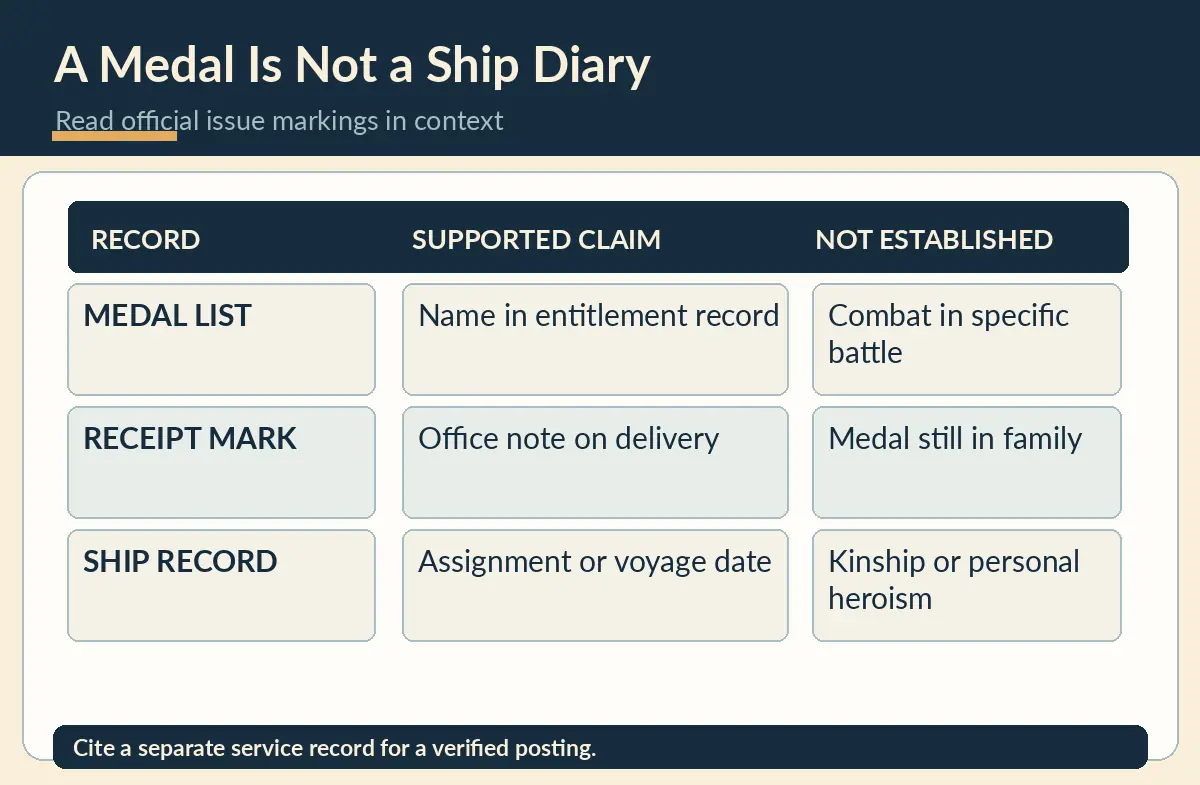
Medal rolls are administrative lists. The National Archives explains that they may record a service number, clasps and marks showing whether a medal was received or its delivery failed or it was returned. Always read the roll’s legend. A mark on a line can have a defined office meaning that differs from the intuitive meaning of a tick or cross today.
A statement that a sailor was entitled to a campaign medal is not the same as saying that a surviving family medal definitely belonged to him. For that, compare the engraved rim or named documentation where applicable, a verified service number and the official roll. A medal attributed by a relative without provenance can still be an important clue, but it should not override a conflicting service identification.
Find a Ship or Appointment in Separate Records
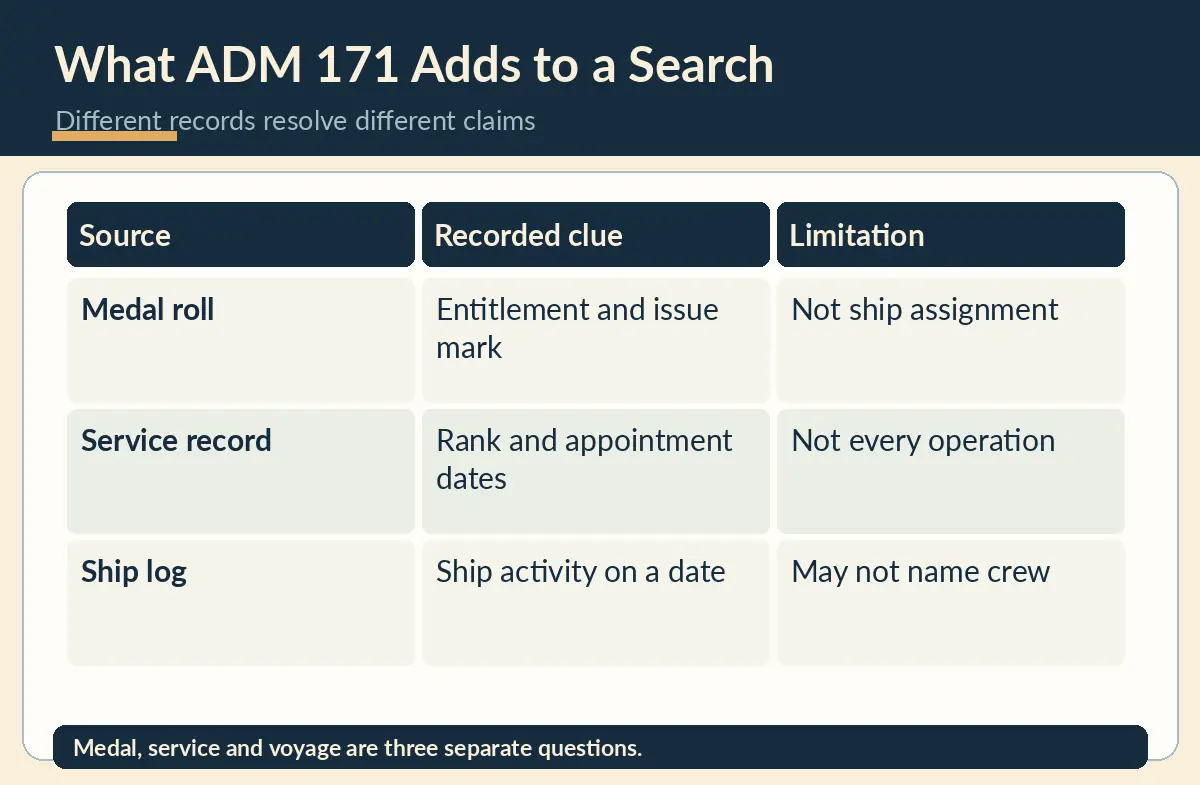
The medal roll is generally sparse as biography. The Royal Navy ratings guide says ADM 171 does not usually contain biographical information. Use a sailor’s service record, assignment sequence, ship muster or ship log to establish where an individual was employed at a relevant time. Medal entitlement alone does not demonstrate a specific port visit, action or episode of injury.
If a unit or ship is established by independent personnel evidence, compare dates with the ship’s diary or logs in an appropriate collection. A log may describe what a vessel did while omitting individual names. The existence of an event at that ship therefore does not prove every assigned man took part in it. Distinguish being on a muster, on detached duty and being aboard on the date of interest.
Handle Royal Marines and Reserve Categories Separately
An individual might appear in official material as Royal Marines, Royal Naval Reserve, Royal Naval Volunteer Reserve or another formation. The ADM 171 subrange depends on the recognized category. Some officer sequences cover more than one reserve grouping; use the archive’s table rather than guessing based on a uniform photograph. Rank language and branch changes can also differ over time.
Create a branch-and-date worksheet showing which exact source supplies the category. Where two records disagree about a man’s service, compare the original entries rather than assuming one transcription is wrong. Medals could be recorded under one administrative description while later family histories use another. Avoid treating all naval auxiliary services as interchangeable with the permanent Royal Navy.
Work Through Two Same-Name Medal Candidates
Suppose two hypothetical William Browns appear in naval-related medal searches. One is a Royal Navy rating, the other a reserve officer. A name match alone cannot place both entries in one family history. Compare rank and service-number details, the relevant ADM 171 subrange, confirmed dates and a family document that gives the individual’s occupation or birthplace. Unexplained incompatible service dates may indicate two men.
A useful decision table lists the contested claim, roll entry, separate service record, contradictions and the specific next source needed. If one entry is fully supported and the other remains possible, say exactly that. Never make a heroic story more certain merely because a medal family photograph is emotionally compelling. A modest, qualified historical statement is stronger than a polished but unsupported narrative.
Report Access and Missing Results Accurately
The National Archives describes name searching via a commercial provider for several medal sequences, alongside digital microfilm and archive access routes. Read the present access notes for the exact record before paying or traveling. Some materials may be browsable at no cost while third-party search conveniences involve charges. Confirm whether the page you accessed is a transcript, a scanned roll or a separate source summary.
Keep a negative-search log with service category, time period, volume range, variants and providers checked. A missing match from the wrong category is not negative evidence. If a surname is damaged or common, browse the alphabetically organized sequence near related spellings and compare independent service identifiers. Cite ADM 171, exact volume and page rather than only a merchant-provided database record ID.
More Records and Archives Guides
How We Research Royal Navy Medals in ADM 171
We consult the National Archives category table, choose the correct original roll, and compare the person’s initials, rank and service number with an independent service record. We read issue or return marks according to the archival explanation, then separately establish any claimed ship assignment. A final conclusion can confirm medal entitlement while leaving an alleged naval engagement unresolved.
Use official catalogues to evaluate paywalled convenience searches, and see the GenHis affiliate disclosure for outside referrals. The research output should be an exact ADM 171 entry citation, a note on what the medal notation means, and a distinct, sourced statement about service if one can actually be established.
No. A medal roll concerns eligibility or administrative issue, not a complete account of ships, movements or actions.
The National Archives lists ADM 171/94–119 for Royal Navy ratings and ADM 171/89–91 for officers; check the appropriate service category.
Markings concern administrative receipt or issue as explained in the archive guide; interpret the legend and do not confuse receipt with combat participation.
Use a separate naval service record or muster and a dated ship log; the medal roll generally does not supply a complete ship history.
The archive guide identifies distinct ADM 171 ranges for officers, ratings, Marines and different reserve categories. Choose the correct classification first.