
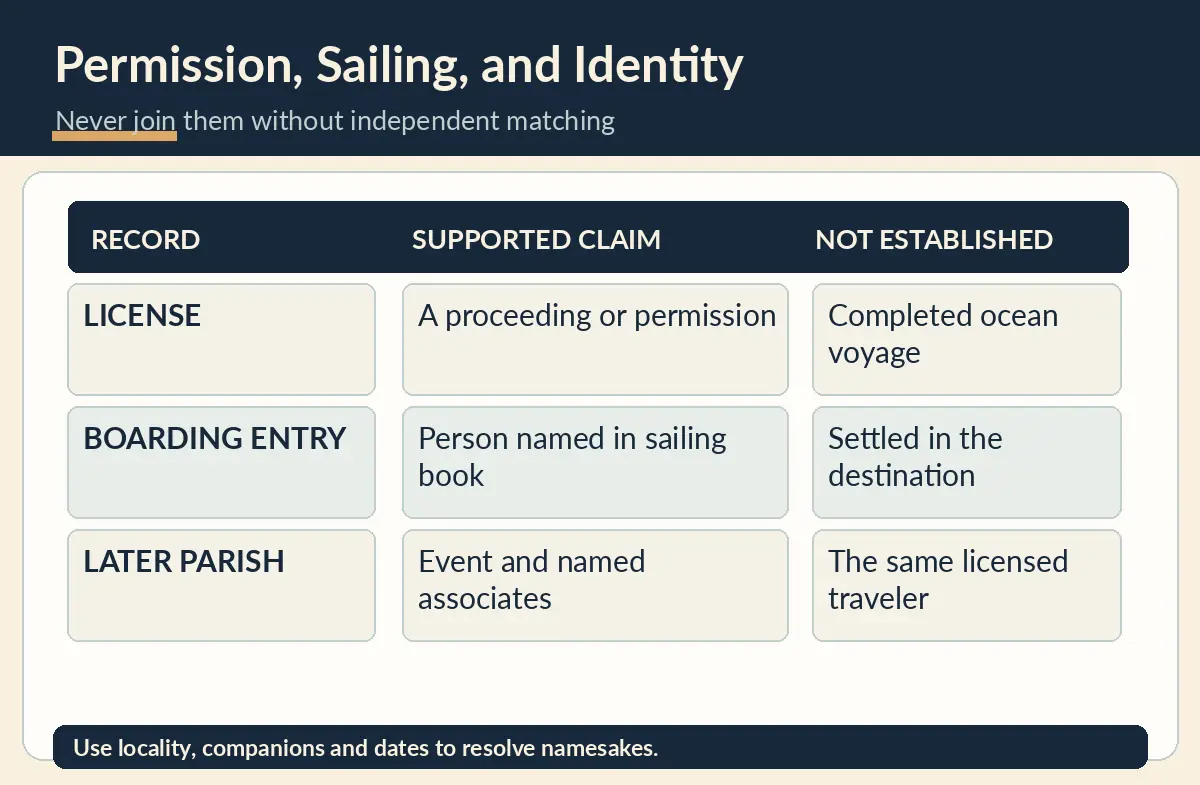
Begin with which kind of passenger evidence you need, not a surname alone. Spain’s Archivo General de Indias preserves the Pasajeros a Indias series in the Casa de la Contratación records. Its official migration source guide separates books of passenger entries from information and license dossiers. A travel permit, an entry associated with embarkation, and a later American parish record answer different questions. Search them as separate sources and do not treat a namesake in an index as your ancestor.
Choose the Correct Contratación Passenger Subseries
The series-level PARES description for CONTRATACION S.42 gives an overall span of 1509–1790. That does not mean one uninterrupted chronological manifest exists. The books of passenger entries primarily span 1509–1701, while the files of informaciones y licencias are described for 1534–1790. These are complementary records with different administrative purposes, not interchangeable name lists.
Start with the year or decade indicated by an independent document. If the question is who was recorded boarding, investigate the passenger books first. If the question is what identification, personal qualifications, or accompanying family were put forward when seeking permission, the license dossier may be more informative. When both types exist for the same surname, establish the person’s locality, associates, approximate age and destination before combining them.
Search the PARES Catalogue Rather Than Only a Name Box
Open the Spanish State Archives license subseries description. Note the hierarchy from Archivo General de Indias to Casa de la Contratación, passenger series, subseries, legajo and individual item. A catalogue record may have a scanned page, detailed item description or only a broader archival unit. Record the level actually examined, because a family-tree citation to the entire collection cannot reproduce your finding.
Try both surname variants and given-name forms in Spanish. Search a named locality when known, and inspect date ranges attached to promising volumes before opening hundreds of images. A phrase in a catalogue title may describe a family group or a petition rather than every individual on the pages. If keyword searches fail, move upward through the archival hierarchy and browse a time-appropriate unit. That is a coverage test, not proof that the person never migrated.

Read Passenger Books and License Files Differently
The migration guide explains that the passenger books can note the ship and its master as well as a licensed traveler. Those details help distinguish two same-name travelers when compared with a ship history or destination record. Transcribe the text exactly: an early modern personal name may have multiple elements and a place name may refer to an older jurisdiction. Do not quietly modernize a disputed reading in the evidence column of your notes.
License investigations sometimes contain baptismal or marriage documents, declarations and evidence connected with travel permission. Documentation became more elaborate in later periods, so do not demand a standardized twentieth-century application form from sixteenth-century material. In particular, recorded accompanying persons might include relatives or servants; infer their relationship only if the record actually states it. An administrative qualification does not establish ancestry by itself.
Build a Ship-Date-Identity Evidence Chain
A safe reconstruction has separate dated rows for application or inquiry, official permission, a passenger-book entry, and the earliest independently sourced appearance overseas. Add exact spelling, witness or associate, stated home town, destination and original signature to every row where available. The source column should distinguish PARES catalogue text, a transcription and the actual manuscript. That distinction matters because an abstract can omit identifying qualifiers.
Imagine two hypothetical men named Juan García from different Castilian towns. A license that names one locality and a passenger-book record with the same name but no locality are not automatically a match. Test chronology, family companions, occupation, destination and document references. If a conflicting date or named spouse appears, preserve the conflict. Your result can be “two candidates remain” even when a commercial search offers one attractive combined profile.

Treat 1509, 1534, 1701 and 1790 as Different Boundaries
The earliest general passenger-book boundary is 1509; the information-and-license subseries begins later in 1534. Books of passenger entries are described to 1701, while license material continues to 1790. These dates describe the surviving named archival structures, not the start or end of travel between Spain and the Americas. A 1710 search therefore belongs in the license subseries, other AGI records and American receiving documents rather than an imagined extension of the passenger books.
Check the limits of digitization and description on the item opened. A series badge at a parent level does not guarantee that every personal name has been transcribed. Older Spanish handwriting and spelling change can defeat a modern exact-name query. Keep a log of which years, signatures and folios you read, and mark which portions remain unsearched. “Not indexed,” “not imaged,” and “not present on a reviewed image” are three different statuses.
Cite the Original Signature and the Evidence Type
A useful reference starts with Archivo General de Indias, Casa de la Contratación, CONTRATACION S.42, the relevant subseries and exact signature, folio or page. Add the PARES item permalink and image locator when supplied. If the evidence is just a catalogue-level description, cite it as such rather than alleging you read an original letter. Transcribe name variants and dates beside the reference, so someone can find the same document without knowing your search history.
Build separate proof statements: a license confirms that an administrative proceeding was recorded; a passenger-book entry records a person in a boarding-related register; later colonial civil or ecclesiastical evidence may identify a settled person. None alone automatically establishes parentage or final place of death. When quoting an assertion of age or status made by the applicant, label the informant and consider why the statement was supplied.
Handle Family Members, Servants and Historical Language Carefully
Passenger paperwork was generated within a colonial regulatory system. It can use legal, religious or social categories that need historical explanation, and those classifications should not be treated as a contemporary judgment about a person. Accompanying people’s names are valuable evidence but do not always identify kinship; a servant or dependent may appear without documentation of their later life. Respect the original wording while identifying which part of your interpretation is inference.
A negative result is only meaningful within a defined searched corpus. Write down whether you searched passenger books, license dossiers or both, which years and record groups were accessible, and any alternative spellings. Before closing the question, compare independently dated parish, notarial or local administrative sources on the American side. There may never have been a surviving licensed entry for a particular arrival.
More Records and Archives Guides
How We Research Pasajeros a Indias in PARES
We start with the official Spanish migration guide, verify the two subseries at catalogue level, then choose the time-appropriate type of original. We track a specific signature and image, record who supplied each personal claim, and ask whether an independent overseas source can corroborate a proposed identity. These checks keep permission, embarkation and proven kinship separate in the final conclusion.
For commercial index or image services, access terms may differ and should be checked before purchase. GenHis does not assume a provider relationship; see our affiliate disclosure. The immediate research product should be a source-cited timeline containing both positive matches and explicitly unresolved alternatives.
No. A license documents permission or a procedure; a boarding entry, arrival record, or other independent evidence is needed to establish an actual voyage.
The principal surviving books of passenger entries span 1509–1701; the separate information and license files span 1534–1790.
Some license investigations contain baptismal, marriage, or accompanying-family evidence, especially in more developed later dossiers, but no such field is guaranteed.
No. The archival series represents particular official procedures, with uneven preservation, indexing and coverage; absence is not proof of no travel.
Record Archivo General de Indias, Contratación series, the exact legajo or book signature, folio or image locator, and the consultation link.