
Sheriff Payments T 90/146–170 can answer a narrow historical question, but it cannot carry a larger family-history claim by itself. The starting point is the record’s creator, date and function; the next step is independent evidence for an individual, place or event. The examples and routing method below separate what the archive actually documents from an interpretation that still needs to be tested. In particular, distinguish a name present in official paperwork from confirmed identity, kinship, employment, judgment or completed action. The archive references and access routes used here are from the named official guides, not an invented case file.
Why an Expense Record Can Rescue a Missing Court Search
The National Archives warns that many early assize papers were lost, and court clerks did not preserve every document. Records of sheriff payments sometimes supply a different route to a person’s name when a case file has not survived. Its guide specifically identifies T 90/146–170 for payments to sheriffs referring to individual prisoners in 1733–1822. This is an administrative Treasury pathway, not a miniature substitute for a full criminal trial record.
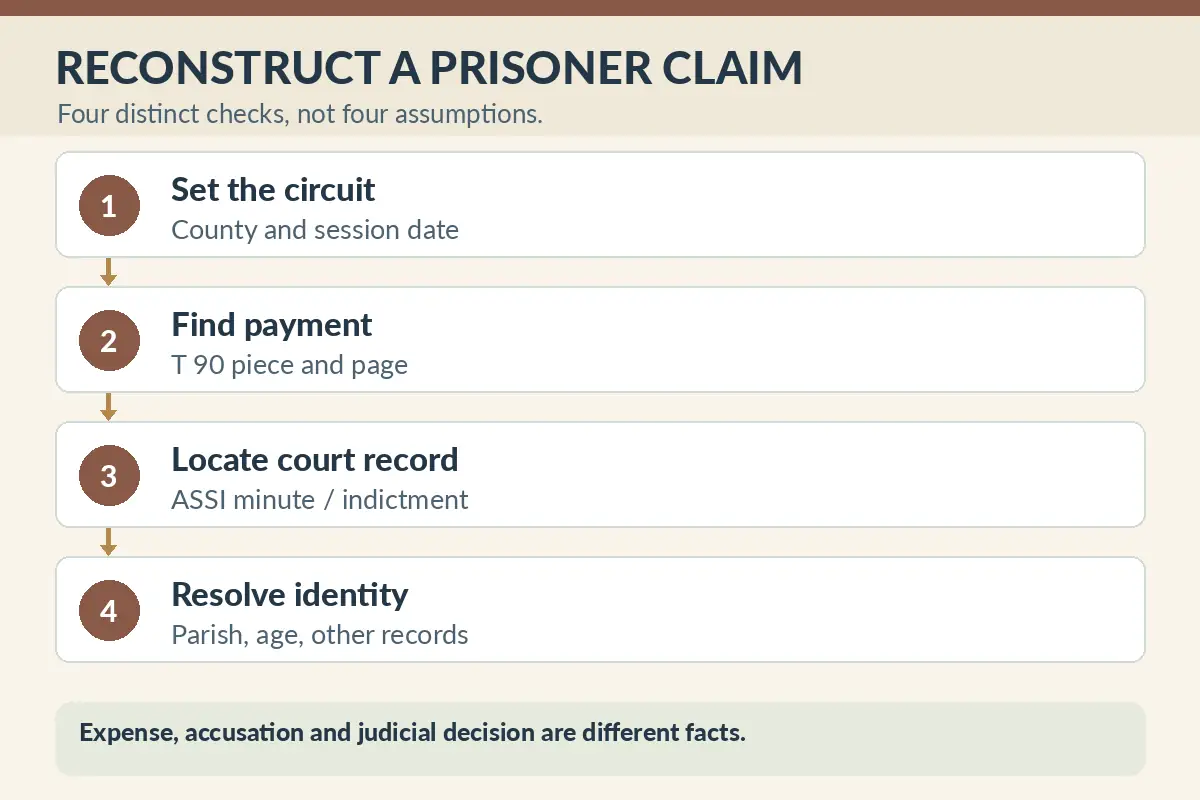
The central research question should therefore be modest: does a payment entry connect a named prisoner to a county, period or sheriff, and what can another surviving source establish? Begin with the county and likely session year. If the family story provides only a nickname or a supposed offense, seek independent date evidence in newspapers, calendars or parish material before trying to browse a large chronological financial series.

Use Date-Based Browsing Instead of a Name-Only Search
The TNA guide states that the relevant sheriff-payment material cannot be searched by keyword and must be browsed by year range. Record the piece reference before examining original pages. A search of an online catalogue for a surname may therefore give an empty result even when a relevant handwritten entry exists. Avoid describing that absence as a negative result in the historical record; it is merely a limitation of a catalogue search interface.
Create a compact search plan with the possible county, circuit, range of years and what counts as a successful identification. Inspect both headings and the entries themselves. Note whether a payment concerns transportation, prison maintenance or another expense, rather than forcing every row into the category of execution. The function of a bill or voucher depends on its wording, and a total amount may group many people and administrative actions.

Compare T 90 With E 389 and T 53 Without Mixing Their Roles
Sheriff’s assize vouchers in E 389/241–257 cover a partly overlapping period, 1715–1832, and require attention to the paper list held in the reading rooms. Treasury warrant-entry books in T 53/1–68 cover 1676–1839. Those are alternative or related financial descriptions, not consecutive stages that every prisoner was required to pass through. A voucher may support a financial claim without adding details about a charge or outcome.
Keep three questions separate in the log: what was requested, what payment was authorized, and which event the expense concerned. The date of a Treasury entry may follow the trial or imprisonment by an unknown interval. If two records share an amount but not a specific identifying name or county, do not link them as the same transaction. This is especially important where multiple sheriffs submitted claims in the same accounting period.
Seek the Legal Decision in the Assize Series
For a trial result, the original court series must be consulted when they survive. Crown and gaol books may report an accused person, plea, verdict and sentence; indictments express the allegation and can be annotated with a result. An indictment without such annotations does not automatically prove conviction. Pre-trial depositions record statements that may have been contested. These distinctions are essential when a family history includes imprisonment or an alleged serious offense.
The county and legal jurisdiction may change the archive route. The National Archives notes that palatinate jurisdictions did not all join the assize system on the same date. A claimed trial in historical Chester, Durham or Lancaster can require a different repository or record arrangement for earlier periods. Establish the court and date before declaring a search complete. Where an assize record and a payment entry disagree on spelling, copy both variants and test the identity instead of silently merging them.
Create a Small Evidence Table for a Difficult Namesake
Imagine that a family letter mentions a prisoner called Thomas Reed, while a T 90 account appears to list a Thomas Read in the appropriate decade. The payment entry may justify a lead, but names alone do not show it is the same person. Add county, session year, named sheriff, alleged offense if separately documented and later residence to an evidence table. Mark the court outcome as unknown until a reliable court source is found.
Do not erase excluded candidates. Record that a second Thomas Read belonged to a different county, or that his case fell outside the relevant year range, along with the sources supporting the exclusion. If the court papers have been destroyed, the honest conclusion may be that a named expense and an associated detention are documented but the verdict is unproved. That is still a defensible historical finding and a useful next-search decision.
More Records and Archives Guides
How We Research This Archival Record and Its Limits
We check the series against the original government or archive custodian descriptions, then compare the purpose and date coverage with the exact claim a reader wants to make. Sources consulted on 2026-11-08: Primary repository guidance 1; Official guide 2. A series-level catalogue is a map of the collection, not evidence that a particular named person appears in a document. Catalogue availability and online access can change; always verify the individual piece and its current access conditions before traveling or paying for a copy.
Our editorial method separates four evidence levels: the collection description, the specific original document, an independently created corroborating source and a written conclusion with stated uncertainty. Any hypothetical person or example in this article is illustrative, not a transcription of an identified historic individual. For clarity about commercial relationships, read our affiliate disclosure. We do not infer an affiliate arrangement or recommend paid access unless its practical benefit is established for the exact record sought.
The National Archives directs researchers to browse the relevant payment material by year rather than rely on a keyword name search.
No. An expense is financial evidence. A verdict needs a court record or other credible contemporary confirmation.
The National Archives identifies E 389/241–257 as assize vouchers, covering 1715–1832.
T 53/1–68 contains payment-warrant entry books, a different record type that may help assess the Treasury transaction.
Document the survival gap and distinguish the limited prisoner or expense association from an unverified criminal judgment.