
M850 records pension payments to veterans or dependents between 1907 and 1933, excluding World War I cases; a card is not the original service or pension application file. Begin with the official archive research guidance. Review the GenHis affiliate disclosure before selecting any external access service.
M850 Proves a Payment Record, Not a War Story
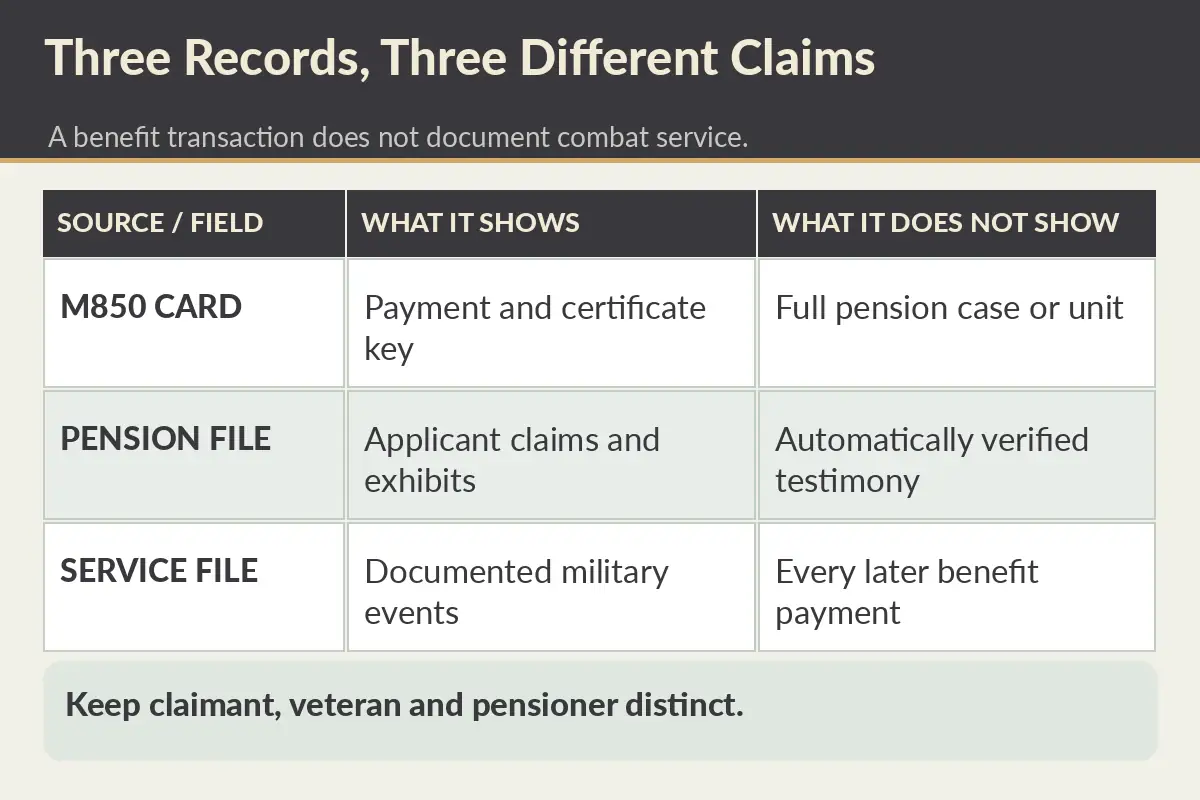
Microfilm publication M850 reproduces Veterans Administration pension payment cards dated 1907–1933, held among Record Group 15 financial records. The National Archives states that the cards cover pensioners other than World War I veterans and can include a pension certificate number. A card establishes how an agency recorded a benefit or payment account; it does not independently establish the complete military service of the person named or the truth of every family statement that appeared in an earlier pension claim.
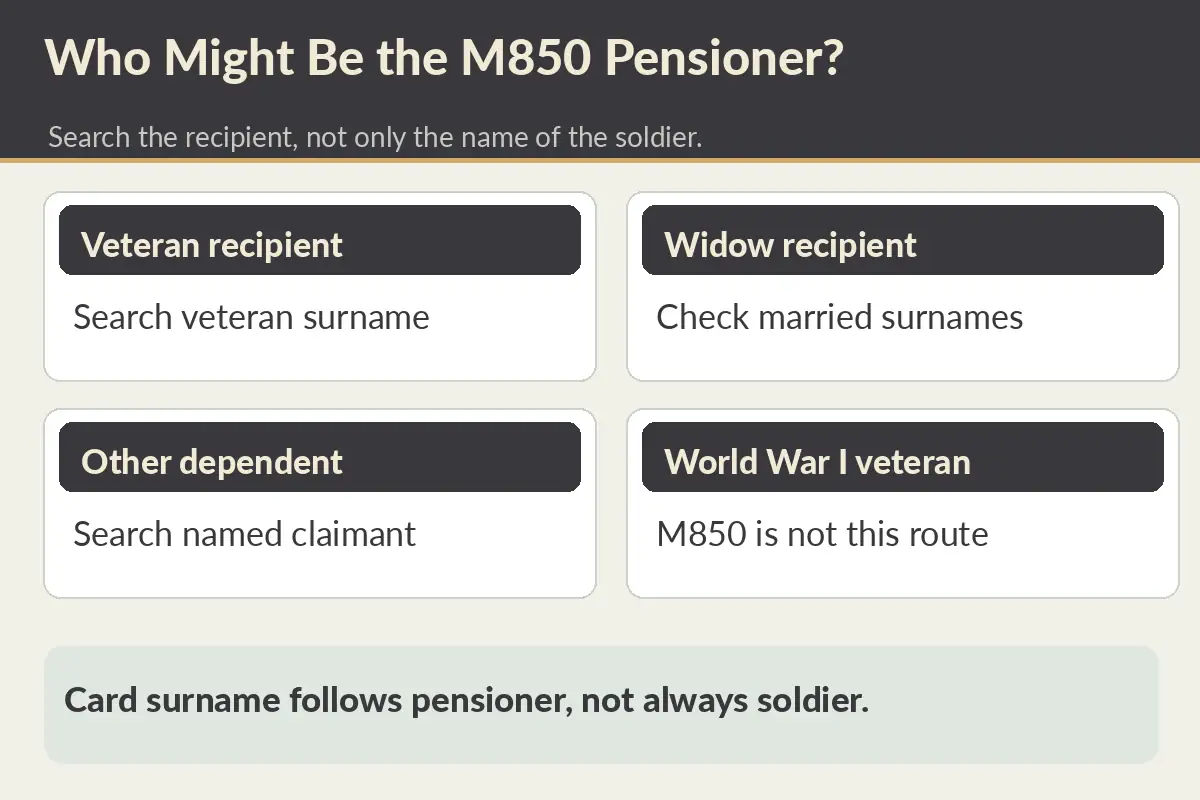
The pensioner may be the veteran, a widow or another dependent, and the surname on the card may be the claimant’s rather than the soldier’s original service name. Begin with the person whose benefits you want to trace, approximate residence, a known veteran relationship and a possible pension certificate number. If your only lead is an ancestor who fought in World War I, do not assume M850 will contain his pension. This publication is not an all-veteran census and is not a general benefits ledger continuing after 1933.
Search the Claimant’s Surname Before the Veteran’s
M850 was arranged alphabetically by the pensioner’s surname, so a widow may appear under a later married surname. Build a short list of documented surname variants, potential dependent claimants and relevant approximate dates. Search the M850 collection or roll descriptions at a permitted access provider, recording whether you saw an index entry or an original card image. The National Archives lists a FamilySearch access route, but availability, account conditions and digitized coverage should be checked when searching.
If the name appears more than once, do not merge cards without comparing given name, certificate number, known locality and supporting pension evidence. Search under a deceased veteran’s spouse or children when the pensioner was a dependent. A card for a similar surname in the correct state is merely a candidate. Preserve the exact card wording, including any corrections, handwritten notations and dates, because an index may omit the detail needed to resolve an apparent duplicate.
Separate Certificate Numbers From Application Numbers
A certificate number is an important retrieval key, but it is not always equivalent to an original application number, military service number or veteran’s unit number. NARA explains that several indexes to pension applications and certificates served different roles, and records of payments form a separate class. Read the literal label on the M850 card and record its number exactly before searching related application material. If a number is unclear, compare indexed forms rather than inventing the missing digit.
Build a small chain with pensioner, M850 image, certificate number, candidate general pension index and original case-file custodian. The next source may be a surviving application containing testimony, medical exhibits, affidavits or marriage evidence; none should be assumed to exist simply because a payment card survived. A certificate demonstrates a different administrative stage from filing an application. Treat approval, payment, termination and later dependent claims as separate events with different dates.
Read Payment Dates Without Overclaiming Residency
Cards may record administrative payment information and status changes. A date attached to a card may concern accounting, renewal, transfer, death notation or another benefit transaction rather than a date of military discharge. Verify column headings and neighboring entries before explaining what a particular date or code means. An address or agency location used for payment is not necessarily a permanent home, birthplace, location of service or legal property ownership.
Construct a record-of-payment table with the exact stated date, apparent transaction type, the person whose account was affected, number and source citation. If a card ends in 1933, that can reflect the publication’s terminal coverage rather than the pensioner’s death. Do not infer that a widow remarried, a veteran died or an award was withdrawn from a missing later entry. Test potential death, migration and marital-status clues against civil registers, a pension file and household records independently.
Use the Original Pension File to Investigate the Claim
A detailed pension application is the correct place to evaluate the evidence that qualified someone for benefits. Such files can contain testimony from applicants, neighbors and military associates, but sworn claims still need corroboration. NARA’s Army pension guide sets out separate application and pension-related record paths. The record-creating department and pension category depend on the claimant’s service and legislation; do not assume a Civil War index automatically covers every conflict or Navy claim.
Use the M850 certificate number only as a starting key. Verify the filing system, jurisdiction and claimant before ordering or searching a case file. Compare each claimed marriage date or disability with an independent civil or military source. Never publish a claimant’s allegation as an unquestionable fact simply because an office paid a pension. The outcome of the M850 search should be one administrative link in a larger evidence chain, not a final biography of the soldier.
Document a Negative Search Responsibly
A failed M850 name query can reflect name variants, remarriage, age or benefit eligibility, lack of coverage, index error or a misidentified claimant. The source’s 1907–1933 dates and exclusion of World War I cases set important boundaries. Build a negative-search note listing variants, image and index providers, collection extent, dates and whether a dependent search was attempted. Checking only a free text result is too weak to conclude an eligible pensioner was absent.
When comparing relatives, keep pension recipient, service member and certifying witnesses as distinct people. A family tree should cite M850 for the recorded payment, separate pension-index documents for application numbers and original military records for service. Express uncertainty explicitly: “card under surname X may refer to widow Y pending certificate-file comparison.” Such precision prevents a benefit-account coincidence from creating a fictitious military ancestor.

How We Research M850 Pension Payment Cards
We search by the actual pensioner’s name, including possible remarried dependents, and capture the M850 card’s literal certificate number. We then identify the relevant pension index and original application separately, compare identities, and verify any claimed service in military records. We do not infer events after 1933, treat card absence as a denied pension, or equate a payment to proof of a particular battle.
More Records and Archives Guides
Original Archive Sources and Proof Limits
For the specific archival series and its original arrangement, read the primary custodian guide (Identifies M850 as the 1907–1933 Veterans Administration pension payment cards, and connects it to pension case files and access routes.). For a separate official explanation of related records and coverage, use the supporting archive source (Documents RG 15 financial holdings including 1907–1933 payment-card microfilm and distinct pension application registers and pension payment rolls.). Keep a catalogue description, an index transcription and an examined original as distinct levels of evidence.
No. NARA describes this publication as excluding World War I veteran cases.
They are sorted by pensioner; a widow or dependent may have another surname.
No. It proves an administrative pension entry; use service and pension application evidence separately.
To identify associated pension indexes and possible original case files, after confirming the number type.
No. 1933 is the terminal date of this microfilm publication’s covered records.