
M1749 historical registers can reveal a U.S. veteran’s service, family contacts and multiple admissions, but being admitted does not itself prove a pension award. Begin with the official archive research guidance. Review the GenHis affiliate disclosure before selecting any external access service.
M1749 Is a Home Register, Not a Pension Roll
The National Home for Disabled Volunteer Soldiers operated a network of residential and medical facilities serving eligible veterans. The National Archives reproduces historical registers in publication M1749 for the period 1866–1938. The registers may give military service, personal and family information, admission or discharge dates and circumstances of later residence. Their purpose was to manage residents, not to certify every statement in the entries as true. Admission alone does not mean a pension was approved or a service-connected injury was officially established.
The record system also changed across decades and branches. A person may enter, leave and return, with the same original home number. Ask a focused question first: when was the veteran admitted to a particular branch, who was listed as nearest relative, or what does a later death entry actually say? Locate the probable branch from a pension address, household record, obituary or family correspondence. Do not assume a person lived continuously at the home between two dated appearances.
Find the Correct Branch and Home Number
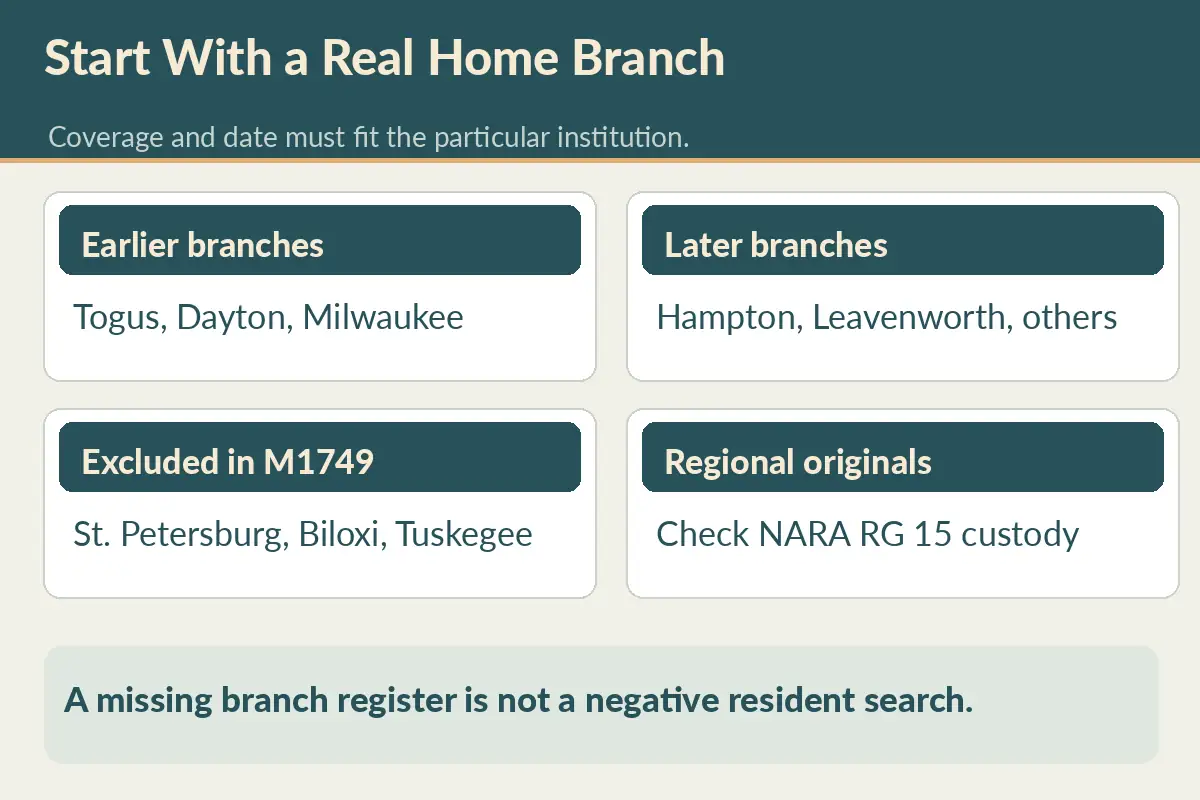
M1749 material is organized around facilities, not one national alphabetical list of all veterans. The National Archives lists home branches including Togus, Maine; Dayton, Ohio; Milwaukee, Wisconsin; Hampton, Virginia; Leavenworth, Kansas; and later facilities. Verify the particular branch’s operating years and archival survival before searching. The series includes registers and selected other records, not identical forms for every home or all years. An index hit may refer to a branch and volume that requires viewing a separate image.
When a candidate is found, capture its branch name, entry date, exact home number, volume, page and complete NARA citation. That number can tie an individual’s original admission to a later readmission without assuming the intervening residence was uninterrupted. Beware of branch transfers and similarly named veterans. If the entry is unclear, examine neighboring pages and headings, and compare age, state, company, regiment and nearest relative. Keep a record of which branch indexes and variants were searched.
Read Military History and Domestic History Separately
The National Archives describes four principal sections on a typical register page: military history, domestic history, home history and general remarks. The military panel may report enlistments, rank, unit, discharge, reason for separation and the disability stated on admission. These details often came from documents presented by the resident and administrative reporting. They are valuable search keys but should be checked against compiled military service, discharge and pension case records when making a stronger historical claim.
The domestic panel may identify age, birthplace, occupation, religion, marital status, last residence, physical traits and a nearest relative with address. A “nearest relative” is an emergency contact or reported next of kin at that time, not necessarily proof of a legal relationship or the person’s last surviving child. Transcribe its name and role exactly. Verify every relationship through independent marriage, probate, census or vital records. Remember that an elderly resident might report changing family information over successive readmissions.
Interpret Home History and General Remarks
The home-history portion may give original admission, later reentry, discharge, stated reasons for leaving, pension rate if any and possible death or burial information. General remarks can mention supporting discharge or pension papers, money and personal effects, or other case administration. Preserve the column headings and specific dates because an “admission” is different from the date a name was entered in a volume, and a “discharge” from residence is not the same as the end of military service.
A noted pension amount should be cited as a report in the home register, not as an independently certified complete payment history. Compare it with the relevant pension records, including the distinct M850 payment cards when the dates and claimant support that route. If an entry refers to a death at home, test it against a death register or burial and cemetery records. A home entry showing a place of burial can be accurate without proving that a surviving memorial or grave marker exists today.

Know Which Branch Records Were Not Preserved
M1749 is not a universal register of every later veterans facility. The National Archives expressly notes that it does not hold Historical Registers for the St. Petersburg, Biloxi or Tuskegee homes. Selected ancillary materials—such as particular burial, funeral, death or hospital registers—survive only for certain branches. Different NARA facilities may have regional original records, with availability and formats varying. A missing page, unindexed volume or excluded home is a coverage limitation, not evidence the veteran never received care.
If a home register cannot be found, use the RG 15 guide to identify the relevant regional custody and the institution’s actual dates. Search newspaper notices, local cemeteries, state death certificates and pension-account evidence as separate substitutes. Note whether the record system originated in a federal or previously state-run facility, especially for homes that joined the system late. A claimant appearing in an entirely different home record may be a namesake or a separate stay; do not merge facilities by a matching surname.
Reconstruct a Resident’s Life Without Overstating Care
Create a row for each identifiable admission, readmission, transfer, discharge or death statement. Keep the home number, branch, dates, source, quoted remarks and alternative interpretations. Then align those administrative events with a civil residence timeline and contemporary service documentation. Service wounds, disability assessments and personal kinship claims have different proof requirements; do not conflate a resident’s reported history with a formally documented battlefield event.
The strongest outcome is a limited, reproducible narrative such as “listed as readmitted to the Dayton branch in a stated month, with a reported nearest relative in a given town.” Explain unresolved gaps and the next source needed. If the home record has sensitive medical or family descriptions, quote only what is relevant to the research question and avoid imposing modern diagnoses. An archival institution’s classification is evidence about administration, not authority to label a person’s entire life.

How We Research M1749 Soldiers Home Registers
We locate the correct National Home branch and its date range, identify the original home number, and compare initial and subsequent register entries. We transcribe the four panels independently, verify military service and family contacts against outside records, and distinguish residence from pension eligibility or payment. We check branch-specific missing holdings before considering a no-result meaningful.
More Records and Archives Guides
Original Archive Sources and Proof Limits
For the specific archival series and its original arrangement, read the primary custodian guide (Details M1749 home-number assignment, four-part register structure, readmissions, family fields and branch-specific record survival.). For a separate official explanation of related records and coverage, use the supporting archive source (Describes RG 15 National Home branch records, regional record custodians and the 1866–1938 administrative history.). Keep a catalogue description, an index transcription and an examined original as distinct levels of evidence.
No. Many admitted veterans lacked a federal pension, particularly in earlier decades.
The original home number usually followed the resident after discharge and return.
No. It names a reported contact; verify the relationship independently.
No. NARA notes no Historical Registers for St. Petersburg, Biloxi or Tuskegee.
Not necessarily. Verify any reported burial with an independent register or site record.