
The strongest route to a Royal Irish Constabulary service record is a warrant or service number, not a guessed home parish. Most constables appear in HO 184/1–43, officers in HO 184/45–48, and Auxiliary personnel in HO 184/50–51; the right branch matters.
Begin With a Number, Not a Familiar Surname
Start by writing down the person’s exact known name, approximate appointment date, native county and any remembered police station or rank. Search the service indexes described by The National Archives to obtain a warrant or service number. Save every plausible candidate rather than selecting the first matching surname.
The same surname can recur among constables recruited decades apart. A researcher who knows only a county can still proceed, but that county alone is not proof that an indexed officer belongs to the family. Record whether a reference came from the original register, a modern transcription or a name index.
Route Constables, Officers, and Auxiliary Personnel Separately
The National Archives assigns the general constabulary register to HO 184/1–43, arranged by service number. The four officer volumes in HO 184/45–48 use date of appointment. HO 184/50–51 is a distinct search path for Auxiliary Division personnel.
An officer appointed directly as a cadet may not have a constable’s service number in the expected sequence. A man promoted from constable to officer may need two entries: a constable register entry ending at promotion and an officer register entry recording later service. Do not interpret the second entry as a separate person solely because the arrangement changes.

Read the Service Register Column by Column
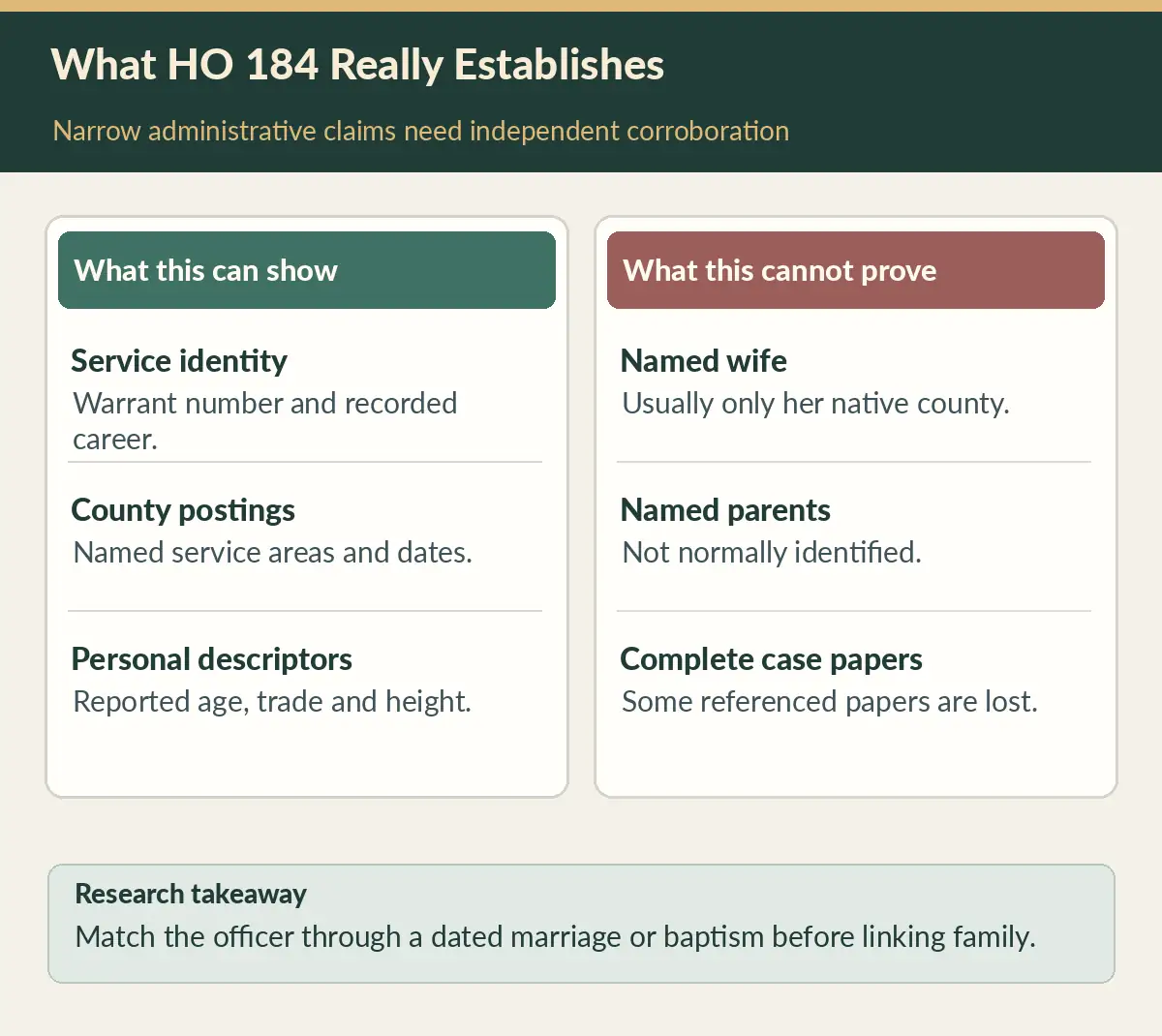
An HO 184 entry commonly identifies full name, recorded age, height, religious affiliation, native county, former trade, marriage status, native county of the wife, appointment date, counties of service and retirement or death notation. It does not normally give parents or the wife’s name. The register may use an administrative shorthand or a reference to related papers no longer surviving.
Transcribe the header and marginal notes along with the main line. Keep the document’s historical language in a quotation or a labeled transcription, then interpret cautiously in modern prose. A stated native county is not necessarily a precise birthplace or the place where a spouse resided.
Separate Posting County From Home County
Police service could involve assignments in several counties. A transfer or station entry is employment geography, not evidence of the individual’s permanent household. Place each recorded appointment, transfer, promotion and retirement in its own dated row.
Compare native county separately with the locality named in an independent baptism, marriage or civil registration. The PSNI Police Museum genealogy guidance warns that centrally held records do not normally specify localities smaller than counties. Resist the urge to convert a county label into an exact village. If a family story names a barracks, seek a contemporary directory or local record before accepting it.
Use Pension Registers as a Different Kind of Evidence
Pension registers, including records from 1873 onward drawn largely from PMG 48, may help after you establish a service identity. Pension data can provide residence or financial context not present in the register of service, but it is not a duplicate of every career event. A pension date is not necessarily the date of retirement or death.
Do not assume that a person without an online pension entry never served; digital coverage and entitlement rules matter. Note the person’s name, pension identifier if present and award date, then compare them with the warrant number and service chronology. A widow appearing in payment records needs an independent kinship test.

Access the Original Register, Not Just a Search Hit
Name-search collections may display indexed metadata before providing an image, and remote copies may require a subscription. The National Archives describes both online searches and microfilm consultation at Kew, including an alphabetical printed list used to find service numbers. Record the HO 184 piece, register page and exact original spelling when available.
If the online index says one county and the manuscript says another, preserve both readings and state the conflict. A failed keyword query is not a failed search of the microfilm sequence. Ask which volume and number interval you have actually inspected before recording a defensible negative result.
Test Two Officers With the Same Name
Imagine two historical constables named Patrick Walsh. One entered service in the 1850s and came from County Clare; another entered two decades later and stated County Mayo. Your family has an 1870s marriage in Clare, so the first looks tempting but is not yet identified.
Compare ages, trade, dates of recruitment, religious affiliation, later postings and independent marriage evidence. Keep two candidate rows and retain disconfirming data in the same comparison. If the second man’s service number appears on the only verified retirement receipt, the chronology may reverse the apparent conclusion. These are illustrative names, not real records.
How We Research HO 184 Matches
We begin with the National Archives’ series and arrangement instructions, identify the appropriate HO 184 range, and inspect original image evidence where access allows. Then we map each service date or posting against separately sourced family events. We treat a wife’s native county as a clue, not a named wife, and reject any family tree link that rests only on a shared surname.
A repository reference number can point to papers that no longer exist. We record the access method, the exact part of each register reviewed, and our unresolved identity questions. Editorial relationships are explained in the affiliate disclosure.
Record a Citation and a Practical Next Step
An effective citation includes The National Archives, HO 184, piece number, page or folio, original name and any service number, followed by the image provider or consultation details. When an indexed hit has no image, describe it honestly as an index and write down the next action required to inspect the register.
If an officer’s entry refers to previous constable service, pursue the constable volume too. If a man’s apparent marriage occurs far from his native county, check a civil or parish record rather than inventing an explanation about posting location. Keep every conclusion proportional to the documentary claim.
More Records and Archives Guides
Interpret a Missing Name Without Overstating the Gap
No result under the expected spelling may reflect aliases, transcription mistakes, a different class of officer record, or an incomplete online index. Try initials, anglicized variants, the remembered enlistment decade and—if available—a warrant number directly. Then check the selected HO 184 piece and the separate officer or Auxiliary registers.
The finding aid’s descriptions may also identify administrative documents that do not name every constable individually. Only after documenting the exact runs reviewed should you say that a particular man was not found in those records. This is a statement about a search, not an assertion that the man did not serve.
No. The general constable registers are principally arranged by service number; search an index or printed alphabetical list to establish that number.
Usually not. It may report her native county or marital status without identifying her by name.
Yes. A former constable promoted to officer may have both constable and officer register entries.
No. Some references within service registers point to papers that have not survived.
No. Police deployment geography must be tested against independent records of residence or marriage.