
For the 1798 land tax assessment, locate the historical county, parish and IR 23 item before searching for a surname. The schedules list many owners and main tenants, not every resident, and a person taxed on land is not automatically the occupant or the legal owner.
Start With a Historical Parish and County
The practical entry point for an 1798 land tax question is a place, not a national person index. Find the parish or township where a family farm, house or tenancy was thought to exist, confirm the contemporary county and use The National Archives Discovery catalogue to locate the matching IR 23 item structure.
A sample catalogue page lists a Durham parish assessment as IR 23/23/62, with the folio and locality in the description. This example is not a citation for your own ancestor; it illustrates the level of archival precision needed. Record any variant spelling of a parish and the exact folio you inspect.
What the 1798 Assessment Does and Does Not List
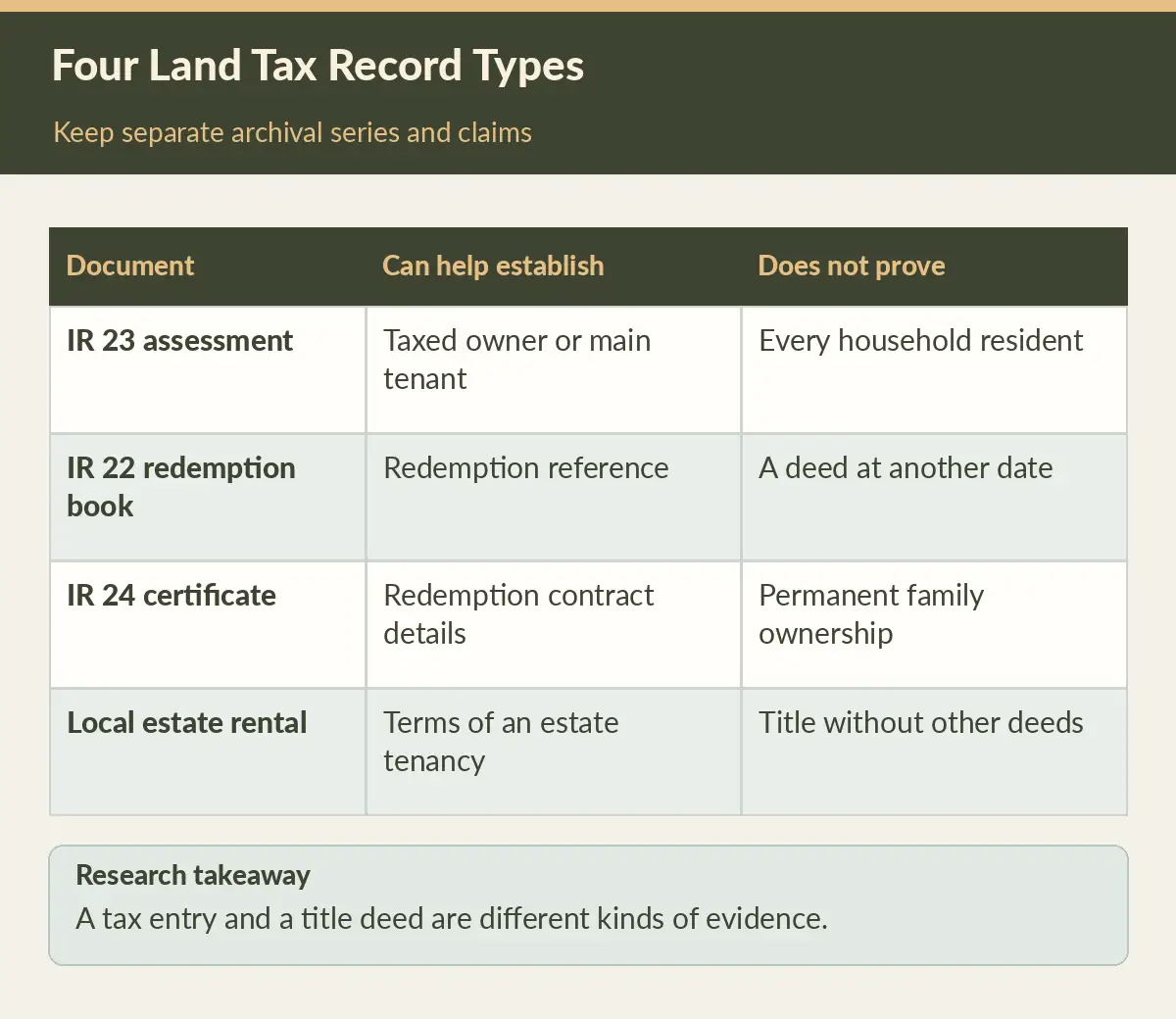
IR 23 contains the 1798 quotas and assessments under the Land Tax Perpetuation framework. The schedules are useful for identifying significant landowners and their main tenants, but they do not list all subtenants, laborers or poor households. A household missing from an IR 23 return may therefore have lived in the parish without appearing on the tax roll.
Some local returns refer to an occupier with a title rather than a full forename. Never turn a missing name into proof of migration or death. Compare the return with rates, parish registers and estate rentals before evaluating presence or absence.

Distinguish Owner, Occupier, and Assessed Property
A tax entry can put a landowner and a principal tenant on the same line while a cottage subtenant remains unmentioned. Transcribe every heading, adjoining entry and named role before producing a family timeline. Where a name seems to occur twice, it may represent two parcels, a proprietor with several properties or different people sharing a surname.
The amount assessed is a tax figure, not a reliable conversion into acreage, sale price or total household wealth. A tax liability is also not an automatically valid deed. If you need legal ownership, search conveyances or manorial and estate records and document that different evidentiary purpose.
Read the County and Parish Arrangement Before Browsing
The National Archives item descriptions follow archival county and parish units, not a modern street-search database. Start with a written place hierarchy: present place name, historical parish, township if relevant, county and the IR 23 piece. Use the catalogue’s browse hierarchy to identify neighboring localities when a parish name was altered or split.
Some catalogue items remain viewable only in a reading room or through a separately ordered copy. An online description of a folio does not mean the handwritten assessment itself is available as a downloadable image. Document which level of description you examined before describing any person-level result.
Do Not Confuse a Tax Assessment With Redemption
The assessment is not identical to a land-tax redemption contract. Related series IR 22 and IR 24 concern redemption bookkeeping and certificates; their purpose and details differ from a yearly assessed parish list. A redemption entry can offer further property information, but it does not automatically confirm an 1798 taxpayer’s ownership at an earlier date.
When a marginal annotation refers to redemption, copy that notation exactly before selecting the corresponding additional series. Treat dates on the assessment, later contract and deed as distinct events. A citation to IR 23 cannot substitute for actually reading an IR 24 certificate.
Compare Adjacent Names Without Assuming Family Relationships
Neighbors on a parish tax list may belong to the same locality, estate or filing group. The order of the entries is not an independently proved map of houses or a kinship diagram. Suppose the assessment lists two people named Thomas Green and a later baptism names a father Thomas Green; you have competing candidates, not one obvious ancestor.
Check occupations, separate tenancies, estate references and subsequent parish events before matching them. An unrelated landlord may carry the same surname as his tenant. Give each candidate a separate research-log row and preserve the exact wording by which the assessment identifies each role.
Build a Two-Date Property Evidence Table
Begin with the date of the 1798 assessment and a second independently dated source. On one row record the tax name, county, parish, owner or occupier designation and amount; on the next record an enclosure award, estate rental, tithe record or deed and its date. Differences may reflect transfers, changed occupiers or a changed assessment system.
They are not automatically family migration. Flag the fact that a taxpayer might hold property in multiple parishes and even several counties. Keep property evidence and household residence in separate columns; then ask which record would actually resolve a claimed owner-to-occupier transition.
How We Research IR 23 With Proper Limits
We check the archive’s hierarchy and determine whether an original image, an item-level description or merely a county-level guide has been seen. We transcribe owner and main-tenant columns without silently converting them into household members. We compare a tax entry with independently dated land or parish evidence and use the correct series for later redemption questions.
Uncertain name readings and omitted population categories remain explicit. The financial and editorial relationship notice is available in the affiliate disclosure. We do not invent a modern postcode or exact house from a broad eighteenth-century parish name.

Request the Correct Piece and Capture the Full Citation
For a request to The National Archives, supply IR 23, its piece and item numbers, named county, parish and folio. The record’s online catalogue may indicate that the original item has not been digitized for direct download.
Include the desired method of access rather than assuming a website image is available. If you need a particular landowner’s holdings, collect every relevant entry in that parish before asking for a specific copy; the same name may appear in multiple line items. Store the original spelling and tax amount as a transcription, and add a note explaining the limits of an owner or occupier identification.
More House and Local History Guides
Use the Source as a Link, Not a Final Title Search
The main genealogical value of IR 23 is to place a named taxpayer within a documented tax assessment and suggest other records to inspect. It does not necessarily establish legal title, length of residence, family size or relationships among adjoining names. A modern house may stand on altered parcels with completely different boundaries.
Trace the location through independent plans, deeds and rate books only where the sources actually overlap. If a tenant name is absent, confirm the schedule’s inclusion rules and the relevant parish before deciding the search tells you anything about that family. Your strongest conclusion is narrowly dated and explicitly sourced.
No. Work through historical counties, parishes and catalogue descriptions to identify an assessment.
No. Subtenants, laborers and many poorer occupiers may be absent.
No. Owner and main tenant are distinct roles; legal title requires other records.
IR 23 primarily concerns quotas and assessments; related redemption material is found in other IR series.
No. The catalogue may summarize a folio without offering a digitized manuscript image.