
Begin with a Parish and an Eligible Man
A Danish lægdsrulle is a register of men liable for military enrollment, not a list of everyone who became a soldier. The Danish National Archives, Rigsarkivet, describes registers from 1701 onward and gives a detailed search route for 1789–1864. Begin with a male ancestor, approximate birth year, and a documented parish of residence during the period of possible registration. A surname-only query cannot reliably identify the man because a roll is arranged through districts and administrative periods, not as one national alphabetical list.
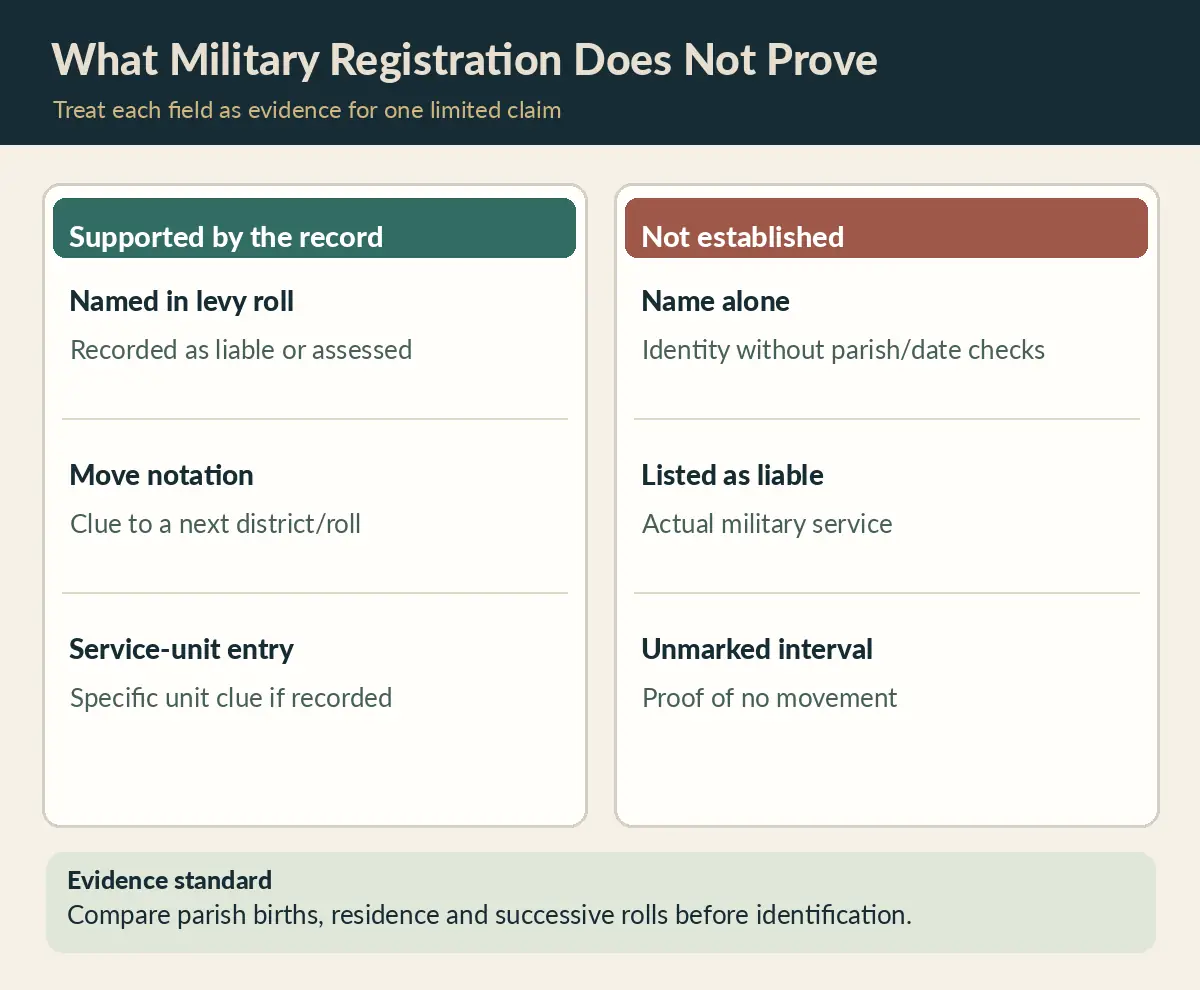
Write a target statement before using the scans: “Identify the levy-register entry for the man living in this parish in this approximate year.” Keep a second column for alternative candidates of similar name and age. This matters especially with patronymics and recurring given names; the first plausible entry should remain a candidate until a birthplace, residence or consecutive roll ties it to the same individual. Registration, exemption and actual completed service are different historical outcomes.
Use the Parish-to-Lægd Number Crosswalk
Rigsarkivet directs researchers to its alphabetical parish directory, Lægdsruller – Sognefortegnelse 1789–2012. Locate the historical parish to learn its lægd number and county (amt) or recruiting district. Then navigate Søg i Samlingerne to the archival creator and a volume for the correct year and county. A present-day municipality may span several older parishes; place conversion is a documented step, not a spelling convenience.
Note the exact county, levy number, archival creator, series, date range, page and digital image reference. A parish number can occur under a new administrative configuration later, so never copy a number from an undated family-tree note into a different period. If the residence is uncertain, list two or three defensible neighboring parishes and check each systematically. Negative searches are meaningful only after the historical jurisdiction and surviving roll type have been established.
Distinguish Main Rolls from Accession Rolls
For 1789–1864 Rigsarkivet distinguishes hovedruller, or main rolls, normally compiled every third or fourth year, from tilgangsruller, accession lists compiled in the intervening years. Main rolls carry men already enrolled in the system; accession lists capture new entrants, including newcomers to a levy district. They are related record types, not interchangeable name indexes. Search the accession list if a man appears to have arrived between main-roll years.
A practical sequence is to identify a dated main-roll entry, transcribe its whole line, follow any movement notation to the next levy number or register and then confirm the later entry. If you find a newcomer in an accession list, locate the next relevant main roll rather than treating the newcomer line as a complete military career. Preserve crossed-out items, annotations and the column headings used for that specific volume; forms and administrative conventions evolved.

Respect Who Was Required to Register
Rigsarkivet notes that in 1788–1848 liability chiefly concerned rural men of the peasant class; people in market towns and higher rural social classes were exempt from that system. Broad male liability followed in 1849–1860, with changes to qualifying ages as well. That makes a blank search especially weak evidence when the subject belonged to a category outside the enrollment rules. Do not apply one year’s age threshold to the entire eighteenth or nineteenth century.
The older 1701–1788 registers survive only sporadically and are commonly bound to estate records. That is a different retrieval problem from the later national route. If the research subject belongs to the eighteenth-century land militia, identify the manor or estate and consult the earlier instructions rather than trying to force the person into an 1800s district. State the source’s period and eligibility limits in the research log before interpreting a missing name.
Read Identity Fields without Inventing Service
The archive’s guide lists fields that can include age, birthplace, place of residence, physical height, assessment at the military session, exemption reason, transfer information, a service unit when called, and a parent’s name. An entry does not necessarily supply all fields. Transcribe the actual column captions and only the details present on the page. A father’s name is a strong clue when combined with locality and chronology, but may not exclude a second man with identical patronymic.
Classify every observation: directly written on the roll, inferred from a previous roll, or corroborated independently in a parish register. An exemption is an administrative decision rather than evidence of subsequent service. A service assignment should be checked in the relevant muster or service material when available. Movements describe a registration trail; they are not a complete diary of where the man slept every year.
Handle Bornholm and Other Geographic Exceptions
Bornholm had a separate militia system before being incorporated into the general recruitment administration in 1862. Rigsarkivet points researchers to Bornholm Milice muster lists and service books instead of the ordinary lægdsruller for the earlier period. The guide notes that these local records are not scanned in the same way as the national 1789–1864 levy-roll series. An unsuccessful national-roll search on Bornholm before 1862 should trigger a repository and series change, not a conclusion that the ancestor escaped registration.
Other regions also require chronological attention, particularly areas with changing nineteenth-century administration. Keep a dated location map alongside the family timeline and look for the region-specific instructions in the archival guide. If a scan is unavailable, record a precise reference for a reading-room request. Confusing “not digitized” with “not preserved” can eliminate a useful line of inquiry before it begins.

Work a Two-Candidate Identification Test
Imagine two men named Jens Nielsen in neighboring parishes. One appears in a roll with a birthplace matching a baptism and later a move to a known residence; the other has a different birthplace and an unrelated levy trail. Score the candidates against the same criteria: documented age range, parish, father or birthplace if written, transfer notation, and a later independent record. Treat the example as a method illustration, not an archival transcription of real people.
The successful identification is a chain of citations across records, not the repeated appearance of a common name. A conflict should remain visible rather than being silently normalized: age can be approximate, a place name can be abbreviated, and the registration number can change. Use church books for family linkage, not the military roll alone. If both candidates fit equally well, label the result unresolved and seek a third independent source.
Build a Reproducible Levy-Roll Citation
Record the issuing archival creator, named roll series, historical county and levy number, roll type, year, folio or page, person entry, and either image number or reading-room order reference. Include the repository name and access date for the digital object. A bare personal name and year will not let another researcher locate the correct volume. If a scanned book is paginated differently from its viewer, note both image count and handwritten page number.
Preserve a small evidence table separating the literal roll entry from an interpretation and from an outside corroboration. Follow references to a succeeding roll and write that citation separately. Keep uncertain Danish spellings in the transcription, with an English explanation in the note rather than altering the source. This workflow helps researchers return to the same evidence when a new parish fact changes which candidate best fits.
How We Research Danish Levy-Roll Claims
We start with Rigsarkivet’s official levy-roll guide, establish eligibility rules for the year, and identify the historical parish-to-levy conversion. We then record whether the selected object is a main roll, accession roll or exceptional local source, and inspect the scanned page rather than trusting an isolated index transcription. The goal is to confirm a continuous identification trail while making each change of number or jurisdiction explicit.
We compare reported ages, home parishes, parent references and transfers against independent church or residence evidence. We do not equate liability with service or take a missing digital image to mean the man was absent. For transparency, sources distinguish the guide that explains archival arrangement from the primary volume that would verify a particular ancestor. Research involving an actual person requires his or her original page before a family relationship is stated as fact.
For editorial transparency, see our affiliate disclosure; this independent archival workflow does not depend on an affiliate purchase or an invented access arrangement.
More Records and Archives Guides
Sources, Access, and Responsible Next Steps
The principal gateway is Arkivalieronline, reached through the Rigsarkivet collection search when a series has scans. Read the archival description before taking a digital filename as the name of the record; local systems and preservation vary. Some materials must be ordered in a reading room, while other periods have special access conditions. Use the custodian’s current instructions for availability and restrictions, especially for records nearer the present.
If the identity remains unsettled, choose a follow-up that can distinguish the two men: an original baptism, marriage, moving register, census or related military service record from the same time and place. Record a negative search with county, roll type and year. This closes the workflow without making the person’s appearance, service, family membership or absence more certain than the documents allow.
No. The roll records military liability or administrative assessment; service is a separate claim requiring relevant service information.
Main rolls list continuing registrants periodically; accession rolls capture those added in intervening years.
The enrollment system then chiefly applied to rural men of the peasant class, with important social and locality exclusions.
Consult the Bornholm Milice muster and service series rather than relying only on the standard national rolls.
Keep the county, lægd number, year, roll type, archival series, page, and repository image or order reference.