
Danish probate records, called skifte records, may identify heirs, describe belongings and preserve correspondence about an estate. The key to older records is often not surname but jurisdiction. Before 1851, the authority handling probate depended heavily on residence and the deceased person’s social or occupational position. Establish the death place and approximate date, determine the appropriate town, manor or local court, then use a probate name index to reach the original skifteprotokol.
Set the death date and identify the correct archival creator
Rigsarkivet recommends beginning with the deceased person’s name, residence and approximate death time. For probates before 1851, status or occupation is especially important because a town resident, an estate tenant and a freeholding rural resident might be handled by different authorities. Do not search only under the modern county label and then stop when a surname is absent.
Check church burial records, a dated census and known tenancy or property evidence to place the person in the right setting. Keep a brief “possible authority” list when a farm moved between estates or the person’s status is uncertain. The historically relevant office that created the probate papers becomes the entry point in the archival catalog. For a related choice, see our guide “Scottish Kirk Session Minutes”.
Route a town resident to the byfoged and its register
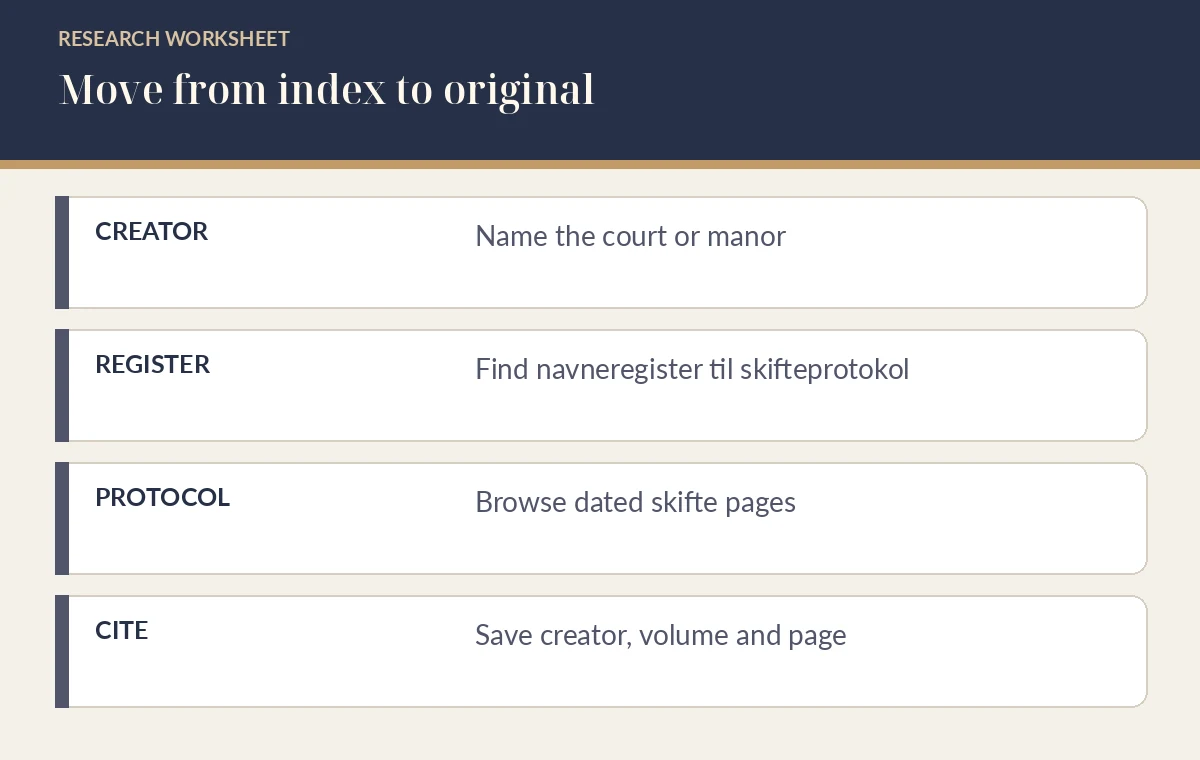
For residents of a købstad, the town’s byfoged often administered the probate process. Rigsarkivet advises searching the town byfoged as record creator and skift as the record series. When there is a navneregister til skifteprotokol, use that index first and copy its page or case reference before opening the skifteprotokol itself.
An index can omit a case or contain an old spelling. Check the dated sequence and death-notification books when relevant. A probate protocol might be several volumes removed from the name list, so preserve all intermediate references. A printed abstract or volunteer transcription is a useful finding aid, but confirm the wording from the court’s own page.

Search manor estates for tenants and estate employees
For some rural tenants and manor employees, the manor estate—gods—was the probate authority. Search the estate’s name as creator and look for probate lists, protocols and supporting documents. Rigsarkivet notes that the routing can vary; smaller manors after 1817 and former cavalry districts could follow other local courts. A single district-wide surname index is therefore not a reliable substitute for checking the named estate.
If the household lived at a named village, determine whether a manor or district court had jurisdiction before opening an unrelated volume. Compare a tenant designation or farm affiliation in the probate with the church and land evidence you already hold. Do not infer legal ownership of the farm from the mere appearance of a deceased tenant’s belongings in an estate inventory.
| Evidence source | What it can support | What it does not establish |
|---|---|---|
| Købstad resident | Town byfoged / skifte name index | Do not assume village or manor custody |
| Manor tenant or employee | Named gods and its probate volumes | Tenancy is not land title |
| Other rural resident | Historic amt / herredsfoged / birk | Check jurisdiction and reform period |
For independent rural residents, examine court dates carefully
Rigsarkivet distinguishes other rural residents from manor tenants. Before 1793, different county-level archival creators may be relevant; for 1793–1851 a herredsfoged or birk authority may be the route. Use the archive’s current guidance for the specific locality rather than assuming that one reform immediately changed every local record arrangement.
Search name indexes to a skifteprotokol when available and record the historical court district beside the death parish. A person who died away from the family’s last known residence may require a different search. When court and parish boundaries do not align cleanly, test the location evidence rather than forcing the individual into the first digitized volume you see.
Treat a death notification or private probate as a separate outcome
A dødsanmeldelsesprotokol can mention a death even when there was no ordinary estate division, a surviving spouse retained an undivided estate, or a private arrangement was made. Rigsarkivet lists such books as important fallback sources, in relevant jurisdictions from around 1820. This is not equivalent to the full inventory with heirs and itemized valuations.
For a fictional Niels Hansen dying in a market town, an index with no skifte entry would trigger a search of the death notifications and, where indicated, the correct private-estate series. It would not justify the assertion “the family had no property.” Record the status of each search separately: original inventory found, death only, private process noted, or no surviving record located. For a related choice, see our guide “Swedish Estate Inventories”.
Read names and obligations without inventing kinship
In the original probate, distinguish a widow, heir, minor, guardian, executor, tenant, creditor and witness as the document describes them. A person authorized to speak for a child is not automatically that child’s parent. Transcribe Danish relationship terms before normalizing names or calculating ages. Probate also records assessments and transactions, which cannot by themselves demonstrate actual market value or later ownership.
A working citation should include the creator, series, probate volume, date, page or case, archival platform and image number. Rigsarkivet’s Arkivalieronline contains many scanned books, but its scans are browseable images, not an assurance of full-text personal-name search. When an image is unavailable, note what finding aid points to the original and whether it must be requested.

Audit every unsuccessful path before using alternatives
If one archive route fails, ask whether the deceased was actually a tenant, a town inhabitant or a freeholder; whether the name index covers that year; and whether the books survived. Check the record creator under alternate place names. A lack of probate material is not negative evidence about a person’s marriage or children without first establishing the record system’s scope.
Finish with a narrow next question such as “Which manor administered this village tenancy in the year of death?” or “Does the notification index refer to a private probate?” This preserves the difference between a missing index match and a documented absence of a probate case, and it keeps a future archive inquiry specific enough to answer.
How We Research Danish Probate Records Skifteprotokoller
We followed Rigsarkivet’s official skifte research guide, using its pre-1851 division by social status and local authority. We separately consulted the National Archives’ scanned probate-index lists and browse guidance. The Niels Hansen scenario is fictional, and missing name-index results are treated as an archival routing question rather than a verdict on a family.
More Records and Archives Guides
Archive catalogs and original-source guides for danish probate records
rigsarkivet.dk — Danish National Archives: estate custody, pre-1851 routes and death notification books.
arkivalieronline.rigsarkivet.dk — Arkivalieronline: probate indexes by record creator and specific year.
rigsarkivet.dk — Rigsarkivet: scans versus searchable transcripts and catalog strategy.
These links lead to official or archival research resources, not approved paid endorsements. Read the GenHis affiliate disclosure. Access conditions and digitization coverage may change. Research historical people with appropriate context; do not disclose private details about living people or treat allegations and administrative labels as proven facts.
A Danish probate protocol recording the administration of an estate, where that type of record survives.
Different local authorities handled town residents, tenants and other rural inhabitants.
Start with the responsible manor, gods, and its probate index or protocol.
Check coverage, alternate authority and relevant death notifications before assuming no case existed.
Only if the original wording supports that role; independent church and civil evidence can test the claimed kinship.