
To find County Wicklow Catholic parish records, establish a historical Catholic parish and a plausible year before typing a surname into a general database. The National Library of Ireland (NLI) Wicklow parish page shows several distinct microfilm segments for baptisms and marriages, some with gaps or overlapping dates. NLI provides images of surviving registers rather than a complete name-search index. A failed surname search elsewhere must therefore be tested against the actual parish, date range and original pages.
Fix the historical Catholic parish before selecting a register
Begin with a townland or family residence, a dated civil record or a reliable local description. Identify the Catholic parish serving that place during the relevant period, rather than assuming a modern postal address matches an eighteenth-century parish. County Wicklow and a parish called Wicklow are not interchangeable search scopes. Parish boundary changes, nearby chapels and alternative place spellings may move the expected baptism into another register.
Use the NLI parish map and parish entry to locate the relevant microfilm. Record the parish name as the site labels it and preserve the film number in your research log. If a family lived near a boundary, list adjacent Catholic parishes as competing hypotheses. The aim is not to browse every image in the county indiscriminately, but to define the smallest defensible set of registers that could contain the event. Our guide “Galway Catholic Parish Registers” shows how to find baptisms by parish and microfilm.
Read Wicklow reel coverage rather than assuming one sequence
The NLI’s Wicklow page lists examples such as microfilm 06482/08 containing early baptism and marriage material and 06482/07 covering overlapping mid-eighteenth-century dates. It also lists later segments including marriages from November 1795 through May 1874 on 06482/03, alongside separately divided baptism sequences. These numbers are historical archive identifiers; keep them with the exact dates displayed for each segment.
Coverage dates are not guarantees of every event within the period. There may be missing leaves, a poorly filmed page, an out-of-order entry or gaps between copied sequences. Before labeling an ancestor “absent,” note which reels, image ranges and date intervals you actually inspected. When two reels overlap, compare both if the first image sequence is unclear; the same period on two filmed segments can sometimes clarify a difficult entry.

Browse baptism entries with context and handwriting checks
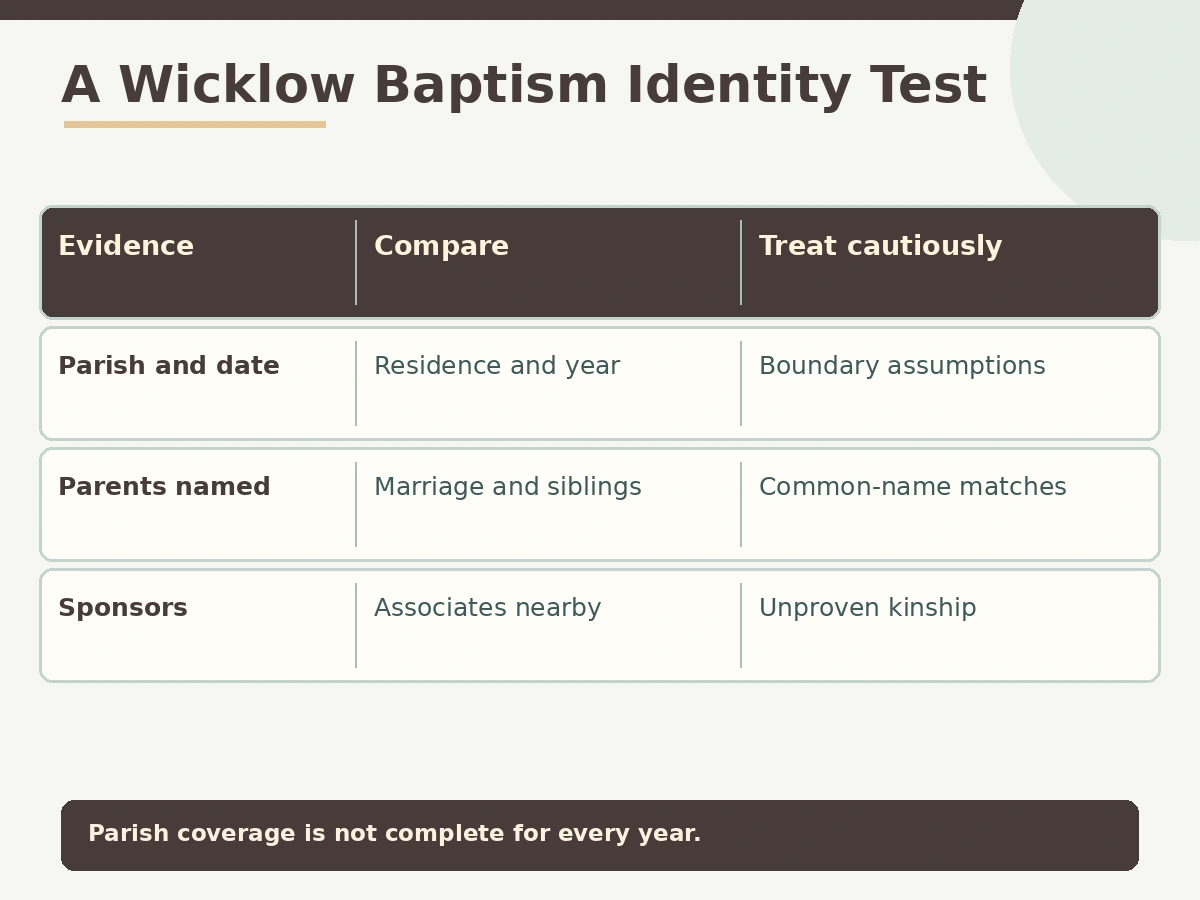
On a baptism page, transcribe the child’s given name, recorded parents, date, godparents or sponsors and the entry’s neighboring lines, but only where those features exist. A baptism date is not automatically a birth date. Treat inconsistent spelling as a transcription question and check whether the minister used Latinized first names or local abbreviations. Reading the entries above and below can expose repeated surnames or a family cluster in the same townland.
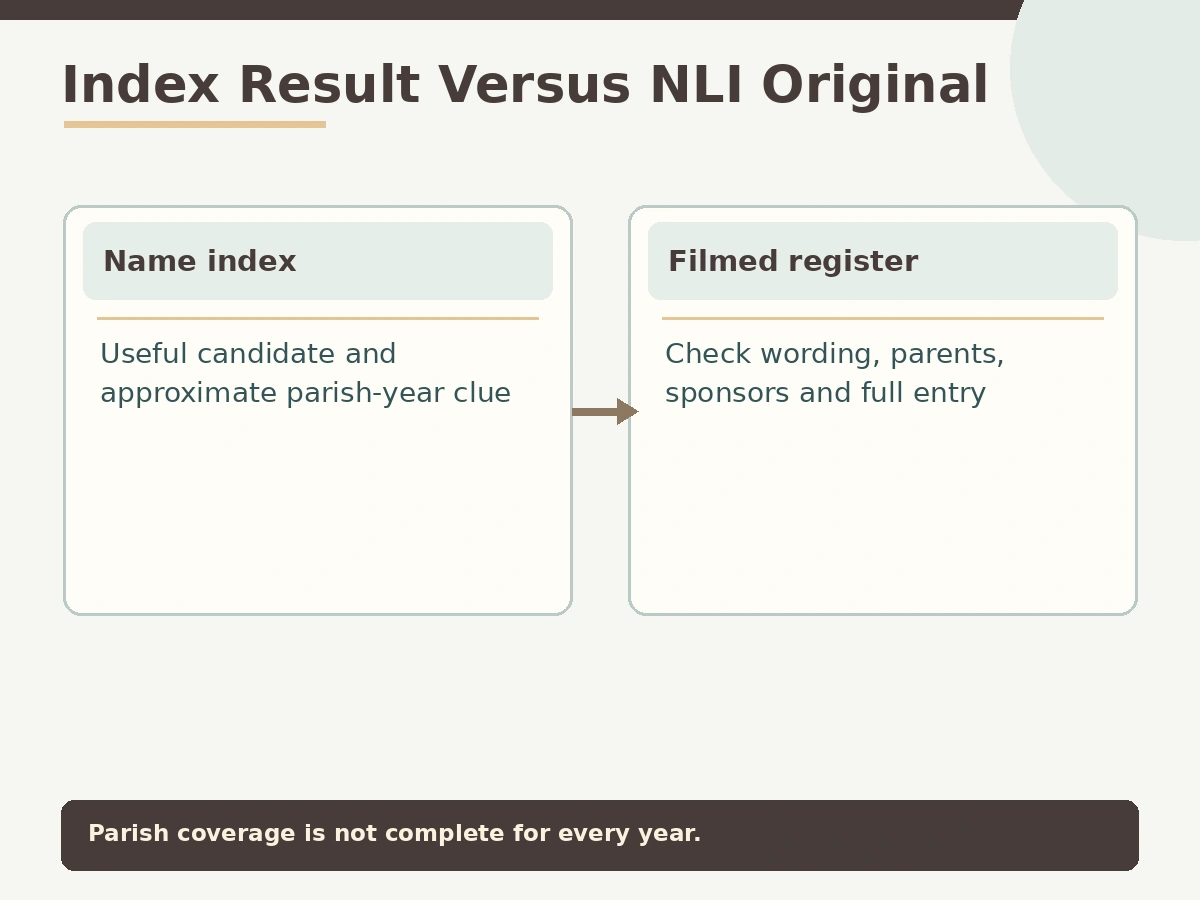
If an index returns a candidate surname, navigate to the original reel and check the complete entry rather than copying the index’s parent-child claim without verification. A common given name and two parents with familiar names may describe another household. Require an independent link, such as the parents’ marriage, later civil registration or a geographically consistent sequence of children, before attaching the baptism to a specific family tree.
| Source | What it supports | What it does not prove alone |
|---|---|---|
| Parish reel | Coverage for event and year | Every event survives |
| Baptism entry | Clerk’s recorded sacrament details | Exact date of birth |
| Marriage entry | Recorded couple and witnesses | Parents where not stated |
Evaluate marriage entries without creating extra facts
Parish marriage registers may identify spouses, witnesses, date and officiating cleric, although the fields and completeness differ by era. Do not invent ages, parents or occupations when the entry contains none. A witness may be a neighbor, relative or recurring parish associate; a shared surname is only a research lead. Transcribe each witness exactly, then see whether the same person appears in nearby marriages or later civil records.
For a union near the introduction of civil registration, compare the available civil record as an independent source while respecting different statutory dates and denominational rules. A parish celebration and a civil index entry may represent the same event through different administrative routes. If a ceremony is only alleged in a later family account, a matching surname in the NLI register cannot by itself prove that particular couple.
Recover missing years and alternate spellings in County Wicklow
The NLI’s digitized microfilms broadly cover Catholic register material into about 1880, not all parish records to the present. Local historical guidance notes different online index ranges and says original parish books remain under local custody. If an 1885 baptism is absent from the NLI image sequence, that is a scope issue, not proof that no Catholic baptism occurred. Verify whether later records require parish contact or an authorized later transcription.
For earlier gaps, try neighboring parishes with a recorded geographical reason. Search variants of O- and Mac- surname forms when supported, and consider that a name written in cursive can be misindexed. Log each negative as “searched this reel and dates with these variants.” Avoid using a very broad surname search as substitute for a place-and-period coverage audit.
Cite the microfilm image and rank the identity claim
An image-level citation should identify NLI Catholic Parish Registers, parish, sacrament, image or page as shown, date, film segment, and access date. Keep a verbatim transcription separate from editorial expansions in square brackets. If you worked through a third-party index, cite it as a finding aid as well, but prioritize the filmed original for the event’s actual wording. For the fuller picture, see our guide “Irish Catholic Parish Registers”.
Classify the claim: the image documents that a clerk entered a baptism or marriage; identifying that entry with your ancestor requires correlation with other records. When parish boundaries or dates remain uncertain, state the alternatives. The useful output is a small evidence matrix of place, time, sponsors or witnesses, and conflicting same-name candidates—not an unsupported parentage leap from one index row.
More Records and Archives Guides
How We Research Wicklow Parish Microfilms
We compared the NLI Wicklow parish reel list and NLI digitization description with the County Wicklow Heritage account of local parish access. Dates quoted here are specific to the Wicklow parish example and must not be projected across all county parishes. No fictional register entry is presented as historical fact. Our affiliate disclosure covers the site; paid third-party indexes are not required to browse NLI microfilm images.
No. The NLI site is principally a collection of digitized register images organized by parish and date; third-party indexes are separate tools.
The surviving and filmed register sequences are divided across reels, sometimes with overlapping years or breaks. Check each segment’s type and dates.
Not normally. It proves the entered baptism event; birth dates must be independently documented unless specifically recorded.
No. NLI microfilm coverage generally ends around 1880; later parish material may exist under other custody and access rules.
Record parish, sacrament, date, original spelling, NLI film and page or image, with any transcription uncertainty and supporting independent evidence.