
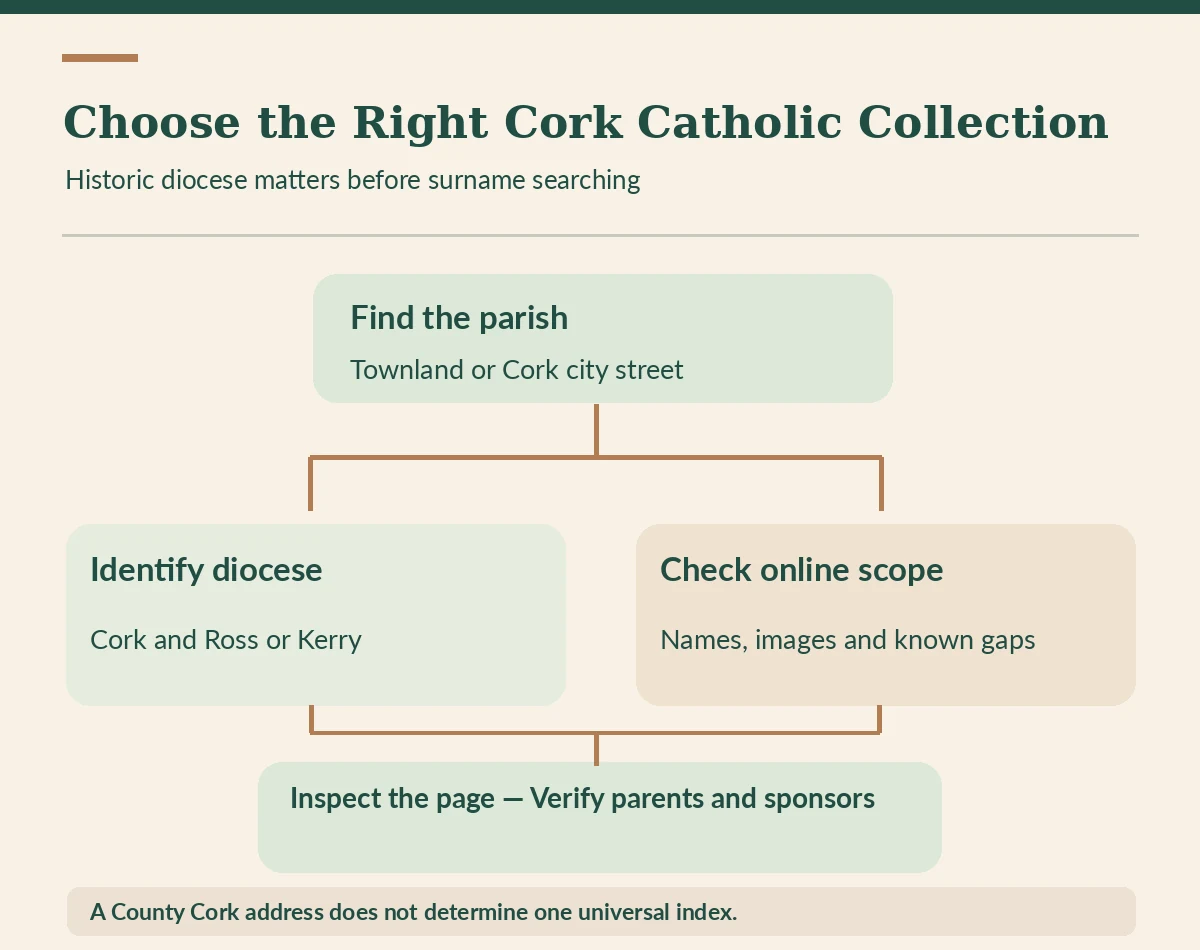
“Cork parish records online” is not one complete county-wide database. IrishGenealogy’s official coverage notes distinguish the Catholic Diocese of Cork and Ross, covering Cork city and much of the south and west of the county, from parts of western and northwestern Cork in the Diocese of Kerry. Some Cork city parishes are excluded from its available transcripts and images. Before entering a surname, identify the likely parish and its ecclesiastical diocese from a dated family residence or baptismal clue. Then decide whether IrishGenealogy offers the relevant images, transcripts only, or no coverage. The National Library of Ireland offers a separate route to digitized Catholic parish microfilms; the existence of a microfilm does not guarantee a name-search index.
Distinguish Cork and Ross from Kerry diocesan holdings
The IrishGenealogy record-sources guide explicitly identifies Cork and Ross Catholic baptisms, marriages and burials with images to approximately 1880 in its covered collection. It also describes Kerry diocese baptism and marriage transcripts extending to around 1900, relevant to parts of northwestern Cork. These descriptions are collection-level, not guarantees that every parish has every event in every year. Search a documented settlement through its diocese, record the database name and its date scope, then inspect the actual parish volume. A surname search restricted to the wrong diocese can produce a misleading false absence even when an original entry survives elsewhere. Our guide “County Wicklow Catholic Parish Registers” covers a related question.
Account for missing Cork city parish coverage
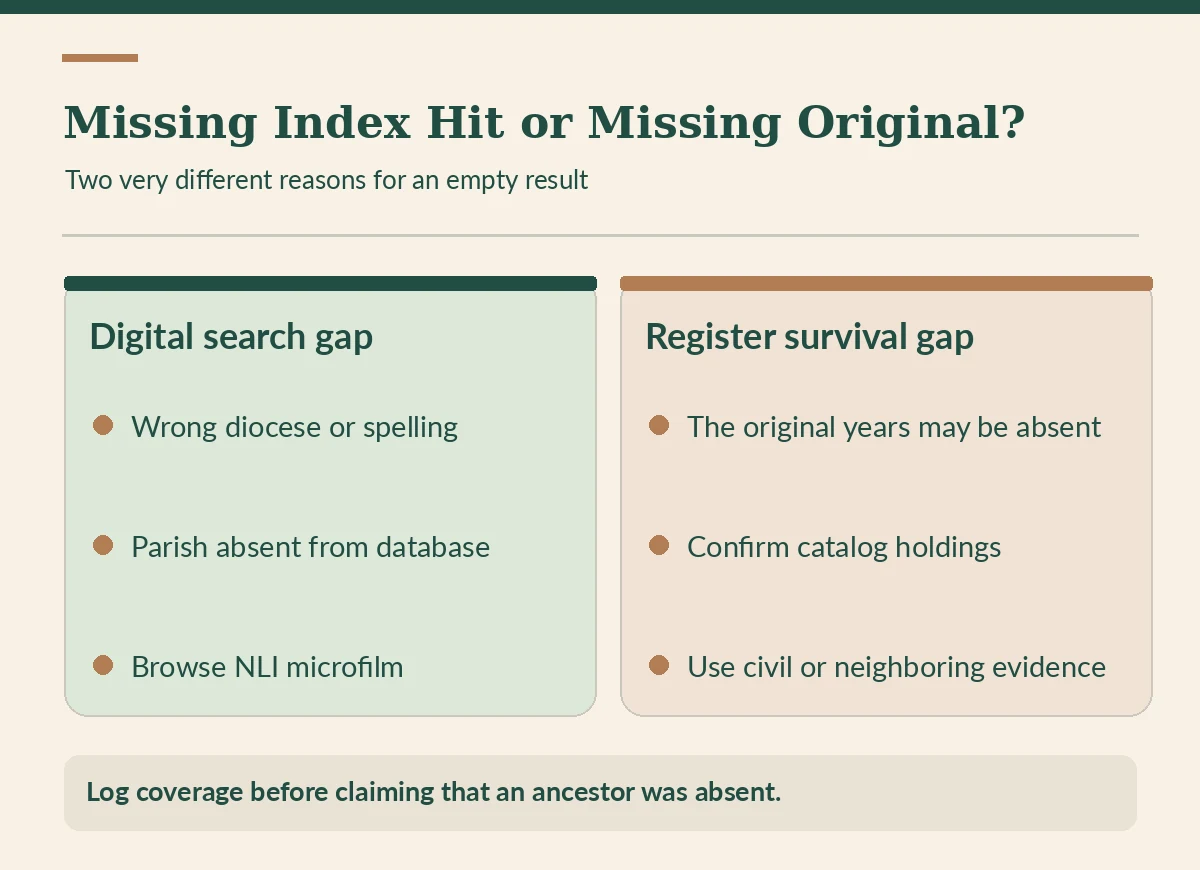
IrishGenealogy identifies unavailable records for certain Cork city parishes, including St. Mary and St. Anne, St. Patrick’s, and Blackrock in the online collection it describes. Do not infer that those congregations lacked baptisms or that the people disappeared from the county. Instead check the National Library of Ireland parish-image catalog, diocesan or parish custodians and other documented repositories. Note whether the gap concerns an online transcription, an image linked to that transcription, or the surviving original register itself. The next action differs for each. Record exact search filters and the archive’s collection scope before treating a negative result as genealogical evidence. For the fuller picture, see our guide “Dublin Church of Ireland Registers”.
Search baptisms by parents and sponsors as well as the child
A baptismal register commonly records the child and parents, with sponsors or godparents and sometimes an address, according to IrishGenealogy’s guidance. Begin with a likely baptism year but allow for differences between birth and baptism dates. Search surname spelling variants and combinations of a mother’s given name, father’s name and locality. A sponsor with the family surname might be related, but a recorded role as sponsor is not direct proof of aunt, uncle or grandparent status. Maintain one field for exact register wording and another for the hypothesis being tested. When a transcription reports an ambiguous surname, consult the manuscript image rather than silently normalizing it.
Examine marriage witnesses without turning them into siblings
Catholic marriage registers often identify the couple and witnesses and may include parentage or residences, but the entries vary substantially over time and by parish. Transcribe every participant in the role actually stated. One recurring witness can suggest a useful cluster search: compare that person’s residence and possible family association in independent entries. Avoid automatically labeling the witness a sibling or using a shared surname alone as proof of a marriage between two ancestors. If several couples have the same names, compare dates, parish location, children’s subsequent baptisms and later civil marriage or death records to keep the families apart. Our guide “County Donegal Birth Records” covers a related question.
Use NLI images when a searchable transcription is not enough
The National Library of Ireland’s Catholic register portal provides digitized microfilm arranged by parish; it is a place-and-volume browsing resource. Search the parish, inspect the listed years, and open the correct volume and neighboring frames. Look for a misplaced page, faded ink, alternate spelling or separate baptism and marriage sections. Record the microfilm or image reference as provided, along with parish and event date. Do not cite a name-search result as though it were the original manuscript. When the image is too faint, preserve the indexed text as a separate source and describe which letters cannot be independently read. Our guide “Galway Catholic Parish Registers” covers a related question.

Avoid treating a church burial absence as a missing death
IrishGenealogy notes that many Irish Catholic parishes did not consistently keep burial registers, particularly before 1900. A collection may contain many baptisms and marriages yet little or no comparable burial evidence. Therefore an empty parish burial search is rarely proof that a named ancestor survived beyond a date or left the district. For later nineteenth-century events, consider civil death registration where applicable; check its relevant jurisdiction and year. Church entries and civil certificates have different purposes and informants. A funeral date, death date and administrative registration date must be recorded separately when the sources supply them. If that is your next decision, our guide “Ontario Roman Catholic Registers, 1760–1923” explains how to find baptisms and marriages by parish.
Follow a Cork family across parish and civil boundaries
A household could move between city parishes, rural townlands and neighboring dioceses without leaving County Cork. Build a timeline using exact townland or street wording. Civil registration of births, marriages and deaths in Ireland began in 1864, with non-Catholic marriages registered from 1845; these boundaries are about the record system, not the occurrence of family events. Use civil registrations as independent checks where available. An 1870 civil birth entry may state parents that help distinguish two families found in similar baptism transcriptions. Keep the place names and original dates in separate columns rather than merging parish, district and county into a generic “Cork” location. Our guide “Drumcree and Portadown Catholic Registers” covers a related question.
Cite the index, original image and any civil comparison separately
For an IrishGenealogy hit, cite its collection name, event, names, parish, and page or record locator. For NLI microfilm, cite the parish, specific register and image identifier and the displayed written entry. When a civil certificate verifies parentage, cite that document independently and state what its informant reported. A third-party transcription is useful but should not be described as original register handwriting. Keep an evidence table with columns for witnessed words, database normalization, and genealogical inference. This is particularly important where baptisms recur among families with repeated given names and closely related sponsors.
Finish with a search plan for an absent Cork record
If the surname search fails, confirm the correct diocese and parish before trying increasingly broad names. If the right parish is absent from the online index, check whether NLI has a browseable volume or whether the diocesan custodian holds the book. Also, if a volume has a gap for the year, seek civil registration, another denomination’s record if relevant, newspapers, or residence evidence from Griffith’s Valuation. If two candidates remain, compare parents and independent locations instead of relying on witness names. A defensible conclusion records precisely which Cork source was searched and what that source can and cannot establish about one family. Our guide “Acadian Parish Registers, 1702–1755” covers a related question.
More Records and Archives Guides
How We Research Cork Parish Records Online
We checked the stated time periods, location boundaries, holdings scope and likely error modes in repository guide; archive research guidance; original collection notes. Editorial illustrations are conceptual, not photographs of particular historical documents. No affiliate relationship is claimed for these official resources. See the affiliate disclosure for site policy.
No. The official collection notes distinguish diocesan coverage and identify Cork city parishes not included online.
Ecclesiastical boundaries differ from county boundaries; parts of northwestern Cork fall within the Diocese of Kerry.
The NLI portal is organized primarily by parish and microfilm. Use a name index as a separate lead where one exists.
No. A sponsor’s recorded role is evidence of participation, not proof of a specific family relationship.
Many Catholic parish burial registers are absent or incomplete. Check survival and consider other date-appropriate sources.