
Search Dublin’s Church of Ireland records with a parish-first route that checks the free government index, original registers and the 1922 losses. Begin with a single research question and a dated location, then identify the surviving original record before assigning a name to your family. A database entry is a useful lead, not proof of kinship or of a field absent from the document.
Establish Which Dublin Church Recorded the Event
For a Dublin Church of Ireland ancestor, locate a plausible historical parish before attempting an island-wide surname sweep. City streets crossed parish and later civil-district boundaries; the nearest modern church is not necessarily the congregation that recorded the family. Start with an address from a dated directory, marriage record or census and write down the likely parish and alternative nearby congregations. Identify the denomination independently rather than deciding it from a surname. Church of Ireland registers preserve particular ceremonies and burials reported to that congregation; they were never a complete registry of everyone residing within its neighborhood.
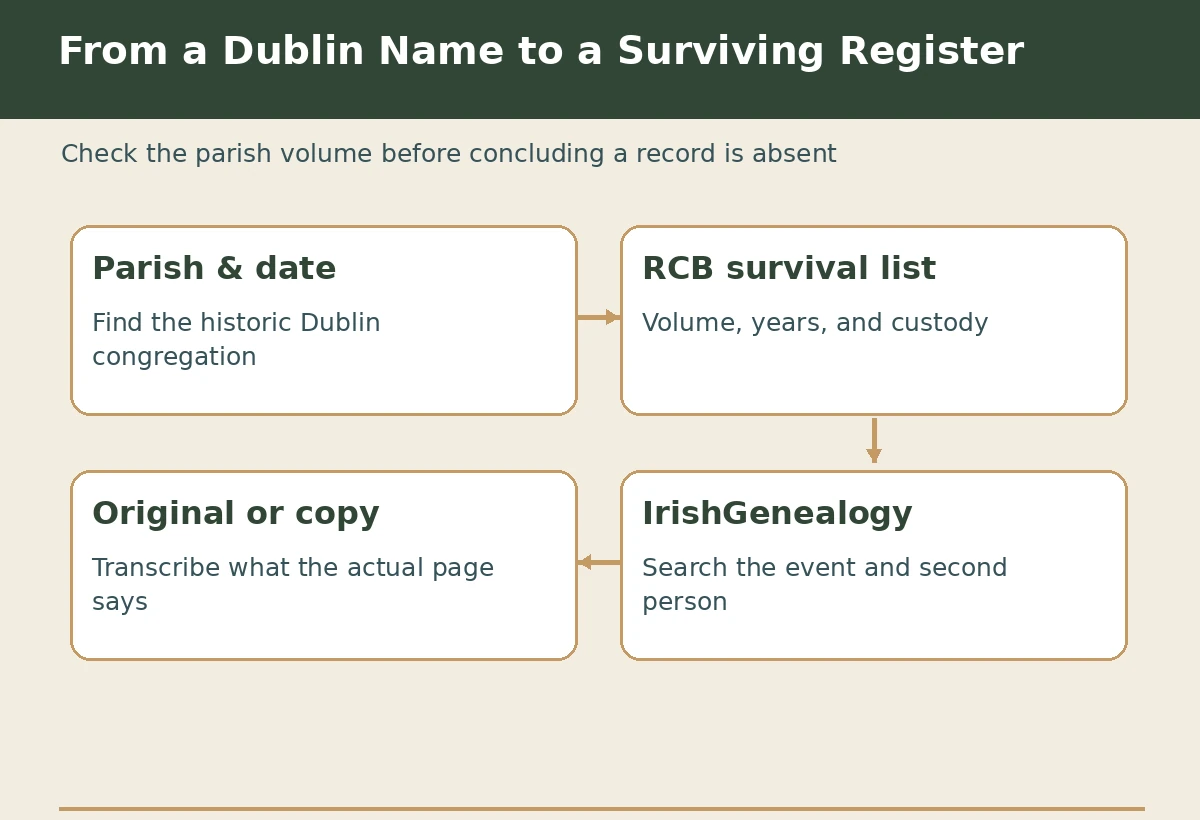
Check the RCB Library Survival List First
Many Church of Ireland registers held at the Public Record Office of Ireland were lost in the 1922 destruction, but many other volumes survived in church custody or elsewhere. The Representative Church Body Library maintains a color-coded list of parish registers showing survival and custody, not merely a search box of names. Use its current list to verify that the event type and approximate years actually exist for a named Dublin parish. Note whether an original, copy or transcript survives. A blank result can stem from a destroyed baptism volume, a transcription omission or an incorrect parish; those explanations require different next steps.
Run the Free IrishGenealogy Church Search
IrishGenealogy.ie has digitized or transcribed coverage of surviving Church of Ireland baptisms, marriages and burials in Dublin City. Select Church Records, the appropriate event type and a modest date interval, then enter one or both names. Open the entry details rather than copying only a search-result title. Try separate filters for a spouse or parent when the main surname is common. The government site describes online church material, but an index entry is a representation of source information, not itself proof that every historical parish page has been consulted. Record the displayed parish and source details for follow-up.
Read the Parish and Event Fields Together
An extracted baptism normally reports the child and baptism date, often parents and sometimes a residence or sponsors. A marriage entry centers on two partners and the stated ceremony; witnesses may help discriminate between people. A burial entry reports burial in a church-related context, which need not be the same as a documented death date. Exact detail changes by era, form and congregation. Do not treat an absent parental field as evidence of an illegitimate birth, nor a repeated witness surname as proven kinship. Transcribe what appears before translating or interpreting a term whose meaning has shifted.
Use the Second Person to Separate Namesakes
Where several Dublin candidates share a first name, do a two-person search: pair the proposed child with a parent or the proposed bride with the groom. Follow with event year, historical parish and residence. A family can have multiple adults bearing a repeated given name, so the second name lowers ambiguity but does not erase it. A baptism with matching parents in a nearby parish is stronger when a dated address or the sibling sequence also fits. Save each incompatible entry in a candidates table instead of omitting it because a different match feels more likely.
| Source | Best question | What remains uncertain |
|---|---|---|
| IrishGenealogy entry | Was a ceremony indexed? | Full wording of original |
| RCB survival list | Does the volume survive? | Whether a person appears |
| Original parish page | What did the clergy write? | Independent identity verification |
| Civil marriage register | Was a marriage registered? | Whether same-named spouse is target |
Understand the 1845 and 1864 Civil Changes
Civil registration in Ireland has different starting boundaries. Non-Roman Catholic marriages were registrable from 1845; all marriages and births and deaths generally enter civil registration from 1864. For a Dublin Church of Ireland wedding after 1845, inspect a civil registration route as well as the parish entry, bearing in mind that the two may preserve different identifying facts. A pre-1845 Church of Ireland marriage usually requires a surviving church source or other evidence. The existence of a civil registration does not repair a lost original parish book, and the parish book alone does not establish every legal detail.

Locate Copies Beyond the Government Transcript
The RCB Library identifies holdings and other custodians; not all surviving registers are searchable at one website. If an indexed Dublin result lacks a scan, use its exact parish, date and event reference when seeking the original or a preserved copy. A local church, diocesan repository or RCB Library finding aid may give an appropriate next route. If the survival list marks one span as missing, search alternative copies, vestry material and related civil records instead of repeatedly entering the same name. Do not assume that access to a catalog means photographs of every page are publicly available. Our guide “Quebec Historical Burial Records” covers a related question.
Test a Hypothetical Same-Name Wedding
Suppose one Church of Ireland record shows a couple in Dublin City in 1838, and a similarly named couple marries in a different parish in 1842. The names alone do not imply a remarriage or a mistaken index. Note both parish names, witnesses, addresses and the ages supplied, if any. A later civil record or baptism naming a residence may help connect one couple to the target household. This example is fictional and intentionally unresolved. It demonstrates that changing denominational or parish context and reused personal names are independent causes of a false positive.
Distinguish Burial Evidence From Death Proof
A burial entry can document that burial was recorded on a given day, but the exact death date might be unstated. For later nineteenth-century deaths, check the civil registration for the date and informant. A memorial transcription could add a claimed age or relationship, yet the inscription may have been erected years afterward. If a parish register contains a historical social descriptor, quote it as the clerk’s terminology rather than endorsing it as a modern fact. Cross-examining each claim is especially valuable when the original page is lost and only a derived transcript survives.

Cite the Exact Book and Preserve Coverage Gaps
A citation should identify the historical church, the parish, type of register, entry date, the actual page or folio when known, repository and the digital transcription used. If only the IrishGenealogy index was examined, explicitly say so. Keep a second audit line describing the RCB list version and the date span checked. When no register survives for a required year, note that documentary absence is an archival survival problem rather than an individual family’s absence from Dublin. This is what makes a negative conclusion defensible and prevents the next researcher from running the same unproductive search.
More Records and Archives Guides
How We Research Dublin Church Of Ireland Parish Registers
We compared the Church of Ireland RCB Library’s register and custody guides with IrishGenealogy’s public search documentation. Surviving copies, transcripts and destroyed volumes are not treated as equivalent. The illustrative Dublin couples are fictional. We avoid inventing parish-by-parish preservation guarantees and encourage verification of an individual parish and date in the live finding aid.
Reference guides reviewed on October 24, 2026: primary research guide; companion institutional resource; source collection; primary research guide. These links explain collection scope; they do not imply that we viewed every original entry or identified a particular ancestor. This article includes no paid recommendation. Our affiliate disclosure explains the site policy; no affiliate relationship is asserted here.
No. IrishGenealogy has substantial Dublin coverage, but surviving original or copied volumes and online indexes have different scope.
Many registers held in the Public Record Office of Ireland were lost; the RCB Library survival list identifies registers and copies preserved elsewhere.
Yes. A Church of Ireland marriage may be documented in both a parish register and civil registration because non-Catholic marriage registration began in 1845.
Not always. It may give only the burial date, which should not be silently substituted for the date of death.
Compare the second party or parent, parish, approximate event date, residence and independent civil or census records before accepting an identity.