
To search Ontario Roman Catholic church records, 1760–1923, begin with a specific parish, approximate event date and sacrament, then open FamilySearch’s Ontario Roman Catholic Church Records collection. The title gives the span of material across participating parishes, not uninterrupted coverage at any one church. Use the image waypoints where a name index does not reach the record, read the original entry, and identify sponsors or witnesses before deciding that a same-name result belongs to your family. Compare church entries with Ontario civil registrations when applicable; these are separate record systems.
Locate the actual Ontario Catholic parish and its historical diocese
A family’s city or county may contain several Catholic parishes, and a parish may have missions or territorial changes. Look for a church name in an older marriage certificate, obituary, cemetery record, city directory or household religious affiliation. FamilySearch’s collection describes material from multiple dioceses and archdioceses, including Ottawa, Toronto, Kingston and several others, but not every parish and year is present. Write down the geographic parish, its diocese at the time of the event, and any associated missions before searching. A modern diocesan boundary or parish website cannot alone tell you where a nineteenth-century entry was filed.
Choose baptism, marriage or burial rather than assuming one record type
Catholic register entries answer different questions. A baptism may name the child, parents, date and sponsors, but the date of baptism is not necessarily the birthday. A marriage entry records a church ceremony and may include witnesses and information about the spouses; what survives varies by parish, period and form. A burial record concerns a religious rite and may note an age or date of interment, which cannot always be substituted for the civil date of death. Establish what event you need to prove. The collection may include other church entries, so a missing baptism does not imply that every associated type has been exhaustively searched. For a step-by-step method, see how to find historical Catholic marriage registers and cite them.
Browse FamilySearch collection 1927566 when the name search fails
On the collection page, identify the parish or hierarchical browsing choices, then move through the relevant book and year. The collection description explicitly permits browsing images. Check a volume’s first and last pages, its internal headings and any handwritten index rather than jumping to a presumed image number. Register images can mix several years or sacraments, and an indexed name can be mistranscribed. When a viewer imposes access conditions, follow those conditions rather than assuming every image will be available remotely. Log the parish, volume title, image number and exact search interval whether you find a match or not.

Extract parents and godparents without immediately adding them to a tree
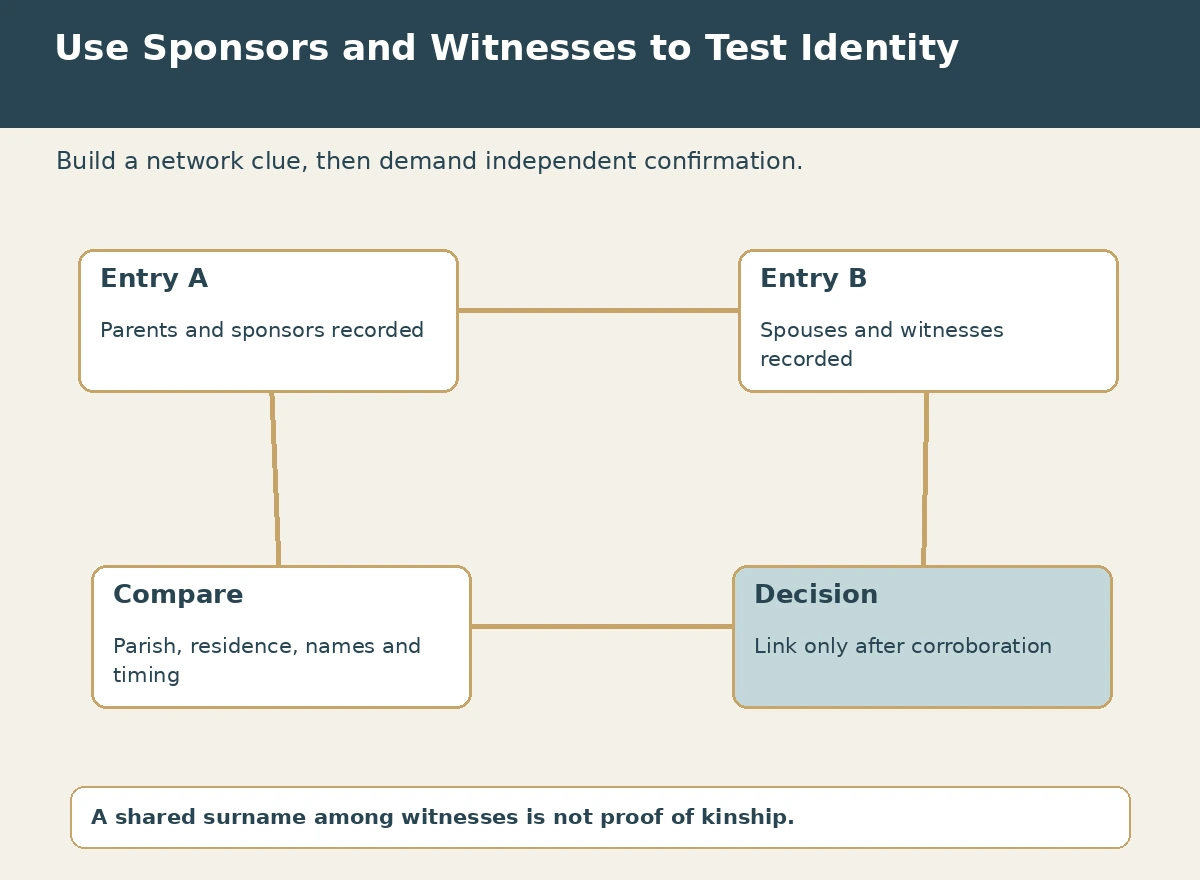
For baptism, transcribe the child’s complete name, event date, reported birth date if given, parents, sponsors or godparents and the priest. A repeated sponsor surname can suggest a relative, neighbor or community connection, but it does not establish an aunt, uncle or grandparent. Match at least one candidate parent against a marriage entry or other independent record before assigning the baptism to a particular family. Distinguish a priest’s abbreviation or Latinized given name from an English-language transcription: “Joannes” may be rendered John in some contexts, but preserve the literal spelling with your interpretation in a separate note.
| Entry | Can record | Needs separate support |
|---|---|---|
| Baptism | Baptism date, parents, sponsors | Exact birth date if not specified |
| Marriage | Church ceremony and witnesses | Earlier identity and civil filing |
| Burial | Burial rite and sometimes age | Exact death date and legal registration |
| Civil vital record | Government-registered event | Agreement of family relationships |
Read marriage witnesses as clues and recognize prior marriages
Marriage books may identify the spouses, date, church, witnesses and, in some periods or parishes, parents or previous marital status. Do not expect every FamilySearch field list to appear in every historical entry. Copy witness names without assuming kinship; use household, land or another sacramental record to test their relation. If the same name recurs on different marriage dates, examine ages, residences and widowhood or remarriage clues before merging profiles. A parish ceremony and a civil registration might create two related documents with different informants. A conflicting spelling should be preserved and explained instead of edited silently.

Interpret Catholic burials alongside civil death registrations
A parish burial may capture the rite, residence, age, or names of family members depending on local practice. Ontario’s government civil vital-registration system began in 1869; the Archives of Ontario guide explains holdings and the different availability of its digital releases. A church burial and civil death registration might disagree because they describe different dates or use different informants. Search one for what the other lacks: a burial place for the church record, or a reported medical and parent detail for the registration, where available. Avoid treating missing civil registration as proof of no earlier baptism or marriage.
Account for French, English and Latin register wording
Many Ontario Catholic communities used French or Latin expressions, and terminology differs by period and parish. Identify the act heading, sacrament, witnesses and recurring entry formula before translating a person’s name. Keep the source transcription, your translation and any uncertain letter shapes in three separate fields. A register might use maiden surnames, patronymic conventions or clerical spellings inconsistently, so test variants rather than force a single spelling. If a word appears to describe legitimacy or a social category, report it as the recorder’s historical notation rather than an independently verified judgment about the people involved.
Create a sacramental evidence grid before deciding an identity
Use a person-by-event table: baptism child and parents, marriage spouses and witnesses, burial deceased and reported age, and independent civil or census details. An illustrative case: two baptisms name similarly spelled children a year apart; one has different godparents and a parish residence consistent with an independently known couple. That gives a hypothesis to test, not instant identification. Check siblings, names of both parents and later marriages before closing the conflict. Record negative searches by parish, book and dates examined, rather than writing merely “no Catholic record.” Incomplete collection coverage makes such precise logs particularly important.
Preserve a complete image-level Ontario church citation
Cite the parish and diocese, event or register type, volume and page or image number, date of entry, repository or microfilm details when displayed, and the FamilySearch collection identifier or URL plus access date. If the original diocesan record or archive copy is subsequently consulted, cite it separately. The collection’s broad 1760–1923 range is not a page citation; nor is the online tree where you first saw the name. An image citation allows another reader to examine the handwriting, neighbors and marginal notes that a search index may omit. Keep both the literal entry and your interpretation available for later review. For a related choice, see our guide “Overwharton Parish Register, 1720–1760”.
More Records and Archives Guides
How We Research Ontario Catholic Registers
We reviewed FamilySearch’s current description and browsing scope of collection 1927566 and compared them with Archives of Ontario civil-registration guidance. We made no claim that every event field is always present or that all parishes are covered. The suggested identification grid is an analytical method, not a report of actual families found.
Primary references reviewed on October 24, 2026: Official source 1 — FamilySearch collection 1927566 coverage, dioceses, browsable images and possible recorded fields. Official source 2 — Archives of Ontario civil registration began in 1869, current holdings and limitations of online collection releases. We do not claim any paid partnership or recommend an unverified affiliate offer. See our affiliate disclosure for the site policy.
No. It describes the collection overall; each participating parish and register may cover a narrower or interrupted period.
FamilySearch describes browse-by-image routes for this collection. Availability and waypoints should be checked for the individual register.
No. A baptism documents a church rite, while Ontario civil vital registration began in 1869 and followed a different administrative process.
No. Sponsors are valuable network clues, but the exact relationship must be established with other records.
Transcribe the full date, spouses, any parents, residences, witnesses, priest and original page or image citation, noting absent or unreadable fields.