
Search Catholic marriage records through the parish responsible for the event. A sacramental marriage register is a church document and is not automatically the same as a civil marriage license or county return. The Archdiocese of Cincinnati explains that its archives preserve registers from parishes within its jurisdiction, but that parish changes and local closure policies affect access. Its public genealogy guidance applies a 100-year restriction to baptism and marriage records, illustrating why researchers must ask the *specific* diocese for its rules rather than invent a universal Catholic policy. This guide shows how to identify the right historical parish, make a workable request, read an event entry, and compare the religious account with civil evidence.
Distinguish sacramental registers from civil certificates
A Catholic marriage register records an event administered in a church context; a civil marriage license or return records actions under a local government’s legal process. The ceremonies and record dates may differ, and one document should not be used as an exact replacement for another. A parish entry may identify the couple, date, witnesses or parents according to local practice and the period. Those details must be confirmed on the actual page before they are attributed to a particular ancestor. A civil record can be an independent comparison, but may itself have transcription errors or a different spelling. Build a short table of religious event date, civil license or return date, jurisdictions and named people so apparent conflicts can be explained rather than hidden.
Identify the historical parish and diocese by date
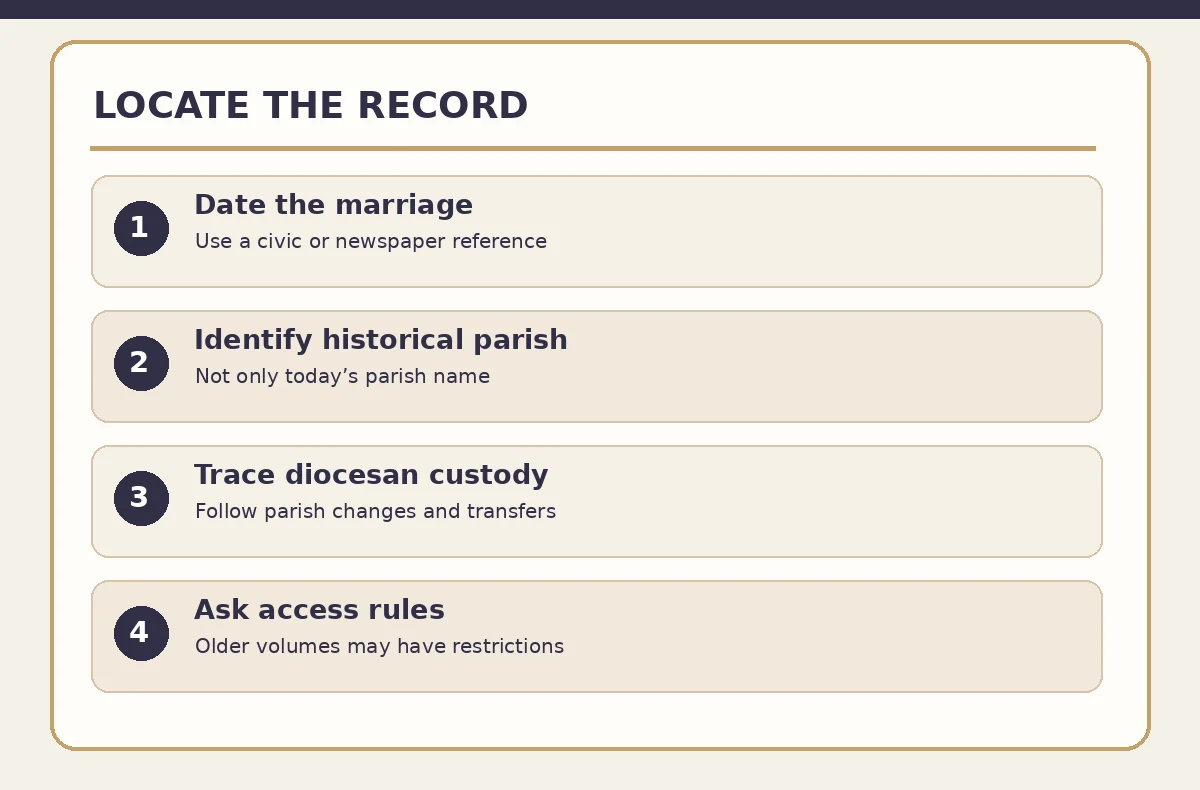
Start with the couple’s known town, approximate marriage date and independent clues such as a newspaper notice, census, family correspondence or a civil marriage entry. Find which parish served the locality at that time. A present parish bearing the same patron saint’s name might have been established later, while an older parish may have closed or its territory may have changed. Then determine the diocese responsible for that church when the event occurred and who now holds the register. Cincinnati’s official genealogy page notes that it does not hold books from parishes no longer within its jurisdiction and directs researchers to the appropriate current diocese. Always check custodianship; a city name alone is insufficient to locate a historical sacramental volume. For a related choice, see our guide “Limerick Archives”.
Respect archive privacy and handling restrictions
Sacramental registers are not generally government public records. The Cincinnati archdiocese publishes a policy that its baptismal and marriage entries remain closed for 100 years, with older material available for genealogical research under stated conditions. That is one archdiocese’s rule, not a date limit that automatically governs every parish in the country. Other dioceses establish their own permission process, handling rules and distinction between official certificates and genealogical extracts. Do not request an unredacted recent register that could disclose a living person’s private religious or marital information. Ask for older material through the authorized custodian and follow its access procedure. The fact that an online index shows a name never authorizes unrestricted access to the original book.
| Question to answer | Best supporting material | What it does not prove |
|---|---|---|
| Did this person belong here? | Original congregation register | Every member or relative was recorded |
| Which institution held the volume? | Repository finding aid or inventory | Every year or page survived |
| Is this the same individual? | Independent dated residence and names | A same-surname match is conclusive |
Read the exact entry and look for later annotations
If an archive provides an image or certified extract, begin with the register title, page, line and column headings. Distinguish the wedding date from the date of banns, license, dispensation or later annotation if any of those items actually appear. Read the names of parties and witnesses exactly as written, including language-specific variants and uncertain letters. A witness who shares the groom’s surname might be a relative, an employer, or simply a friend; the document does not prove their relationship unless it says so. Do not treat later marginal notes as if they were contemporaneous with the original entry. Keep a transcription and a separate interpretation, then compare church and civil documents side by side.

Prepare a focused diocesan research request
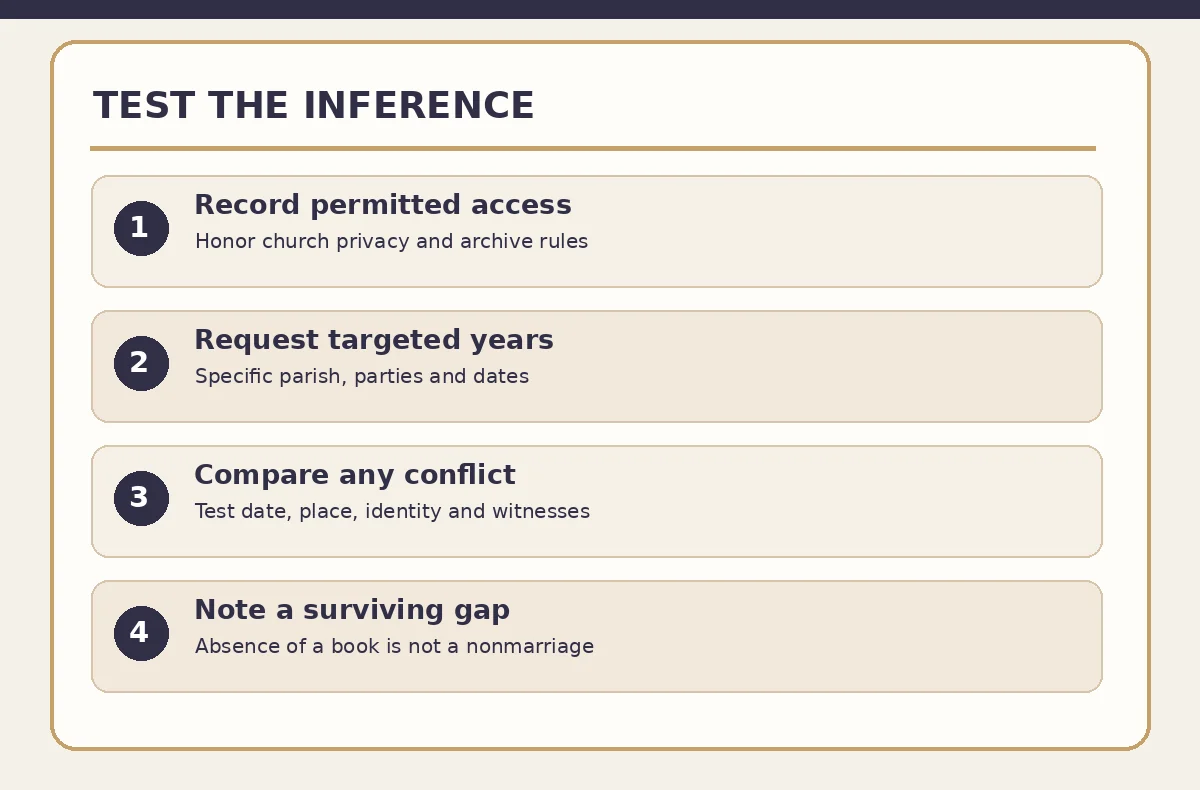
A useful request supplies both parties’ names with variants, a narrow range of years, town, historical parish if known, and the reason you believe the event occurred there. Ask whether the archive holds originals, microfilm, digital images, or only selected transferred registers. Cincinnati describes official genealogical access rules; another diocese may refer you to the parish or an administrative office. If the book is closed, ask when it may become eligible for historical consultation rather than attempting to bypass restrictions. Avoid requesting records of living people without permission. Note the response date, archive name and any identifier for an accessible historical record, and never portray a refusal as proof that the marriage never happened.
Resolve a conflicting date through independent records
Imagine a fictional civil index listing a marriage in June 1898 while a parish entry appears in July 1898. There could be multiple explanations: one record refers to licensing rather than a ceremony, an indexer misread a month, or two couples have similar names. Inspect the source headings and original pages before choosing one. Compare parties’ ages, residences, witnesses and the officiant, and seek a contemporary newspaper announcement when helpful. If the pair is not securely the same, leave the identities unmerged. Write a citation for each record separately and explain precisely which date each records. A narrative that smooths over the conflict without evidence cannot be reviewed by another researcher.
Cite the original volume and plan for record gaps
A usable citation gives parish and diocese, marriage register designation, original volume or book, date, page or entry, repository and method of access. Label an index as an index rather than a parish register. If the event predates the available Catholic books, check a predecessor parish, mission station, nearby jurisdiction, civil marriage records, newspapers and other contemporary sources. A diocesan archive may confirm the earliest surviving volume, but that tells you only what it holds, not every church event that occurred historically. Finish the log with the precise archive consulted, its statement of coverage, unresolved dates and the next justified record to test. The goal is a defensible account, not a guessed marriage date.
How We Research These Historical Records
We used the Archdiocese of Cincinnati’s official genealogy access page to describe its jurisdiction and explicitly local 100-year restriction, then checked diocesan sacramental-register handling guidance and FamilySearch’s US church record methodology. We do not generalize Cincinnati’s access conditions to every diocese or imply that church records are automatically public.
More Records and Archives Guides
Official Archives and Source Documentation
Cincinnati archdiocesan archives describes parish jurisdiction and local 100-year baptism and marriage restrictions. These Cincinnati policies are locally specific, including the jurisdiction and the 100-year closure cited in the guide.
FamilySearch church record research training covers local holdings, access, and record-type distinctions. Church-register training provides methods of identifying the responsible parish and assessing its original event wording.
FamilySearch explains how church records complement civil sources and how to locate congregational custody. The general church research guidance supports comparison with civil records, not access to restricted parish material.
The example diagrams represent historical research steps, not photographs of sacramental registers or information about living parishioners. Church access policies are quoted for information, not as a promise of service or an endorsement; consult the GenHis affiliate disclosure.
No. They record related but different religious and governmental events; compare dates and names on each.
Rules depend on the local diocese. Cincinnati, for example, restricts baptism and marriage entries for 100 years.
Ask the successor or the diocese now responsible for the historical parish books and confirm actual custody.
No. A witness is named as a witness unless the record explicitly documents kinship and it is corroborated.
Parish, diocese, register and volume, original entry or page, event date, custodian, and access method.