
Search Baptist records by congregation, not by surname alone. For many US families the best surviving source is a membership register, church minute book, letter of dismissal, or a Baptist association publication. The American Baptist Historical Society (ABHS) warns that it has no nationwide Baptist membership index and cannot identify every local church a person attended. Its collections are substantial, but denominational history is not the same as a person-by-person vital-record database. This guide helps you determine which church was involved, find the correct custodian, read the specific entry, and decide what it does—and does not—tell you about an ancestor.
Identify a particular congregation before searching names
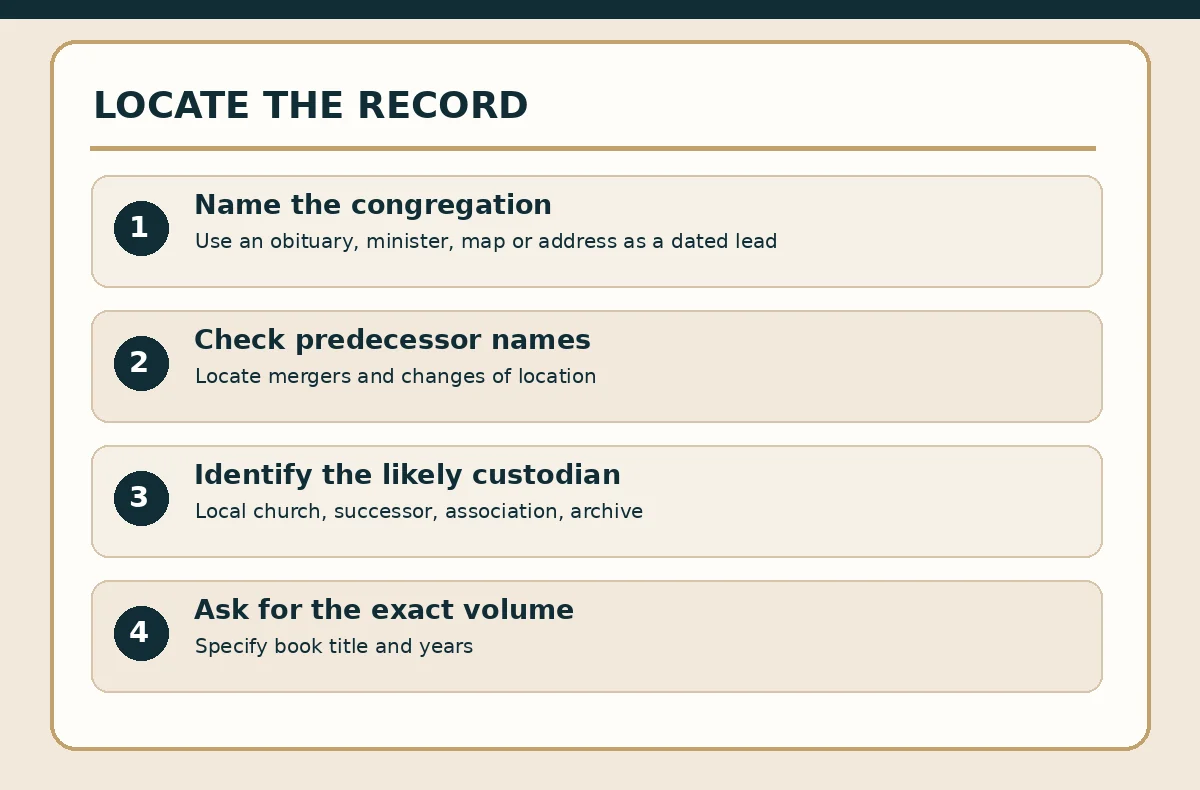
Start with a dated, independent clue: an obituary that names a church, a minister listed on a marriage certificate, a cemetery associated with the congregation, or a town directory showing a house of worship near the family’s address. Keep the date attached to the clue. A Baptist congregation may have changed buildings, split, merged, or adopted a different name, so a modern church website is not sufficient proof that an older congregation belonged to the same organization. Make a locality card containing congregation name, earliest and latest known address, county, years of interest, and the document that led you there. If a church history identifies predecessor congregations, record them separately until the relationship between institutions is demonstrated.
Understand what Baptist baptism records can establish
The ABHS genealogy guide explains the central distinction: Baptists historically emphasize believers’ baptism rather than systematic infant baptism. An entry recording a baptism at a particular church therefore is evidence of a religious event and association with that congregation; it is not automatically evidence of an infant’s date of birth. ABHS notes that its typical baptism entries may record a name and baptism date but not parents, age, or birthplace. Read the actual form before extracting more. If a modern index claims parents or exact birth dates, determine whether those details come from another source or a compiler’s inference. A plausible age based on religious practice must remain a hypothesis, not a new birth fact.
Track membership rolls, transfers, and disciplinary minutes
For a named congregation, ask whether surviving books include membership lists, admissions by baptism or letter, dismissions to another congregation, exclusions, restorations, meeting minutes, or pastoral correspondence. Not every congregation kept all these series and not all records were preserved. A dismissal letter can suggest relocation, but its date does not tell you when a family actually moved. Minutes may mention people with identical surnames who were unrelated. When a name appears, capture the precise wording, surrounding headings, book title, leaf or page, and date. If the handwritten text is hard to interpret, transcribe it conservatively and retain uncertain characters rather than silently converting them into a preferred family spelling. Our guide “Scottish Kirk Session Minutes” covers a related question.
| Question to answer | Best supporting material | What it does not prove |
|---|---|---|
| Did this person belong here? | Original congregation register | Every member or relative was recorded |
| Which institution held the volume? | Repository finding aid or inventory | Every year or page survived |
| Is this the same individual? | Independent dated residence and names | A same-surname match is conclusive |
Follow the record from local custody to historical archives
Begin with the congregation or a known successor. If the original building has closed, check local historical societies, affiliated Baptist associations, state denominational historians, university special collections, and relevant Baptist historical organizations. ABHS states that only a small fraction of Baptist congregations deposited records with it; its holdings are arranged by church rather than a universal surname list. Search a repository catalog under the historical congregation name and date, not merely the name of an ancestor. The ABHS online collections guide also describes missionary correspondence, minister papers, association minutes, and publications. Those record classes can give occupational or organizational context even when a membership book is missing. For a step-by-step method, see how to trace Methodist ancestors through local and conference records.

Make a precise request instead of asking for a family search
Archivists can work more effectively with a narrow question such as: ‘Do you hold the 1885–1905 membership ledger for the named Baptist congregation in this county?’ Attach a church name, approximate dates, town, and source of the identification. ABHS specifically says broad requests for all information on a family are not feasible and that its church records generally are not searchable by member surname. Ask about finding aids, limits on reproduction, appointment procedures, restricted material, and whether an adjacent volume survived. A negative reply from one repository means that repository has not located the item; it does not establish that your ancestor was never a Baptist or that no register exists elsewhere. For a related choice, see our guide “Research Mennonite Family History with Archives, Bibles, and Cemeteries”.
Evaluate a sample entry without inventing family links
Imagine a fictional ‘Mary Ellis’ named on a church roll dated 1896 and a second Mary Ellis on an 1897 city directory page. The matching name and year justify a comparison, not a merger. Check the residence, membership category, named relatives if any, and whether a transfer letter points to another town. A church roll can support an association with that institution at a particular period; a city directory can support a location. Neither necessarily identifies a parent or spouse. If another record mentions the same unusual occupation or address, explain how that raises confidence while leaving uncertainty. Write the conclusion as ‘possibly the same person’ until independent documents resolve the identification.

Document missing volumes and sensible substitute sources
Use a research log with the repository, specific collection or finding aid, years examined, spelling variants, and what could not be accessed. If there is no membership ledger, test church anniversary booklets, Baptist association proceedings, local newspapers, county histories, published obituaries, minister biographies, land deeds for the church, and cemetery records. These sources vary in strength and may repeat hearsay. A printed anniversary sketch written decades later is not interchangeable with contemporaneous minutes. The useful outcome of an unsuccessful search is a dated account of the coverage gap and a ranked list of substitute records, not an unsupported conclusion that the family had no religious affiliation. Our walkthrough on how to use Lutheran parish registers to research family history sets out each step.
How We Research These Historical Records
We compared the American Baptist Historical Society’s explicit genealogical limitations with its description of church and missionary collections, then checked FamilySearch’s denomination-specific research training. We do not imply that a national list exists or that baptism proves a birth date. Examples are invented and contain no identifiable living person’s religious information.
More Records and Archives Guides
Official Archives and Source Documentation
ABHS explains baptism practices, local-church custody, catalog arrangement, and the limits of genealogical queries. The collection rule is decisive: begin with a named Baptist congregation rather than requesting a countrywide member lookup.
ABHS describes manuscript, association, missionary, and ministerial collection types. Association minutes or correspondence can establish institutional activity but are not substitutes for an identified household register.
FamilySearch offers instruction specifically on Baptist record types and finding aids. The research lesson explains where Baptist books may survive, not a global indexed list of individual members.
The original illustrations distinguish congregational files from association material; they reproduce no actual Baptist book or private membership information. No archive commission or Baptist institutional endorsement is assumed. Read the GenHis affiliate disclosure.
No. ABHS specifically says no nationwide, state, or county membership index covers all Baptist churches.
Not usually. A baptism entry may document a later religious event but not age, parents, or birthplace.
Trace its successor, local association, historical society, university archives, or Baptist repository using the congregation’s name.
Only if the particular document actually describes a relationship and that claim is evaluated against other independent evidence.
Supply a historical church name, town or county, approximate years, the exact book sought, and the source of your lead.