
Tennessee Census Substitute: How to Search 1891 Male Voter Lists. Tennessee researchers looking for a missing 1890 census family often find references to an 1891 state enumeration. That record is real, but it was a list of male voters, not a complete household census. Tennessee State Library and Archives (TSLA) explains that counties maintained 1891 lists, that some entries give ages, and that the lists are not necessarily alphabetical or indexed. Its guide also emphasizes the loss of the federal 1890 population schedules. This article shows how to check a county, find the original voter-list entry and avoid treating an omitted spouse, child or ineligible adult as absent from Tennessee.
Define the 1891 enumeration before looking for a family
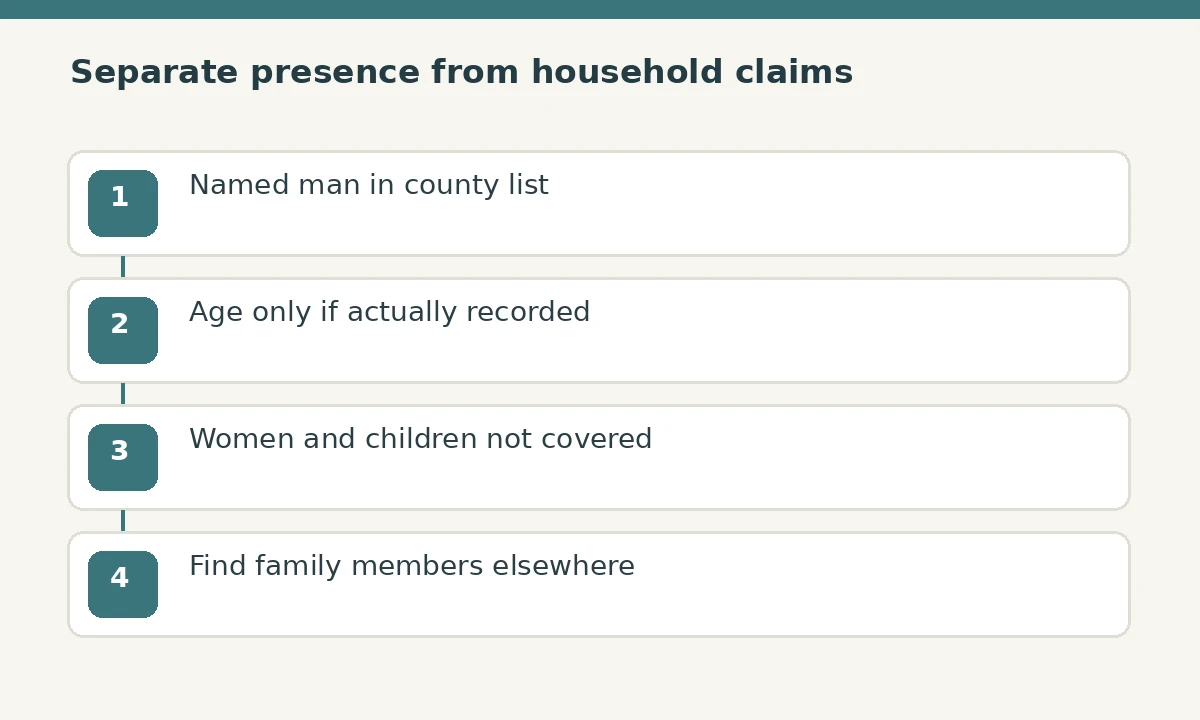
The U.S. Census Bureau’s reference to Tennessee’s 1891 state census can suggest a full decennial alternative, but the State Library and Archives describes an enumeration of male voters in each county. It is a different population slice. A list of potential or qualified male voters cannot document every woman, child, person barred from voting or adult whose status was not captured by the local enumeration. Start with the precise research question: are you trying to place a named man in a county in 1891, or trying to reconstruct the entire household in 1890? Only the first question aligns directly with the source.
A fictional example illustrates the limitation. If an 1880 household contains parents, several daughters and one young son, a failed 1891 voter-list search cannot establish that the family moved. The male members may not have met the applicable voting criteria, might be recorded under a different spelling, or might live in a county without accessible indexed lists. The 1891 source supports a bounded residence hypothesis for a qualifying person, not a complete household inventory. Record the source’s actual population definition on the first page of your notes.
Identify the county and actual index availability
TSLA states that the lists are not alphabetical and that some counties have published indexes while others do not. Its historical guide lists counties for which the library knew of published indexes, but that older webpage should not be treated as an exhaustive statement of present access. Consult the current TSLA catalog or the linked digitized collection and confirm the relevant county. Use the 1880 federal census, 1890-era deeds, tax records, directories or a 1900 federal entry to anchor the likely county before searching the voter lists.
Write two separate statuses for each county: original list held, and usable name index located. These are not interchangeable. An index can be incomplete or keyed to a historical district label that differs from a current one. If a county’s original list survives but no index is available, a page-by-page search may be required. If no list exists for the target area, look at the closest adjacent or predecessor county if boundaries changed, but do not assume any particular person crossed that border. The archive’s holding description comes before a commercial keyword search.

Trace the online entry to the original local list
TSLA’s guide says that the enumeration was indexed and scanned through a partnership with Ancestry; confirm current terms directly rather than promising universal free image access. Search several plausible surname variants, then open the page where possible. Record the county and page or image, original name, any age actually shown, and surrounding names. The list is a record of an administrative process, not a proof of a man’s exact age or birthplace unless those details are actually recorded. Do not copy a database’s calculated birth year into your tree as a nineteenth-century fact.
If a search returns multiple adults with similar names, compare their county and associates with tax rolls, deeds, a 1900 household and a dated newspaper notice. A location match becomes stronger with independent details, yet it still does not prove a particular wife or child belongs to that man. If an index contains no result, determine first whether the county was indexed. The right fallback is often an image browse or a call-number inquiry, not another exact-match search through the same incomplete name index.
Reconstruct the missing 1890 decade with multiple sources
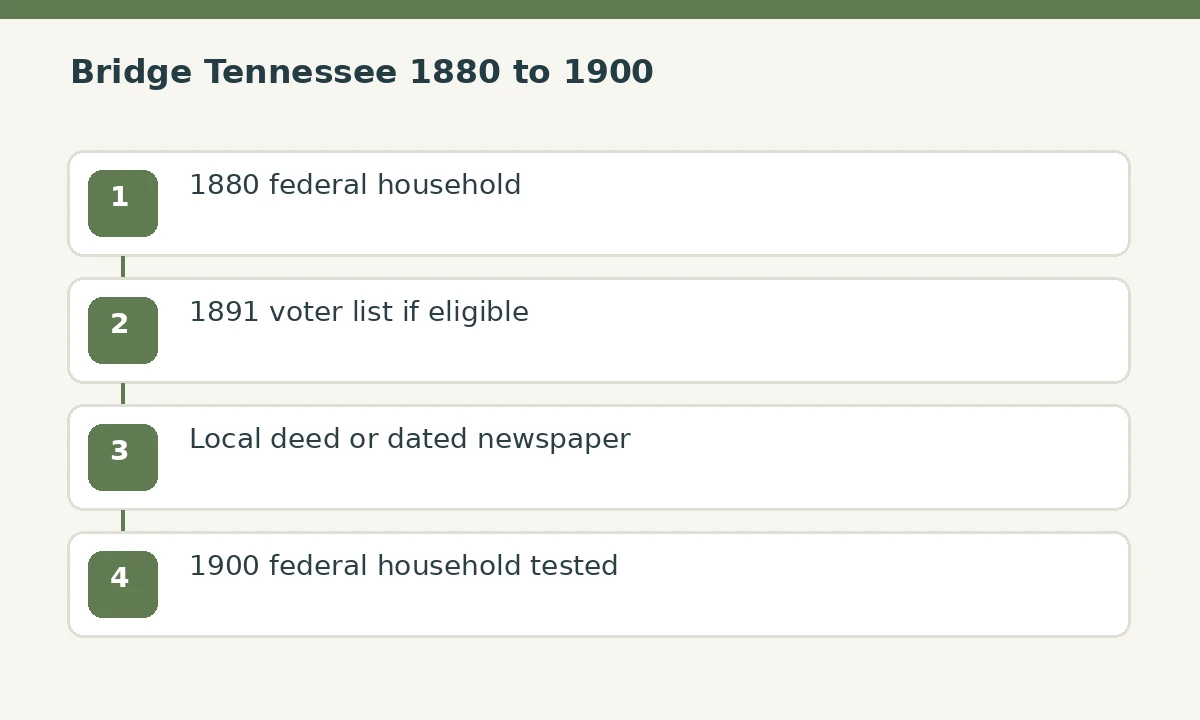
The federal 1890 population census largely did not survive, so a 1891 voter entry is one potential bridge rather than a replacement census. Plot a timeline from 1880 to 1900 with dated records such as land conveyances, tax assessments, marriage bonds, church membership, probate, newspapers and city directories where available. Each source establishes a different kind of fact. A land deed may show a transaction in a county without proving permanent residence. A burial entry may fix a death date but not identify all surviving relatives. The 1891 list adds a specific observation about an eligible man.
Build a contrast table with document date, named person, locality, witnessed fact and unresolved inference. For a fictional example, an 1887 deed and an 1891 voter entry with the same name and neighborhood create a possible continuity; a 1900 federal household can be used to test that identity, not assumed to match it. Check whether a child’s stated birth place aligns, but remember that later household members or informants may misremember. If two candidate men have the same name, keep separate research profiles until direct evidence resolves them.
| Source state | What is supported | Next necessary test |
|---|---|---|
| Original name-bearing entry | Wording on this exact census page | Compare another independent dated source |
| Index hit or transcript | A candidate locator, not proof of a relationship | Obtain and transcribe original source |
| Coverage limitation or abstract | What holdings or totals are documented | Choose a different record series |
Consider disfranchisement and other historical limits
Who was allowed to vote and whose name appeared in an official list was shaped by law, administration and racial discrimination. An 1891 voter enumeration cannot be used as a neutral count of everyone residing in Tennessee or of everyone eligible under a modern understanding of suffrage. Do not convert omission into claims about ethnicity, social status or a person’s whereabouts. If the project concerns African American family history, compare the list carefully with independent Reconstruction-era and post-Reconstruction sources and address legal restrictions as part of the evidence context.
Likewise, the source’s reference to “male voters” is a historical description of the record, not a model for who should be included in a genealogy. Wives, mothers, daughters and children remain part of the research question and must be investigated in records that can name them. A later census might show a widowed mother heading a household, while the 1891 list says nothing about her residence. Preserve the difference between a documented inclusion, a documented exclusion under a specific rule, and an ordinary absence from the pages actually searched. For a related choice, see our guide “Oregon Census Records”.
Cite the county list and explain a negative result
A defensible citation identifies the census substitute as Tennessee’s 1891 enumeration of male voters, plus county, original list title or repository, page or image, and access platform if used. Save the original wording separately from a modern index. Include whether the relevant county’s lists were indexed and what spelling variants were tested. If your search relied on a TSLA catalog rather than the list itself, cite the catalog as a holdings source, not as proof that an individual appeared in 1891. This keeps a later researcher from inheriting unsupported certainty.
Choose a next step that addresses the true gap. An indexed hit needs confirmation from the underlying list and an independent dated source. An unindexed county requires image browsing or an archivist inquiry. A missing list calls for another record category, not a declaration that the ancestor had moved. A list entry proving only a man’s presence leaves spouses, children and other relatives to be identified elsewhere. The central benefit is a historically accurate small piece of the 1880–1900 timeline, clearly labeled for what it can support.
How We Research This Census Collection
We distinguished the Census Bureau’s short Tennessee 1891 listing from the more precise TSLA description: a male-voter enumeration with incomplete indexing. We also consulted the National Archives on the destroyed federal 1890 returns. Examples are fictional and no state-list omission is treated as proof that a family moved.
More Records and Archives Guides
Official archives and source documentation
Tennessee State Library and Archives explains the 1891 male-voter list, indexing limitations and federal 1890 gap. The library explanation establishes why this is a male-voter record, not a complete enumeration of Tennessee families.
U.S. Census Bureau lists Tennessee 1891 among state censuses as a broad finding aid. A compact federal guide calls the year a state census but does not describe the included electorate.
National Archives discusses what survives of the 1890 federal population schedules and substitute sources. The federal archival reference helps explain the missing 1890 population schedules that motivate a substitute search.
The text-free illustration is not a genuine voter sheet; it represents a finding aid. Voting rules and discriminatory practices limit the conclusions that can be drawn from this material. The voter-list procedure is educational, and no subscription commission or archive endorsement is asserted. See the GenHis affiliate disclosure.
No. Tennessee State Library and Archives describes it as an enumeration of male voters, not everyone living in the county.
It was a separate state/local enumeration. It can supply some names close to 1890 but does not restore the destroyed federal schedules.
No. TSLA says the lists were not alphabetical and some county lists lacked indexes; verify the current holding.
No. Use other dated family and civil records for those relationships.
Check county coverage, spelling, historical eligibility, and independent evidence; omission alone does not prove departure.